
St.Gallen: Stop the Fox and Badger Massacre
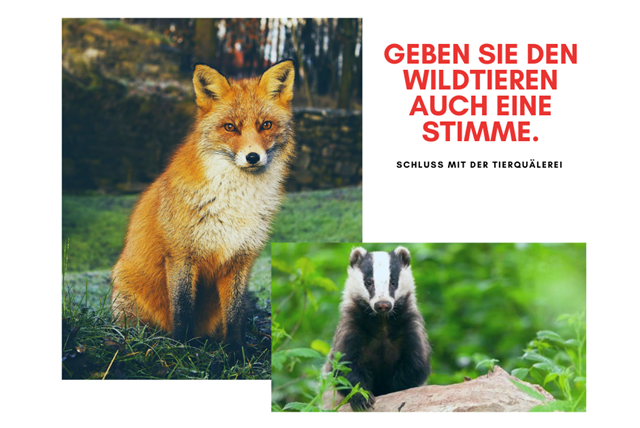
To justify the merciless persecution of one of our most interesting predators in Canton St.Gallen, it is simply claimed that hunting foxes or badgers is necessary because their populations would otherwise get out of hand – an outdated view!
Fundamentally, lightly hunted fox populations also produce fewer offspring. Humans always create conflicts with wildlife sharing the same habitat. Humans cause, particularly in wildlife habitat, far more damage than the few grapes a badger can enjoy.
In Switzerland, the cantons Bern, Aargau,Graubünden, St.Gallen, Wallis, Lucerne and Zürich stand out negatively, with disproportionate hunting of foxes and badgers.
In Canton Bern, around one-fifth of all red foxes in Switzerland are shot, although experts see no sense in it.
«From a wildlife biology perspective, fox hunting is not sensible; the population cannot be regulated this way.»
Peter Juesy, former hunting inspector of Canton Bern.
It is known, according to the Swiss Rabies Center, that the activities of recreational hunters have only spread the disease further, and it is no different with fox mange etc.
Given the stress and pathological hunting pressure from recreational hunters in the sometimes densely populated habitat, one should not be surprised when wild animals become ill.
St. Gallen recreational hunters also do not hunt ethically. Swiss recreational hunters and hunting associations like to boast that they hunt "ethically." Ethical hunting means not only being in compliance with laws, but also always following the unwritten rules of hunting. In the Hunting Code on ethical hunting from 2014, the Swiss Hunting Association explains its philosophy for Swiss recreational hunters regarding responsible and sustainable hunting. For example, it states:
- I avoid unnecessary disturbance of wildlife.
- I avoid unnecessary suffering of animals.
- Where wildlife refuges as retreat areas are compromised, I advocate for wild animals.
- I care for the environment and work to ensure that habitats are protected and enhanced.
- etc.
That these are, as usual from the association, merely empty phrases has recently been confirmed by a court in Bellinzona.
With the beginning of mating season from early December, pregnant vixens and regularly the fox fathers are very likely already among the hunting bag. These then later fail as the main providers for young fox families. Particularly during night sits, there is great danger of confusing the vixen with a young fox and ultimately killing a parent animal that is absolutely essential for raising cubs. At the latest from the beginning of fox denning season, this is a criminal offense. Anyone still hunting foxes at this time is not hunting ethically. Even hunting literature acknowledges that the male is necessary for raising the young. However, hunting legislation does not adequately address the fact that precisely between mating and denning season (the time when the young are born), fox parents are particularly intensively hunted and killed, which constitutes animal cruelty.
For foxes, this hunting ethics apparently does not apply. Here recreational hunters, hunting associations and legislators even approve of killing parent animals necessary for raising young!
We therefore call upon the responsible authorities to immediately ensure protection of parent animals during mating season and the period of raising young through appropriate laws or closed seasons.
IG Wild beim Wild
Cantons, such as Geneva, Neuchâtel, Vaud, Fribourg, Zug or Obwalden, are already partially doing this to put an end to this animal cruelty.
Vaccination baits instead of symptom treatment
Recreational hunters propagate intensive fox hunting as a panacea for combating infection in the face of fox mange outbreaks. Similar to rabies and fox tapeworm, however, there is no indication why even more merciless fox hunting should contain the spread of mange — after all, the past has shown that reducing fox density through hunting means is not possible. Moreover, hunting promotes migratory movements in fox populations, whereby the spread rate of the disease — similar to what has been proven for rabies — is likely to increase rather than decrease. Since mange occurs in clusters and can establish itself significantly less well in some areas than in other regions, epidemiologists also suspect that fox populations largely immune to mange are developing in some places.
In Great Britain, the National Fox Welfare Society (NFWS) for example reportedly uses a homeopathic medicine with great success, which is administered to diseased foxes in residential areas via a prepared bait — in this case honey sandwiches. According to the NFWS, the treatment works in 99 percent of all cases.
A tablet preparation that works for twelve weeks with a single application is Bravecto (active ingredient: fluralaner). Bravecto works against mange mites and is successfully used to treat wild foxes suffering from mange. Like selamectin, Bravecto is well tolerated by nursing vixens and cubs.
It is also a fact that mange has been flaring up locally at irregular intervals for decades. This shows that weakened foxes are particularly susceptible to infection. In addition to parasites, diseases or food shortage, high hunting pressure can also impair the constitution of the animals. Various studies show that when a male fox dies that provides food for his family, the physical condition of both the vixen and the cubs can be significantly impaired. This also suggests a counterproductive effect of fox hunting.
There is now multiple evidence that fox populations develop - particularly after a mange outbreak - that are largely resistant to mange. Only a small portion of these animals actually show symptoms. However, recreational hunters cannot see a fox's potential mange resistance and thus randomly kill resistant animals as well as those susceptible to the parasite. Consequently, the survival advantage resulting from resistance is eliminated, which again would run counter to the goal of reducing mange cases.

For foxes, there is no legal shooting plan and population assessment. Fox hunting resembles a short-circuit ecology for inadequately trained recreational hunters.
It is precisely this mentality of senseless exploitation out of greed or misguided nature experience that leads to Switzerland having the longest red list of threatened species in all of Europe. Senseless killing takes place at national, regional and local levels. It is obvious that biodiversity, habitats and ecosystems in Switzerland are not adequately protected by recreational hunters. Paradoxically, it is always these circles of recreational hunters and livestock farmer representatives with their lobbying work who have been responsible for this through politics, media and laws for decades. They are the ones who notoriously block contemporary, ethical animal welfare improvements and sabotage serious animal and species protection.
Recreational hunters in St.Gallen are known beyond the canton borders as drivers of a primitive culture of violence, which hunting undoubtedly is, and troublemakers in the animal kingdom.
For IG Wild beim Wild, it is not productive to give the cantons more powers in the hunting law, as was voted on May 17, 2020 – on the contrary. They cannot handle the responsibility, are overwhelmed, are inadequately trained as recreational hunters and decision-makers, and they lie. Moreover, they already have enough carte blanche. Current examples include the department head for hunting and fishing in Canton Zurich, who recently introduced night hunting for foxes, claiming foxes transmit rabies. As we know today, only animal-friendly vaccination baits were able to defeat terrestrial rabies – it has been considered eradicated in Switzerland since 1998 and in large parts of Europe!
Violence begins in St.Gallen, where knowledge ends
Time and again, claims from the recreational hunting milieu have their origins in hunting literature and such unscientific sources when subjected to careful analysis. This is mainly due to the frequently inadequate training in hunting examination courses, which are predominantly conducted by fanatics with sect-like ideologies who require no regular qualification credentials. After training, the recreational hunter only moves within the echo chamber of the hunting press, which constantly repeats its skewed and often false representations.
In hunting associations, members then mutually confirm each other in their worldview. In this way, an isolated and militant group (8) has emerged that is hardly accessible to scientific information. The fatal aspect is that local press and politics still believe that expertise lies beneath the hunter's hat and gladly consult the local recreational hunter on all nature topics. Thus recreational hunters also contaminate public discourse.
Here we praise the Canton of Geneva with professional wildlife management without recreational hunters, but with professional wildlife wardens. At Lake Geneva there are vineyards and other crops, just as in the rest of Switzerland. Apparently they have humane and ethical approaches there in dealing with wildlife and intelligent measures to protect crops. In Geneva, no foxes, martens or badgers are regulated simply because hunting season has arrived. This is also reflected in the federal hunting statistics (2). Instead, practical deterrent measures (12) and sensible education and assistance as well as continuing education among the population with wildlife wardens take place. Safety, animal welfare and ethics are the principles.

According to the Animal Welfare Act (Art. 26 TSchG), a "reasonable reason" must exist for killing an animal – however, hunting foxes and badgers is usually merely the satisfaction of a bloody hobby. For these wild animals there is no legal shooting plan. The animals serve recreational hunters as living targets, as there is neither a wildlife biological nor health-related reason for the mass hunting of healthy predators.
Accordingly, every fox or badger hunt in St.Gallen is a clear violation of the Animal Welfare Act, because it lacks reasonable justification. Fox and badger hunting in Canton St.Gallen is thus primarily organized animal cruelty.
Wild animals also have feelings and emotions. They can suffer, mourn and experience joy. They live like us humans in family units and social structures, which recreational hunters usually terrorize and desecrate for fun.
For at least 8 months, foxes in Canton St.Gallen are pursued – for badgers it is over 6 months, according to federal hunting statistics. With such stress, one need not wonder why these animals become ill. Throughout Europe, the epicenter of tapeworm notifications lies in Switzerland, precisely in that area of Switzerland where hunting-affine recreational hunters have embedded themselves in cantonal authorities. These absurd disturbances and noise emissions always also disturb entire wildlife populations and residents.
Master Grimbart – as the badger is called in the fable – is not frequently observed: The largest animal in the marten family is shy and only active at night. Badgers spend the day mainly in their sett, which usually lies at the edge of settlements and is often used continuously across generations. Badgers are also harmless to humans and pose no danger to agriculture and forestry, nor to wild animals and pets. Badgers do not attack cats and are mainly active at night. When they must defend themselves against dogs, the dog usually loses. Badgers spend winter or periods of low temperatures predominantly sleeping – they enter winter dormancy.
Science versus hunters' tales
For more than 30 years, there have been at least 18 wildlife biology studies proving: Fox hunting does not regulate and is also useless for disease control. On the contrary!
Scientific investigations (5) have shown that even when three-quarters of a population is shot, the same number of foxes are present again the following year. The more intensively they are hunted, the more offspring there are – any kind of "regulation" of these populations is neither necessary nor possible through hunting methods.
Fox populations are regulated through a complex social system. Foxes live in family groups in which only the highest-ranking vixen produces offspring (like the lead sow among wild boar). Birth control instead of mass misery, commented biologist Erik Zimen on this phenomenon. However, when humans intervene in the fox population with traps and rifles, these family communities (3) are destroyed. As a result, nearly all vixens become ready to mate, and the number of cubs per litter also increases significantly.
«Even without hunting, there would not suddenly be too many foxes, hares or birds. Experience shows that nature can be left to itself. From a purely pragmatic perspective, small game hunting is not necessary.»
Heinrich Haller, Former National Park Director Graubünden and Wildlife Biologist
Studies in various countries and at different times have also documented the influence of the red fox not only on the roe deer population: For the Bernese Midlands, it is estimated that a fox can catch an average of eleven fawns in the months from May to July. This also reduces wildlife browsing damage (1).
Many case studies such as national parks,Luxembourg (10) or for example Canton Geneva have demonstrated that there are no valid arguments whatsoever for these massacres. Habitat that becomes available is immediately reoccupied by these animals. It is scientifically well-documented that fox populations develop largely independently of hunting influence attempts, because hunting conversely causes reproduction rates to skyrocket.
In Switzerland, however, recreational hunters shoot around 20,000 healthy foxes annually for the garbage dump or incineration (2). Exactly the number needed so that the risk group of recreational hunters can later spread their sectarian hunters' tales as indispensable regulators.The senseless pile of carcasses at taxpayers' expense must be ended. The recreational hunters cause more problems than they allegedly solve.This absurd behavior also does nothing to help the forests.
During these hunts, fatal misidentifications repeatedly occur and recreational hunters shoot protected species such as golden jackals or wolves (8).
Can the enlightened female taxpayer and the responsible male taxpayer still reconcile with their conscience supporting such functionaries in the canton who don't care one bit about ethics, science or animal welfare and lie to the population and endanger them?
End the animal cruelty and tax money waste in the canton.
Food consumption by wildlife in shared habitats is not damage, but a natural process for the survival of these living beings. Tolerance and fairness are required here. We humans build over and destroy wildlife habitats at all levels to a far greater extent. Wildlife has just as much right to exist as humans. These disrespectful killing campaigns and bounty rewards are completely disproportionate to a healthy and heart-centered sense of justice. Against hail and bird damage, one also protects oneself with nets or deterrent measures (12).
Fox hunting is ecologically, economically and epidemiologically senseless – indeed even counterproductive! – and must therefore be banned in the interests of humans, nature and wildlife, as well as from the perspective of ethics, morality and animal welfare. Blind activism and violence helps no one.
With this direct submission of the petition to decision-makers, we demand that the killing of these wonderful creatures be prohibited as quickly as possible and published in the official gazette.
Send petition and/or comments independently via email to the following offices:
- Office for Nature, Hunting and Fisheries: info.anjf@sg.ch
- Government Councillor Bruno Damann: info.vdgs@sg.ch
- Greens St.Gallen: info@gruene-sg.ch
- SP St.Gallen: info@sp-sg.ch
- Green Liberals St.Gallen: sg@grunliberale.ch
- Animal Protection St.Gallen: info@tierlidienst.ch
Express your opinion to decision-makers in St.Gallen by telephone:
- Office for Nature, Hunting and Fisheries +41 58 229 39 53
- Government Councillor Bruno Damann +41 58 229 34 87
- Greens St.Gallen + 41 076 456 25 15
- SP St.Gallen + 41 071 222 45 85
- Green Liberals St.Gallen + 41 071 250 18 81
- Animal Protection St.Gallen + 41 071 244 42 38
In addition, we demand for fox and badger:
- Recognition of scientific studies and expert opinions (not from the recreational hunter milieu) that question or refute the necessity of hunting.
- No dissemination of sectarian or debunked hunter lies, such as the alleged necessity of regulating fox populations, as well as fear-mongering about rabies, fox tapeworm and mange, or that the fox is to blame for the decline of small game, etc.
- Killing animals as part of a recreational activity has no place in the 21st century and should also be prosecuted under criminal law.
Justification:
In Canton St.Gallen, during the 2018/19 hunting season, mostly healthy 1,681 foxes and 304 badgers were killed by militant recreational hunters without scientific basis or wildlife biology expertise. Roadkill for red fox is listed as 729 in the federal hunting statistics.
The alleged threat to meadow birds, i.e. ground-nesting birds, can be relegated to the realm of hunter fairy tales, as there are research studies that classify the influence on bird populations as insignificant (3). This becomes all the more understandable when one considers the main food of foxes: mice and earthworms. Foxes are extremely beneficial for agriculture. And that foxes are extremely beneficial for forestry and also protect humans from diseases through their diligent consumption of mice (which are considered the main carriers of Lyme disease, for example) is known to only a few people.
Industrial agriculture is the main factor in the population decline of threatened species, as it destroys animal habitats. Through new farmland, monocultures, fertilizers and pesticides, natural structures vital for their survival are increasingly destroyed – with over-fertilization, the food supply also diminishes. However, the killing of animals by recreational hunters exerts additional pressure on weakened populations and can bring them to the brink of extinction. Absurdly, the hunting community attempts to attribute the decline in hare populations to predators like the fox. Foxes, however, feed primarily on mice and earthworms and pose no threat to the hare population or to ground-nesting birds. On one hand, it is a waste of time for the fox to unsuccessfully search for rare and correspondingly hard-to-find prey; on the other hand, a healthy hare is no prey for even the fastest fox – with their powerful hind legs, the long-eared animals can catapult themselves from a standstill to more than 70 km/h. Studies show that by far the largest portion of hares consumed by foxes is taken as carrion.
The false arguments of allegedly combating rabies, fox tapeworm or mange through merciless hunting are scientifically refuted. Mange is much rarer than assumed and foxes with good constitution can heal from mange. These fox populations are then resistant to new infections. Furthermore, mange in foxes poses no danger to humans or domestic animals. It is very easily treatable. There are far more injured or fatalities caused by the militant recreational hunters themselves!
Fox tapeworm
Fewer foxes, less fox tapeworm, thus also less infection risk for humans. At first glance a plausible conclusion, but upon precise analysis, merely hunters' tales, as several international studies (6) demonstrate.
Throughout Europe, the epicenter of fox tapeworm reports lies in Switzerland, precisely in that region of Switzerland where hunting-affiliated recreational hunters have entrenched themselves with cantonal authorities. These senseless disturbances and noise emissions during recreational hunters' hunts in habitats always also disturb entire wildlife populations and residents.
There are far more zoonoses in domestic and farm animals. Typically, only recreational hunters contract a zoonosis like fox tapeworm. About 20 – 30 people in Switzerland become infected with this liver disease (Echinococcus multilocularis) per year. This is no more than previously, when fewer foxes were found in cities. Most people's immune systems are strong enough to ward off infection. Typically, fox tapeworm larvae form in the livers of mice and some rats. When a fox eats the infected mouse, a tapeworm develops again in its intestine. Cats and dogs that eat mice can also spread the parasite in this way, but do not become ill themselves. The fact that the disease frequency in Switzerland is very low, that direct transmission from fox to dogs is not possible, and that neutered animals cannot contract fox tapeworm can be seen as somewhat reassuring.
Urban foxes typically have an infestation rate below 20%, as their diet consists mainly of food scraps. Rural foxes, however, have a higher infestation rate because they feed abundantly on field mice.
The infection risk for normal forest visitors is minimal. Contrary to many rumors, no fox tapeworm patient is known to have become infected through forest berries. Berries that hang high on bushes are ruled out as an infection pathway. It is hard to imagine how fox feces could reach berries hanging high up.
«We have observed that fox mothers give birth to more young where the animals are hunted. While culling can create localized relief, the vacant territories are quickly reoccupied. Nature regulates this itself.»
Wildlife warden Fabian Kern
Culling of foxes can even have the effect that the vacated habitat is newly inhabited by foxes with a much higher proportion of fox tapeworm carriers.
Fox mange
Not every scruffy-looking fox has mange, and dogs are not highly susceptible to infection either. The parasitic mange mite can indeed infest dogs or humans – but this infestation is very treatable in both cases. The locally apparent increased occurrence of these mites is not the result of excessive population density in foxes. Therefore, increased hunting will not prevent the spread of mange either. Scientific evidence shows rather that with foxes specifically, hunting to contain wildlife diseases is counterproductive. Generally, it also becomes apparent that in intensively hunted areas, the fox population does not decline, but actually increases through increased reproduction and immigration of animals.
The main reasons for the spread of fox mange are considered to be intensive hunting. Hunting results in an artificially rejuvenated and increasing population with weak immune systems, and consequently in autumn an increase in migrating young foxes that spread pathogens they carry.
In the 2018/19 hunting year, 1’681 foxes were listed under culling in the St. Gallen hunting statistics. IG Wild beim Wild wanted to know from Dominik Thiel what percentage of these and the 729 listed under natural mortality were infected with a disease like mange, distemper, etc.
«We do not have complete, uniform and therefore analyzable detailed statistics that would give an exact answer to your question.»
Dominik Thiel, Office for Hunting and Fisheries
Different for example in Canton Lucerne:
- Natural mortality mange: 14
- Natural mortality distemper: 1
- Natural mortality other disease: 5
- Culling mange: 32
- Culling distemper: 1
- Culling other disease: 6
- Culling disease total: 39
Even in the past, mange and distemper flared up locally again and again and then died out on their own. Especially where mange has spread particularly strongly, foxes seem to develop increasing resistance against new infections. Since hunting nullifies the actually given survival advantage for mange-resistant foxes (a recreational hunter cannot see a fox's mange resistance after all), killing foxes is likely to be counterproductive in this respect as well. Incidentally, with distemper it has been found that wild animals have already formed antibodies and the danger is therefore marginal.
Foxes protect us
A new study (7) suggests that the extinction of mouse-hunting predators, particularly foxes, is the cause of the increasing number of tick-borne diseases in humans.
Foxes also have a positive influence in protecting humans and animals from hantavirus, botulism, or for example leptospirosis (11).
«If not so many foxes were killed, farmers would not have to spread so much poison on the fields against mouse plagues – which in turn burdens the entire ecosystem.»
IG Wild beim Wild
Foresters must use chemicals, mechanical devices and traps to combat mice that damage seedlings and trees, while recreational hunters hunt foxes, which would actually keep the mice under control. Millions of francs in damages and additional costs for forest management due to hunting are the consequences. Farmers and fruit growers must hire mouse hunters because foxes and other predators are missing.
Barbaric folklore or normal hunting method?
Fox hunting involves practices that are actually prohibited by animal protection laws. The underground hunting and the training of hunting dogs on live foxes are particularly cruel.
At least among the Swiss population, underground hunting enjoys little acceptance; this is shown by a representative survey in September 2017 of 1015 people, conducted by the market research company Demoscope on behalf of Swiss Animal Protection (STS). 64 percent support a ban, only 21 percent want to maintain underground hunting. The rejection is somewhat more pronounced among women and 15- to 34-year-olds. A cultural divide does not exist.
The fox is a very illustrative (and sad) example of how recreational hunters, with their ignorance and compulsive need to control nature, create problems themselves and worsen natural regulatory mechanisms. If one examines foxes without prejudice, one quickly recognizes that they are fascinating animals with impressive abilities. They are very caring parents and possess extraordinary abilities, such as incorporating the Earth's magnetic field in food procurement. Moreover, as mouse hunters, they are very important for both agriculture and forestry and have a significant role in containing «rodent-transmitted pathogens», such as hantaviruses or Borrelia. For these reasons, we should see the fox as what it is – namely an important component of the ecosystem and an enrichment of native fauna.
Actually, all small game hunting should be banned.Those who kill senselessly do not protect, and it serves no purpose for civilized society. Recreational hunters therefore do not ensure healthy or natural wildlife populations either.
Sources:
Related articles
- Fred Kurt: The Roe Deer in the Cultural Landscape. Ecology, Social Behavior, Hunting and Management. Kosmos Verlag, Stuttgart 2002, p. 83.
- Federal Hunting Statistics Link
- Explanations and source references Link
- Scientific literature: Red Fox Studies
- Hunters spread diseases: Study
- Hunting promotes diseases: Study
- Recreational hunters in criminality: The List
- Ban on senseless fox hunting is overdue: Article
- Luxembourg extends fox hunting ban: Article
- Small game hunting and wildlife diseases: Article
- Deterrence of wild animals: Article
Interest Group Wild beim Wild
The IG Wild beim Wild is a non-profit interest group that advocates for the sustainable and non-violent improvement of human-animal relationships, with the IG also specializing in the legal aspects of wildlife protection. One of our main concerns is to introduce contemporary and serious wildlife management in the cultural landscape following the model of the Canton of Geneva – without recreational hunters but with dedicated wildlife wardens who deserve the name and act according to a code of honor. The monopoly on violence belongs in the hands of the state. The IG supports scientific methods of immunocontraception for wildlife.