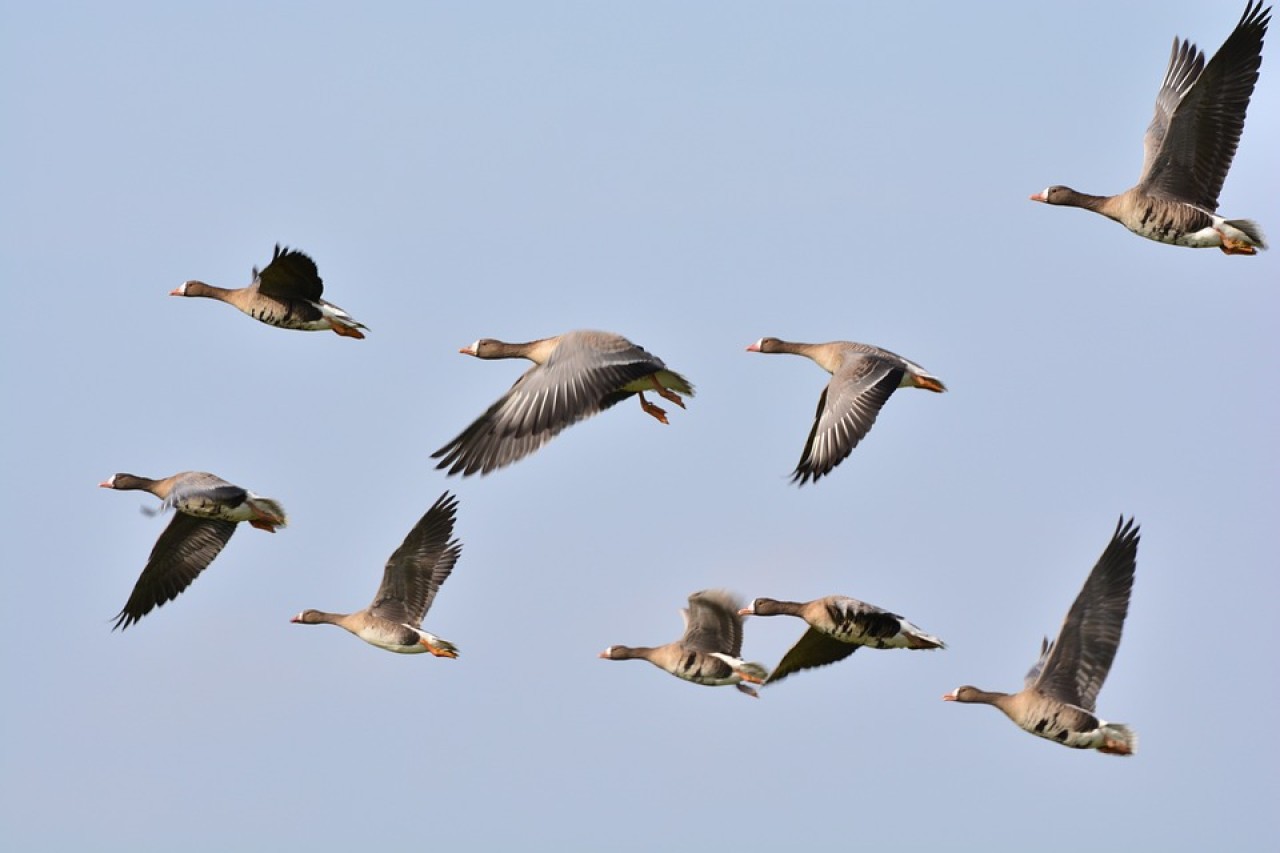
Welcoming the new year with a grand and loud fireworks display — that is a long-standing tradition.
But for the wildlife it means pure stress. A study shows: the consequences for wild geese, for example, reverberate for days afterwards.
GPS data reveal dramatic flight responses
Fireworks may look impressive, but the whistling rockets and fine particulate matter mean stress above all for wildlife. Researchers at the Max Planck Institute for Behavioral Biology in Konstanz and the Netherlands Institute of Ecology spent eight consecutive years examining how New Year's Eve affects wild geese. For this purpose, birds were equipped with GPS transmitters. The results show: the fireworks affect the animals for longer than just one night.
According to the study, movement data from 347 geese in northern Germany, Denmark and the Netherlands were analysed — each within the period from 19 December to 12 January. The geese fled their roosting waters precisely at midnight on New Year's Eve and flew to areas with fewer people. The animals' nightly rest was shortened by two hours. Fine particulate matter levels above their resting zones rose by up to 650 percent.
According to the researchers, they flew up to 16 kilometres further and up to 150 metres higher than usual. In individual cases, extreme distances of more than 500 kilometres were also covered. The animals recovered only slowly from the exertion, according to the analyses.
“Shocking to witness”
“It is shocking to see how much further the birds flew on New Year's Eve,” said study author Andrea Kölzsch of the Max Planck Institute for Behavioral Biology. “Some animals covered hundreds of kilometres in a single winter night — distances they normally only travel during migration,” the scientist explained.
Four species of geese were observed: white-fronted, barnacle, pink-footed and bean geese. These are Arctic migratory birds that spend their winter in northern Germany, Denmark and the Netherlands. Normally, the animals feed or rest throughout the day in order to consume as little energy as possible.
Energy loss and long recovery time
The flight on New Year's Eve costs the geese a great deal of energy. To recover, they were noticeably more restrained afterwards. They ate ten percent more and moved significantly less during the day. “In harsh winters, where not enough additional food can be found or cannot be consumed quickly enough during the short days, this may lead to problems,” Kölzsch explained. The study was published in the journal «Conservation Letters» at the end of November — approximately one month before the start of fireworks sales on 29 December.
Other animals also suffer on New Year's Eve. “However, the reactions to this disturbance vary by species,” said Kölzsch. A songbird in a nesting box would press itself into a corner and compensate for the shock with an elevated heart rate or a great deal of hopping back and forth, a wild boar might hide in the undergrowth, and wild geese, which by nature flee into the air when faced with danger, would simply fly away.
Even smaller explosions on New Year's Eve would be sufficient to frighten animals enormously. This had been shown by analyses from the COVID years, when the use of fireworks was restricted in many countries.
| You can help all animals and our planet with compassion. Choose empathy on your plate and in your glass. Go vegan. |