What is the hunting law in Switzerland?
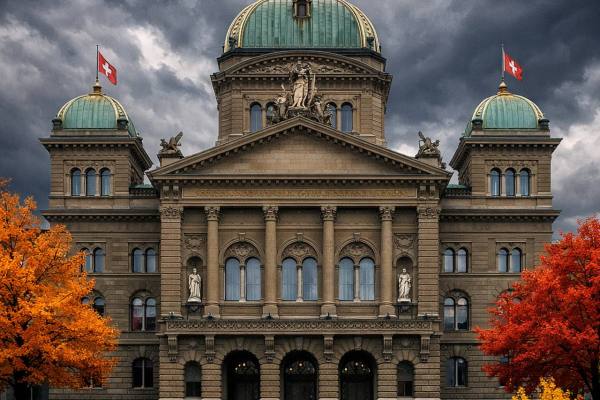
The Swiss Hunting Act (JSG) is the legal foundation of hunting in Switzerland. It regulates at federal level which animals may be hunted, which are protected, how closed seasons and hunting methods function and how wildlife that causes damage is dealt with.


What sounds like a technical regulatory framework is in reality a highly political document – shaped by decades of interest politics, a narrowly lost popular referendum and a controversial revision that came into force in 2025.
The history of the hunting law: From 1876 to 2025
The first federal hunting law dates back to 1876. It was part of a comprehensive regulatory wave following the founding of the federal state and ended the previous cantonal fragmentation of hunting rights. In 1925, a first revision followed that introduced closed seasons and placed certain species under protection.
The fundamental restructuring took place in 1986: The Federal Act on Hunting and the Protection of Wild-Living Mammals and Birds (JSG) still valid today came into force. It established huntable and protected species at federal level, defined framework conditions for cantonal hunting laws and created instruments for the first time for regulating species that cause economic damage.
In 2020, Parliament attempted to revise the Federal Hunting Act. The revision included, among other things, facilitated shooting of wolves – and failed at referendum. On September 27, 2020, 51.9 percent of voters rejected the Federal Hunting Act revision. It was a narrow defeat for the hunting lobby and a clear signal from the population: The majority did not want facilitated wolf culling without proven damage thresholds. The Dossier Introduction to Hunting Criticism describes the political context.
In 2022, Parliament again presented a revision. This was implemented without a referendum vote – a maneuver that was sharply criticized by critics. The Federal Council put the changes into force on December 13, 2024, effective February 1, 2025.
What the Federal Hunting Act specifically regulates
The Federal Hunting Act defines the following core areas:
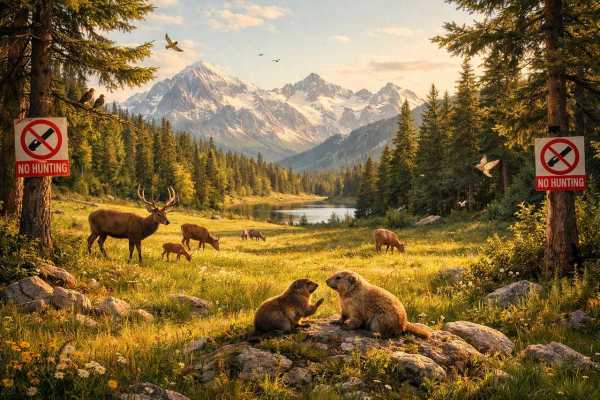
- Huntable species: The Federal Hunting Act establishes at federal level which animal species are huntable. These currently include red deer, chamois, ibex, roe deer, wild boar, marmot, mountain hare, snow hare, red fox, badger, stone marten, pine marten, stoat as well as various waterfowl and forest birds.
- Protected species: All non-huntable wild animals are fundamentally protected. These include all birds of prey, all songbirds, beaver, otter, lynx (except in approved regulation measures), bear, all amphibians and reptiles as well as numerous other species.
- Closed seasons: The Federal Hunting Act establishes minimum closed seasons. Cantons may order longer closed seasons, but not shorter ones.
- Protected areas: The Federal Hunting Act allows the Confederation and cantons to designate hunting-free protected areas.
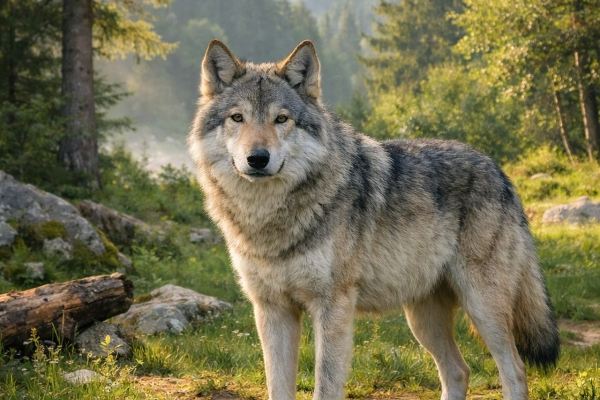
- Regulation of pests: The Federal Hunting Act regulates under what conditions protected species like wolf, lynx or beaver may be regulated (shot) when they cause significant damage.
- Livestock protection and wildlife corridors: The 2025 revision anchored livestock protection and wildlife corridors more strongly in the law.
26 cantonal hunting laws: a patchwork
The Federal Hunting Act is a framework law – it sets minimum standards. Implementation occurs through 26 different cantonal hunting laws, leading to a considerable patchwork. A few examples:
- Concession hunting vs. patent hunting: In 18 cantons the concession hunting system applies – the canton leases hunting concessions to private hunting societies. In 8 cantons the patent system applies (GR, GL, AI, AR, SG, TG, SH, GE) – whoever has a hunting license ('patent') may hunt in certain areas. Geneva has replaced both through its hunting ban.
- Hunting seasons: The main hunting season in Graubünden lasts three weeks in September – one of the most intensive hunting events in Switzerland. Other cantons have different seasons.
- Bans on individual methods: Den hunting (hunting with dogs in fox and badger dens) is banned in Zurich, Bern and Vaud, but allowed in other cantons.
- Cantonal protection lists: Some cantons place additional species under protection that would still be huntable at federal level.
This fragmentation makes coherent wildlife policy almost impossible and allows the hunting lobby to exploit canton-specific weaknesses. The Dossier Hunting in Switzerland – Numbers, Systems and the End of a Narrative analyzes the structural problems of the system.
The 2025 Federal Hunting Act revision in detail
The revision of the Federal Hunting Act that came into force on February 1, 2025 contains several central changes:
- Preventive wolf regulation: Probably the most controversial element. Cantons may now regulate wolves preventively – meaning shoot them before concrete damage occurs. The prerequisite is the presence of at least two wolf packs in the canton. Critics speak of 'wolf hunting in reserve'.
- Increased culling quotas: The maximum permissible number of wolves shot per season was increased. In the 2024/25 season, shooting permits for up to 92 wolves were issued.
- Strengthening of wildlife corridors: The law obligates cantons to designate and preserve nationally significant wildlife corridors. This represents genuine progress – but it contradicts the simultaneously facilitated culling measures.
- Simplified regulation of additional species: Besides wolves, regulatory possibilities for beavers, otters and certain birds of prey have also been facilitated.
The Swiss Hunting Ban Dossier discusses what political levers exist to reverse this development and establish more coherent wildlife protection legislation.
Criticism from BirdLife, Pro Natura and WWF
Prominent conservation organizations have sharply criticized the 2025 revision:
- BirdLife Switzerland particularly criticized the facilitated regulation of birds of prey and cormorants that are part of the revision.
- Pro Natura called it a «setback for predator protection» and criticized that the 2020 public referendum was effectively circumvented by the 2022 revision.
- WWF Switzerland described the preventive wolf regulation as ecologically unjustified and demanded that livestock protection be established as the first and only measure before culling is even considered.
- Wolf Group Switzerland filed a complaint arguing that the culling quotas are incompatible with international species protection law.
The 2020 Referendum: A Close Signal
The referendum of September 27, 2020 is politically significant: 51.9 percent of voters rejected the JSG revision at that time. The vote showed that the Swiss population has no majority for facilitated wolf culling. The subsequent parliamentary majority of SVP, FDP and parts of the Center implemented a largely similar package with the 2022 revision – this time without a public vote. Whether this strategy corresponds to Switzerland's political culture is disputed.
The Regazzi Canton Initiative and the Hunting Lobby
Besides the JSG itself, the political activity of the hunting lobby is an important factor. National Councilor Fabio Regazzi (The Center, TI) has repeatedly submitted motions seeking further liberalization of hunting law. Canton initiatives from hunting-friendly cantons like Graubünden and Valais regularly demand more cantonal autonomy – which in practice often means less protection.
The hunting lobby is well represented in parliament: Schweizjagd and the Swiss Patent Hunter Association have close connections to several federal parliamentarians. The Dossier How Hunting Associations Influence Politics and the Public documents these structures.
Geneva as Exception: What Federal Law Permits
An important legal detail: Federal hunting law does not force cantons to introduce a recreational hunting system. It defines huntable species and framework conditions – but cantons can also completely forgo recreational hunting within the framework of federal law and introduce professional wildlife management. Geneva has done this for 50 years.
This means: A cantonal hunting ban is legally possible without requiring a change to federal law. Other cantons could follow the Geneva model if the political will existed. More on this in the Swiss Hunting Ban Dossier.
Hunting and Animal Protection Law: A Structural Field of Tension
The JSG exists in a structural field of tension with the Animal Protection Act (TSchG). The TSchG obligates all persons dealing with animals to respect their dignity and not inflict unnecessary suffering. Hunting is effectively exempted from the TSchG through the JSG – a special regulation that is nowhere explicitly stated in law but has established itself in practice.
Instead of animal protection law, hunting law applies to hunting. This means: Wounded animals, unfound carcasses, groups panicked by drive hunts – all of this is not subject to animal protection supervision as applies to agricultural animal husbandry. The Dossier Why Animal Protection Law Ends at the Forest Edge illuminates this regulatory gap.
Hunting Control: What the Public Doesn't Know
Who monitors hunting in Switzerland? In theory: cantonal hunting supervisors and game wardens. In practice: hardly anyone. The number of state game wardens is minimal in most cantons. Control capacity is insufficient to regularly inspect all hunting grounds. Missed shots, poaching, illegal methods – much remains undetected.
The JSG prescribes accountability obligations for hobby hunters: shooting reports, bag lists, wildlife control. But this data is not systematically evaluated and made publicly accessible. Citizens who want to know what is being hunted in their canton rarely find complete, current, comprehensible figures. The Dossier on Hunting Laws and Control reveals the control deficit.
What a Contemporary Hunting Law Should Contain
Hunting-critical organizations and animal protection associations have formulated concrete demands for a future-oriented JSG reform:
- Priority of livestock protection over culling for all conflict-prone species
- Ban on battue hunts and other methods with high stress impact
- Legal anchoring of wildlife sanctuaries in all cantons
- Independent, state-funded wildlife monitoring as mandatory task
- Reduction of huntable species to those for which genuine ecological regulation needs are proven
- Possibility for all cantons to adopt the Geneva model
These demands are politically far removed from the majority in the current parliament. But they are legally possible, ecologically justified and ethically consistent. And they find more support among the Swiss population – as the 2020 referendum shows – than hunting discourse would suggest.
Conclusion: A Law in the Power Play of Interests
Swiss hunting law is not a neutral set of regulations – it is the result of decades of interest politics in which the hunting lobby had structural advantages. The 2020 referendum showed that the population does not unconditionally support parliament's hunting policy. The 2025 revision was pushed through against the will of nature conservation organizations and presumably a population majority.
Switzerland's future-oriented wildlife policy needs a JSG that takes wildlife protection seriously, protects predators and promotes professional wildlife management instead of hobby hunting. The legal foundations for this would be available – if the political will were there.
Further content on wildbeimwild.com:
- Dossier: Hunting Ban Switzerland – what would be legally possible
- Dossier: Introduction to Hunting Criticism
- Dossier: Hunting in Switzerland – Numbers, Systems and the End of a Narrative
- Dossier: How Hunting Associations Influence Politics and the Public
- Dossier: Swiss Hunting Law Overview
- Dossier: The Wolf in Switzerland
More background on current hunting policy in Switzerland can be found in our Dossier on wildbeimwild.com.
Support our work
With your donation you help protect animals and give voice to their cause.
Donate now →