USA: Asian killer hornets successfully eradicated
The Asian hornet is continuing to spread in Switzerland as well. This spread is problematic because the Asian hornet hunts primarily native honeybees, wild bees, and wasps to feed its larvae. If the species becomes widely established in an area, the Asian hornet can cause noticeable losses among bee colonies.


The enormous “killer hornet,” once feared as a threat to insects, agriculture, and human well-being, has been eradicated in the United States.
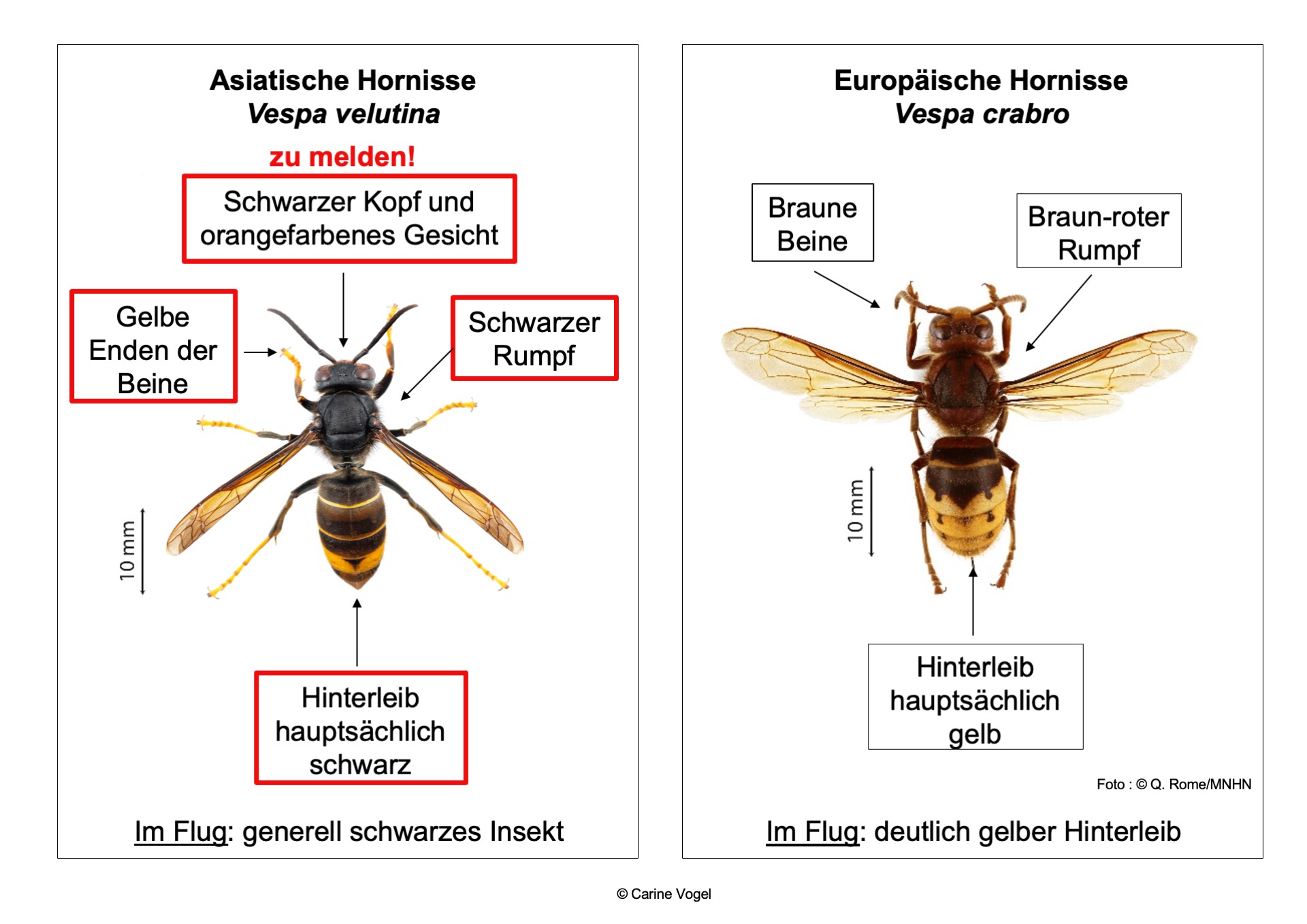
The Asian hornet is slightly smaller than the European hornet and darker in colour. It lies in wait for bees at their hive and kills them in flight. It consumes up to 50 bees per day. Other bees tasked with collecting nectar no longer dare to venture out in the face of this danger.
The Asian hornet is considered peaceful and shy towards humans. However, when it perceives its nest to be threatened, it reacts aggressively. What makes it particularly insidious: a sting releases a scent marker that effectively signals the target to other members of the species and makes them aggressive as well — meaning that further stings from other hornets flying in are liable to follow the first.
A narrow escape from the murder hornet
The battle against the enormous killer hornet began when bewildered beekeepers discovered honeybees that had been decapitated in a deeply unsettling manner. Before long, aggressive trapping and tracking techniques followed.
Specialists from government agencies donned thick suits and cautiously approached the hornet nests in order to remove them using delicate methods. It took years before the last hornet was encountered empty-handed. This outcome was not easily achieved.
The Washington State Department of Agriculture and the United States Department of Agriculture’s Animal and Plant Health Inspection Service, represented by pest programme director Sven Spichiger and deputy director Nicole Russo, are the key figures in this success story.
At the forefront
The individuals who led the fight against this insect were concerned about the possibility of a permanent invasive species.
"As an entomologist, I have been working on this topic for over 25 years now, and it is a rare day when people actually achieve a victory against insects," said Sven Spichiger at the end of the months-long tracking season.
The dramatic effort to locate and eradicate the nests forced all those involved to remain vigilant, set traps, train local port inspectors, and work tirelessly to follow up on every reported sighting.
The project required help from all sides
Attentive residents called the reporting hotlines. Field teams equipped giant killer hornets with tiny radio transmitters. Nests discovered near the Canadian border were carefully cordoned off.
Nevertheless, many authorities remain on alert. The United States Department of Agriculture's Animal and Plant Health Inspection Service described the successful efforts as a "milestone" to be celebrated.
How did the killer hornets get here?
Experts do not know exactly how the killer hornet originally arrived here. Some suspect they may have hidden inside a freight container.
Without clear evidence, there is no guarantee that a reintroduction could not occur again.
Possible future discoveries will likely trigger a rapid response. New sightings remain possible, and teams will continue to monitor them.
Officials in Washington say that any further activity will be followed with the same intense attention as before. The lessons of the past will guide all future efforts, so that no one is willing to take any risks.
Outside the United States, fears related to hornets have alarmed other countries as well.
In parts of Europe, alarm was raised after a related species, the southern giant hornet, appeared in northern Spain, prompting researchers to warn that further outbreaks could follow if it is not brought under control.
The wide distribution of similar insects shows that this is not a limited problem. Scientists point to climatic conditions, global shipping traffic, and changing ecosystems as reasons for the appearance of these insects in unusual locations.
More than just a name
The hornet once caused a stir in the media under various nicknames. Many remember the terms “Asian Giant Hornet” and “Murder Hornet,” but experts have agreed on a name they consider more accurate.
According to the Entomological Society of America, the designation “Northern Giant Hornet” better reflects its range and at the same time reduces problematic associations.
This change can help everyone discuss the insect without tying it to a specific region or stirring up unnecessary speculation.
What really mattered
The potential of the giant hornet to harm honey bee colonies and other beneficial insects has alarmed ecologists, beekeepers, and farmers.
A single hornet nest, if left undisturbed, can lead to severe losses in important pollinator populations. Many experts knew that a spread of the species would be no small matter.
Studies on the behavior of the Northern Giant Hornet (Vespa mandarinia) suggest that these hornets can rapidly invade beehives, and their stings are also painful for humans and other animals.
Key lessons from the murder hornets
One positive insight from this situation is that clear communication and community involvement can pay off. Early detection and rapid response have proven effective.
The strong network of authorities, scientists, and residents raised the alarm, tracked down every possible hornet, and prevented it from spreading to other areas.
The authorities also trained and equipped various inspectors at key entry points. The entire scenario was tense, but made it clear how people can come together to stop a serious threat to the environment before it becomes a persistent crisis.