Hunting Laws: Not Progressive
A new dimension of the hunting law debate: trophy hunting remains permitted. Black grouse, ptarmigan, and woodcock may still be shot. And in some cantons, so may the European hare. JagdSchweiz and others nonetheless promote the flawed law with claims of “greater safety for animals.” Meanwhile, a German hunting travel agency advertises ibex trophy hunting in Valais with the claim: “So far, all of our guests have had the chance to take a shot.”


Hunting grouse species and ibex cannot be justified on wildlife biology grounds.
Black grouse and ptarmigan cause no damage; ibex cause minimal damage. Grouse species are under pressure from climate warming, increasing disturbance, and habitat loss due to tourist infrastructure; among ibex, inbreeding within colonies is becoming an increasing problem. The hunting laws coming to a vote on 27 September 2020 are ill-conceived — not only for wildlife.
All three species are hunted solely for their trophies (antlers, ornamental feathers, stuffed pelts) and for tradition (especially grouse hunting with pointer dogs). This can negatively affect sex ratios (black grouse), disrupt the course of the rut and natural selection (ibex), and undermine conservation efforts — since with these animals, every living individual in the population counts. In Ticino, the cantonal government recently recommended that a cantonal initiative to protect the rock ptarmigan be adopted into the cantonal hunting law.
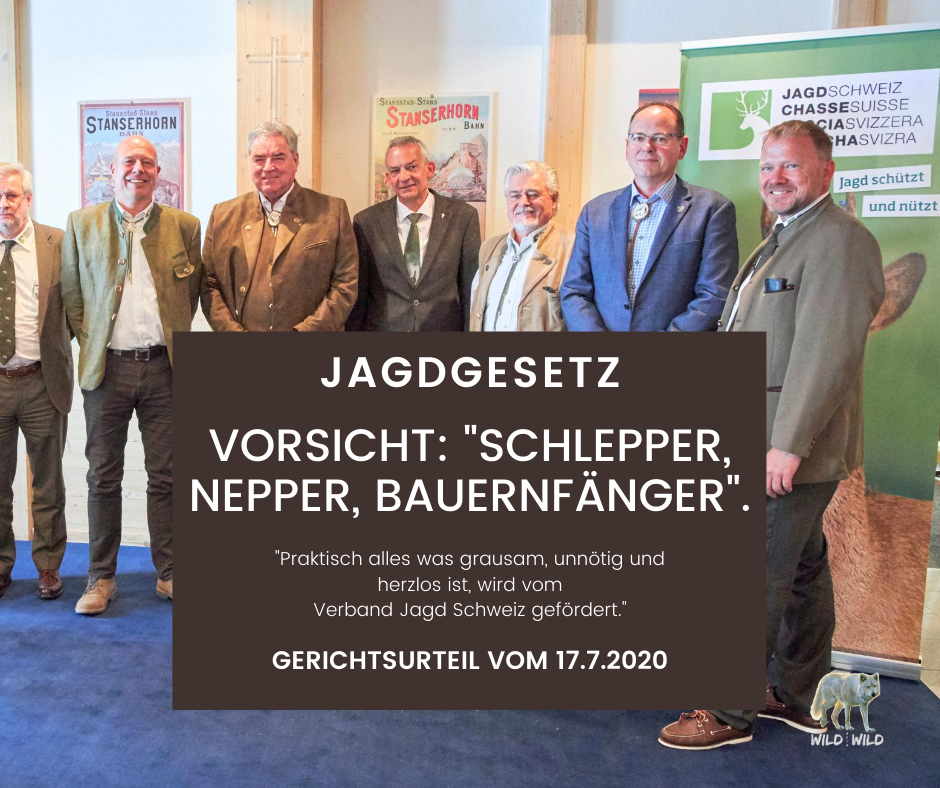
JagdSchweiz — with spokespeople such as David Clavadetscher — along with the Farmers’ Union are selling voters the new hunting law as “progressive.” They claim it offers, among other things, “more safety for wildlife and humans». These are very bold statements, especially given that trophy hunting is still permitted, writes the committee of opponents.


The revision of the hunting law would have been an opportunity to finally place endangered animal species, which can still be hunted, under protection. This opportunity was missed. Grouse will face increasing pressure in the future due to climate warming and habitat fragmentation.
Hunters who also see themselves as conservationists are voting NO on 27 September 2020. Parliament's decision to forgo protection of vulnerable species – while simultaneously relaxing the shooting of protected animals – shows that the new law is no «good compromise», as communicated
by the Federal Council.
Black Grouse (male) (Lyrurus tetrix)

- According to the «Red List CH»: potentially endangered (priority species for species promotion)
- Population: 12,000 – 16,000 males
- Only the male (black grouse) is huntable under current hunting law.6 cantons permit black grouse hunting.This is recreational hunting; there is no basis for population regulation.
- 400 – 500 black grouse are shot annually, with over 200 in the canton of Valais alone.
- The canton of Valais sells shooting licences to foreign hunting tourists (presumably mainly from Italy). According to a statement by the cantonal government, tourist hunting of grouse (black grouse, ptarmigan) brings the canton approximatelyCHF 75,000 annually. This covers part of the costs of the cantonal hunting and fishing department.
- Per black grouse shot, an average of CHF 242 flows into the Valais state treasury.
- Black grouse hunting in Valais is part of the small game hunting seasonPatent B. Cost for Valais residents: CHF 660, cost for non-residents: CHF 2,620.
- Per dayand hunter, a maximum of 2, and per year 6 black grouse may be shot (Valais).
Alpine Ptarmigan (Lagopus muta)

- Red List CH: potentially endangered (priority species for species promotion); strong decline
- Population: approx. 12,000 – 18,000 breeding pairs
- Both sexes are huntable.4 cantons permit ptarmigan hunting. It is purely a sport hunt; there is no basis for population management.
- Approximately 400 ptarmigan are shot each year. 120 of them in the canton of Valais.
The canton of Valais sells shooting licences to foreign hunting tourists. According to a statement by the cantonal government, hunting for grouse (black grouse, ptarmigan) generates approximately CHF 75,000 for the canton each year.
For each ptarmigan shot, an average of CHF 242 flows into the Valais state treasury.
Per day and hunter, a maximum of 2 ptarmigan may be shot, and 8 per year (Valais).
Ibex (Capra ibex)

- The ibex is protected in Switzerland and cannot be hunted under regular circumstances. An exception is the institutionalised “regulation” of populations under federal supervision.
- Within this framework, cantons allocate culling quotas to hunters. Female ibex are also shot in this process.
- In Valais, Swiss and foreign hunters can purchase a day licence to shoot an ibex. Depending on horn size, this costs between CHF 10,000 and 20,000. This trophy hunt targets bucks with large horns. The meat is of no interest. In other cantons, this type of trophy hunting is not permitted.
- The canton of Valais thus collects CHF 650,000 per year. It cooperates with hunting travel agencies, which bring their clients to the hunting area, sometimes by helicopter.
- Each year, approximately 100 older male animals are shot in this way. In addition, close to 330 ibex — both males and females — are shot by Valais hunters.
- On 6 November 2019, the cantonal government announced its intention to ban ibex safaris. Yet at least two foreign operators were still offering ibex hunting tours for 2020, including the German hunting travel agency K&K Premium Jagd. Motion 5.0476 in the Grand Council of November 2019, which called for an end to trophy hunting, has still not been answered by the cantonal government.
More on the subject of recreational hunting: In the dossier The Role and Criticism of Recreational Hunters we shed light on the training, power and self-image of recreational hunters. What the research says about this is shown by Hunting fact-checked: the state of research.
The position of IG Wild beim Wild: IG Wild beim Wild rejects recreational hunting. Our model is the canton of Geneva, which has managed without recreational hunting since 1974: without hunting seasons, without hunting dogs, without driven hunts, without high seats, without the animal cruelty and crime that go hand in hand with hunting season elsewhere. What has worked there for over fifty years disproves every position paper by JagdSchweiz. An association that bases its policy on claims it refutes in its own documents is not a professional organisation, but a factory for misinformation.