Hobby Hunters on Illegal Raised Hides: Unlawful Hunting Practices
Hunting culture ultimately means excommunication from the circle of any ethical culture and can at best be used as a synonym and illustration of a contemptible subculture.

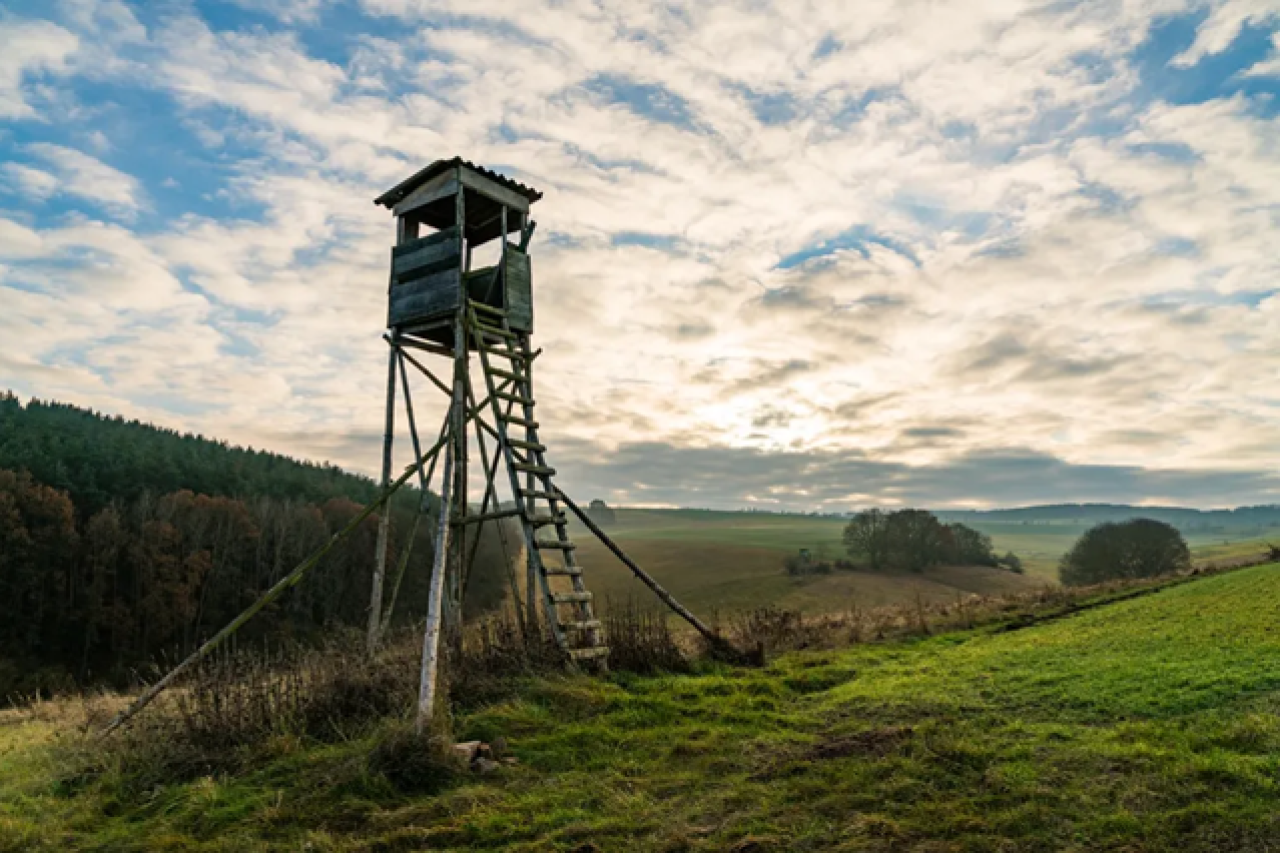
Hundreds of unauthorised raised hides still stand across the Swiss countryside and in forests.
Yet municipalities, cantons, and the federal government rarely enforce building regulations and ordinances.
Raised hides repeatedly spark debate. Last November, «Südostschweiz» reported on territorial disputes among Grisons hobby hunters over individual hides. «Part-built family homes are sometimes erected in the forest,» complained one game warden. There is hardly a canton that has not seen quarrels over the furnishing of the landscape, which invariably disfigures the scenery.
There are all kinds of raised hides, from a simple plank to elaborate steel structures. There are hides with camouflage netting for the treacherous hobby hunter. Hides that are delivered pre-assembled and simply unfolded like a stepladder, for the mobile hobby hunter. Tree ladders with comfortable seating for long vigils — for example for the driven-hunt hunter — or hunting seats with a reclining surface, plexiglass panels, and moon shields for the indolent hobby hunter.
The practice of lounging above the ground during a stationary hunt is no age-old hunting tradition. It arguably owes its breakthrough to the impaired left arm of Kaiser Wilhelm II in the 19th century, who had to prop up his rifle when shooting. In the Swiss canton of Obwalden, raised hides are still regarded today as prohibited aids and considered unsportsmanlike.
Which true hunter from an indigenous people would ever build and use a raised hide?
As a general rule, hunting huts and raised hides may only be erected with the agreement of the landowner and must be kept in good condition. The provisions of building and forestry legislation always remain reserved.
A uniform regulation is still lacking
St. Gallen
St. Gallen regulates nothing. Raised hides are not mentioned in the new hunting ordinance.
Lucerne
Simple, open raised hides (such as a ladder with seating for a maximum of 2 persons and a rifle rest) that are unobtrusive are exempt from building permit requirements. These raised hides must be mobile or constructed on a tree at the edge of the forest.
Glarus
The installation or attachment of feeding stations, raised hides, and fox pass houses may only take place with the written consent of the landowner and, if forest areas are affected, must be reported in advance to the competent cantonal forestry authority. Any additional permits required under federal law remain reserved.
Obwalden
The installation of raised hides and ground hides is only permitted with the consent of the landowner and in compliance with building regulations. No trees may be damaged. Simple ground hides made of wood, max. 1 × 1 m, with a roof, enclosed on a maximum of two sides, do not require a permit.
Solothurn
In principle, only structures and installations for forestry purposes may be erected in forests. Simple, open recreational and hunting facilities (including fitness trails, raised hides, and picnic facilities) are permissible under the Solothurn Forest Act; however, they are subject to permit requirements, even if they appear to be very simple or insignificant to the builder.
Zurich
The more than one thousand raised hides are among the little-noticed minor structures and among the last unstandardized constructions of any kind. They require no official permit, nor is there any obligation to report them. However, the landowner must be consulted. They may not have permanent foundations and must not cause damage to the ground or forest.
Bern
The construction of so-called “non-forestry” structures in forests is permitted only by way of exceptional authorization, for reasons of forest protection, even if they are only temporary. In addition to raised hides, this building category also includes, for example, beehives or larger fire pits.
Grisons
Several parliamentary motions call for the permissibility and authorization of hunting facilities such as raised hides to be regulated at the cantonal level. Against this it must be argued that provisions on raised hides in the cantonal hunting law are not appropriate to the relevant regulatory level. This task should therefore continue to be carried out by the municipalities.
It is required that hobby hunters obtain proper permits from the municipalities for their hunting blinds. Only in this way can foresters have a say and ensure that structures are built with minimal environmental impact.
However, not all hobby hunters properly register their hunting blinds. Some municipalities, such as Flims, have therefore taken active measures. There, hobby hunters were given a deadline by which they had to register their blinds. Unregistered blinds were subsequently demolished by the municipality.
Thurgau
Simple open structures made of poles, for example, do not require a building permit. For the building permit requirement to be waived, the following criteria must all be met cumulatively:
- Space for a maximum of 2 persons only
- Walls no higher than hip height (approx. 1 metre), or at least two open sides
- Ladder-style access with a simple seat, or mobile elevated stands
- Unobtrusive, modest roof serving as weather protection
The Geneva Model: No hunting blinds needed
In the canton of Geneva, recreational hunting was abolished in 1974 following a public referendum. Since then, state-employed game wardens have regulated wild ungulate populations where necessary. No hunting blinds, driven hunts, or battue hunts are needed there. Foxes, martens, and badgers are not regulated. In 2011, for example, not a single red deer, roe deer, red fox, badger, marten, or brown hare was shot in Geneva, according to the federal hunting statistics. Sanitary culls are not the same as regulatory hunting based on hunters’ lore or a misguided understanding of nature. Unlike other cantons, Geneva still enjoys very healthy hare populations.