Highly toxic insecticides detected in Swiss forests
The combined cocktail of toxins is also taking a severe toll on wildlife.

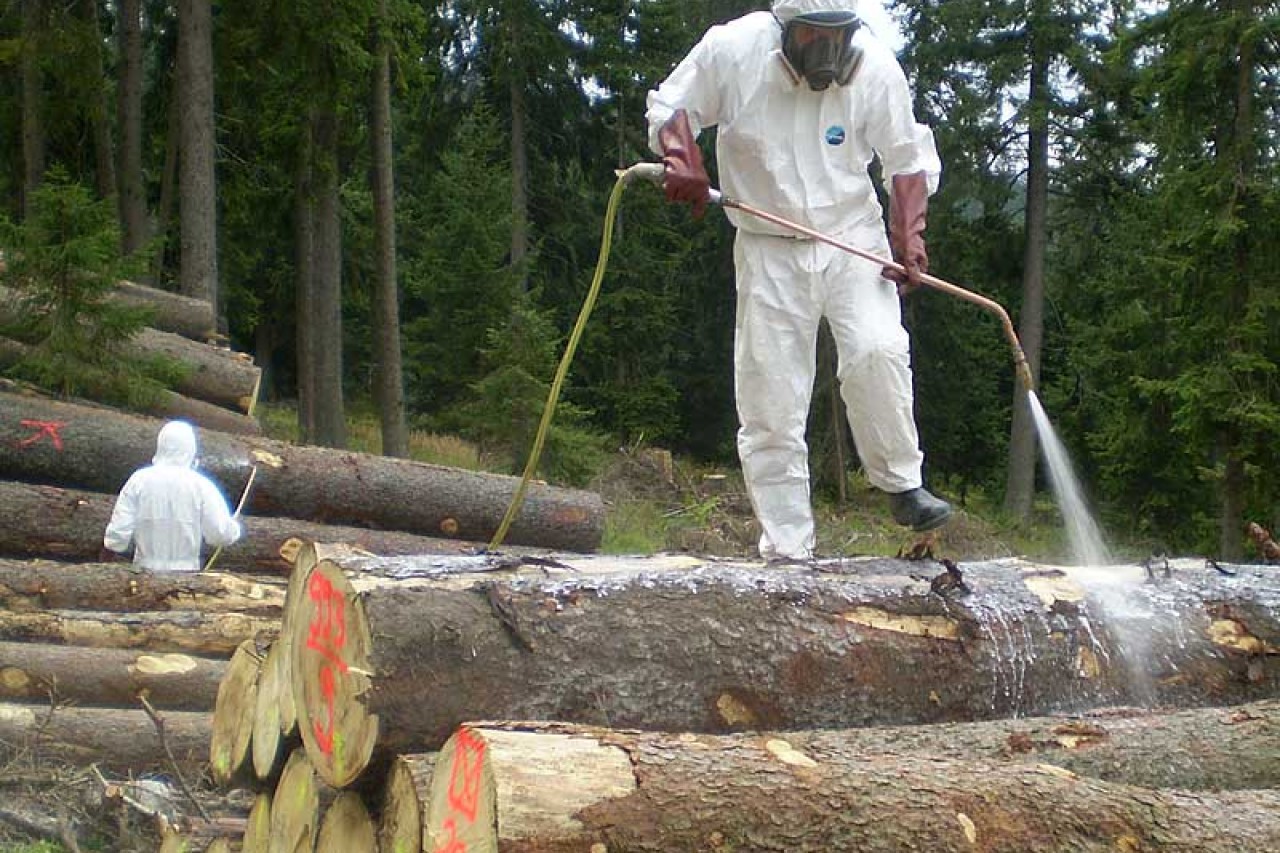
In 2018, around 700 kilograms of highly toxic insecticides were sprayed onto felled logs in Swiss forests. This is revealed by research conducted by Doctors for Environmental Protection (AefU). If forests did not have to serve as timber storage areas, the use of these toxins would be unnecessary, as the example of Glarus shows. The AefU is calling for a ban on the use of chemical pesticides in forests.
The bark beetle thrives on undebarked, felled timber and can infest it. To combat this, many forestry operations — especially now in spring — spray the highly toxic insecticides known as pyrethroids (cypermethrins) onto the logs (see box). The federal government has no data on the quantities of pesticide used in this process.
Doctors for Environmental Protection (AefU) therefore produced an extrapolation based on a survey of the 25 cantonal forest officers. Approximately 700 kilograms of highly toxic insecticides were sprayed onto felled tree trunks in Swiss forests in 2018 (known as roundwood spraying). This means that around twelve percent of the total quantity of cypermethrin sold in Switzerland ends up in forests.
Even banned insecticides sprayed in forests
The AefU research also reveals: in 2018, insecticides that had already been banned were applied in Swiss forests. In the canton of Aargau, four spray products that have been prohibited since July 2017 were applied to tree trunks. Two of them contain the extremely toxic chlorpyrifos (see box). Timber stockpiles in Bernese forests also received a chlorpyrifos-based product as well as two further banned insecticides in 2018. In the cantons of Fribourg, Lucerne and Zug, one banned product each was used.
Felled tree trunks are treated with highly toxic insecticides. Photo: Baudirektion Kanton Zürich
While the Swiss Forest Act stipulates: “No environmentally hazardous substances may be used in forests” (Art. 18 WaG), exceptions are permitted — though these appear to be more the rule than the exception: 22 of the 25 cantonal forestry offices approved the use of highly toxic insecticides in 2018 to ‘treat’ felled tree trunks in forests.
FSC label does not protect forests from insecticides

Surprisingly, the FSC1 Switzerland timber label also permits the use of the highly toxic cypermethrin insecticides. In Switzerland, "forest owners would withdraw from FSC without the exemption for cypermethrin." If the timber "were debarked or permanently removed, the use of cypermethrin would not be necessary," explains Hubertus Schmidtke, Managing Director of FSC Switzerland, in response to an inquiry from AefU. From this summer onwards, FSC Switzerland may no longer accept cypermethrin. That would be a credit to the label.
Glarus Forest Without Poison
What FSC Switzerland is only now planning has been the practice in the canton of Glarus for at least five years. At the time, they decided to stop using insecticides in the forest, says Maurus Frei, Head of the Glarus Forest Office. To achieve this, most timber in the Glarus region must be removed from the forest immediately. If that succeeds, insecticides become unnecessary. It is an organisational matter and worked in 2018 as well, despite storm ‘Burglind’.
A Boomerang for the Eco-Image of Swiss Timber
Most cantons, as well as the Federal Office for the Environment FOEN, justify the use of insecticides on harvested logs by arguing that the Swiss forestry and timber industry must remain competitive. However, this endorsement of insecticides in timber harvesting could backfire on the ecological image of Swiss timber, which the industry proudly invokes.
Stop the Poison in the Forest
AefU is calling for a ban on the use of insecticides throughout the entire Swiss forest. The example of Glarus shows: it can be done without poison.
The Insecticides Cypermethrin and Chlorpyrifos
Pyrethroidsare considered highly toxic to humans, irritating, and damaging to organs. Some are suspected of acting like hormones and causing cancer. All pyrethroids are also highly toxic to fish and pose a serious threat to nearby bodies of water. Zeta-cypermethrin is additionally toxic to bees.
Chlorpyrifosis likewise considered highly toxic and irritating, and is suspected of being hormonally active as well as impairing brain development in children. Chlorpyrifos is also a potent fish poison and is moreover toxic to birds.
Even the Fields of Organic Farmers Are Contaminated with Pesticides
The fields of most organic farms in the Swiss Plateau are contaminated with pesticides. This is the conclusion of a study by the University of Neuchâtel, reported on by the «NZZ am Sonntag». Two researchers analyzed 702 plant and soil samples from 62 farms and published their work in the specialist journal «Applied Ecology».
The Neuchâtel scientists also examined ecological compensation areas. This revealed that 81 percent of the soil and 93 percent of the plants were contaminated with neonicotinoids.
The organic farms themselves are not responsible for the contaminated fields. The level of toxic residues found on them is indeed lower than on conventionally producing farms. The residues reach organic fields through drift from conventional operations.