Cruel Practices of Hobby Hunting
On 14 December, a local resident and her father in Jagsthausen (Heilbronn district) observed and documented a cruel driven hunt targeting a wild boar.


According to the witness, after being shot the animal initially fled onto a field, where over a period of approximately 25 minutes it was repeatedly bitten by three “hunting dogs” and screamed in pain.
According to the local resident, the dogs did not respond to the calls of the hunters.
When one of the hobby hunters reached the injured animal, he reportedly stabbed it multiple times. As he dragged it away, the animal was said to still be writhing. In the meantime, the resident’s father had also arrived at the scene and was able to observe the events at close range.
On 22 January, PETA filed a criminal complaint with the Heilbronn public prosecutor’s office against the hunters involved, citing violations of the Animal Welfare Act. The animal welfare organisation also extends its gratitude to the local resident, who contacted PETA just a few hours after the incident. The woman herself reportedly filed a complaint against the hobby hunters shortly after the event. Yet another case of criminal activity in the context of hobby hunting.
The forests in which the hobby hunt took place belong to Hans-Sigmund Freiherr von Berlichingen.
“The footage unfortunately shows the kind of cruelty that is typical of hobby hunting — incidents that are reported to us repeatedly and that mostly take place hidden in forests. We hope the authorities will impose severe, deterrent penalties in this case,” said Peter Höffken, specialist consultant at PETA. “The entire practice of hunting serves as entertainment for bloodthirsty recreational hunters and is steeped in both legal and illegal cruelties. Only a statutory ban on hobby hunting can truly protect animals.”
Video footage shows this is no isolated incident
Although harassing animals by setting them on another animal is prohibited in Germany, scenes like these occur repeatedly. Numerous whistleblower cases show that acts of animal cruelty are committed again and again in forests, away from public and official oversight — including out of malice or negligence. In December 2023, a hobby hunter in the Rhein-Lahn district repeatedly set a dog on an injured wild boar. In March 2020, a hobby hunter, presumably in the Bad Dürkheim district, proactively drove dogs onto an injured wild boar. Near Gelnhausen, in November 2019, a wild boar was attacked for over 10 minutes by several “hunting dogs” before the hobby hunter intervened. Such incidents document the systematic animal welfare problem of hobby hunting.
Wild boar killings counterproductive and cruel
PETA advocates for an end to hobby hunting of wild boars. The currently exerted high hunting pressure is counterproductive, as it leads to population growth. Scientists have proven that female animals in hunted wild boar populations reach sexual maturity earlier and that birth rates increase. In light of this, the population has been rising for years. Wildlife populations regulate themselves through food availability, climate, and disease. Hobby hunting, on the other hand, destroys the age and social structures of animal populations, leading to increased reproduction among survivors. Losses in the population are thus quickly offset or even overcompensated by offspring and immigration. As studies demonstrate, hobby hunting fails as a means of population control. The driven hunt targeting these animals is also extraordinarily cruel. According to the Veterinary Association for Animal Welfare, around two-thirds of wild boars do not die immediately. With shattered bones and protruding entrails, the terrified animals flee and often do not die until days later, in agony.
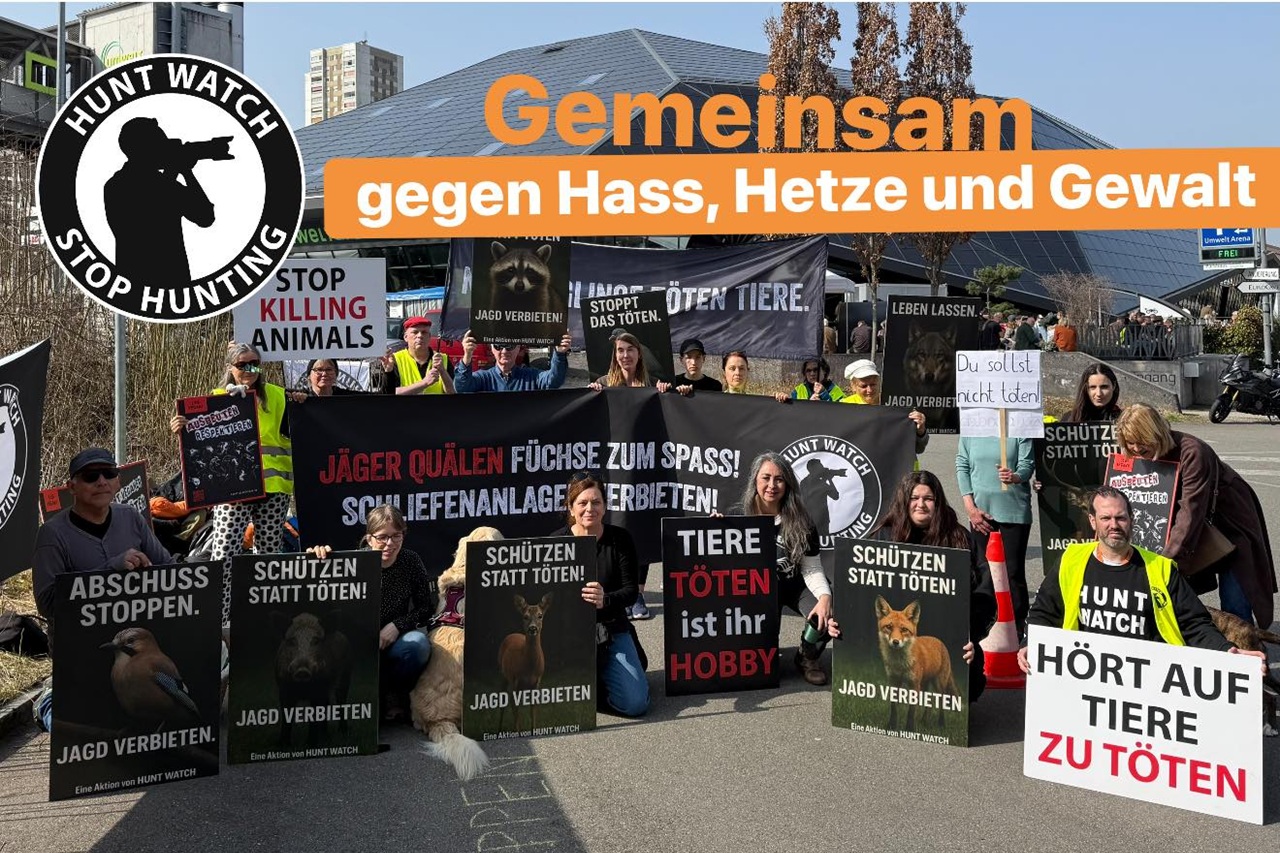
PETA criticizes the fact that the killing of animals under the guise of hunting constitutes a “pleasurable” leisure activity for a small segment of the population. The more than 430’000 hobby hunters in Germany are contrasted with only around 1’000 professional hunters, primarily forestry officials.