Beeches with early-coloured foliage are dying off
Beeches whose foliage discolours early are prone to dying. Climate change is increasingly taking its toll on Switzerland's forests.
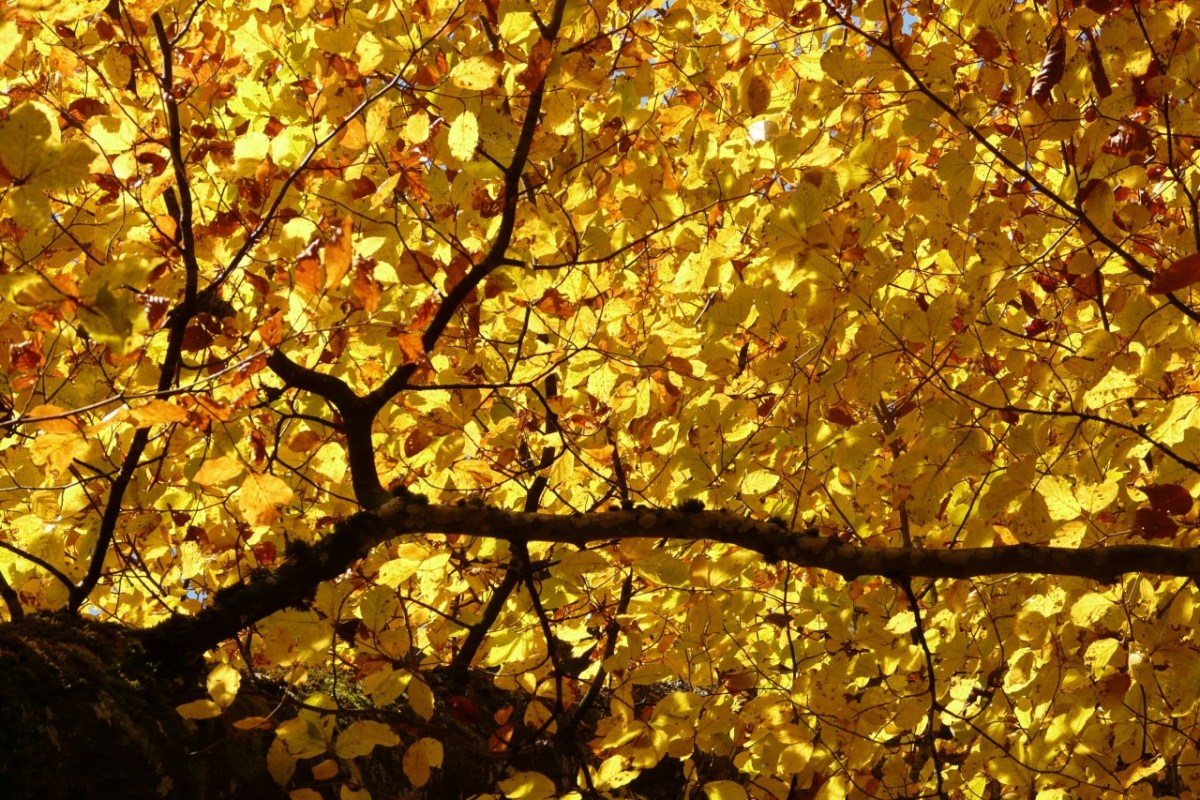
In the extremely dry summer of 2018, beech foliage turned colour as early as July in many places.
Studies by the Swiss Federal Institute for Forest, Snow and Landscape Research WSL now show that up to 10% of these trees have died – many times the natural mortality rate. The summer of 2022 is likely to have further affected beeches on dry sites.
The summer of 2022 felt like a déjà vu: as in 2018, the foliage of various trees began to discolour from the end of July, and in the Mendrisiotto whole forests turned brown over large areas in August. Today, as then, the question arises of how trees that shed their leaves early fare in the years that follow.
In 2018 the Swiss Federal Institute for Forest, Snow and Landscape Research WSL launched an ad hoc research programme on the consequences of the dry summer. As part of it, 1,000 beeches with premature leaf fall were repeatedly observed, located in the regions of Basel-Landschaft, Schaffhausen and Knonauer Amt/Bremgarten in the cantons of Zurich and Aargau.
Until 2021, the research team estimated each year the proportion of dead branches and the loss of leaves in the crowns of around 830 beeches that had shed their leaves early in summer 2018, and of 139 beeches with normal autumn leaf fall. It also counted pests and signs of disease and determined further site factors such as soil composition and long-term summer water deficits. The researchers are now presenting the results in two scientific articles and in the forestry journal Wald und Holz.
Dry sites are bad for beeches
«It turned out that tree damage and a dry climate are linked,» explains project coordinator Esther Frei. «Trees at sites with little rainfall and on soils that retain little water were more severely affected.» Of the beeches with premature leaf fall, 10 per cent in the Schaffhausen region died completely within three years, 7 per cent in the Baselland region and 4 per cent in the Knonaueramt/Bremgarten region. A further fifth of the 1,000 monitored beeches was felled early for safety reasons. Of the 139 trees with normal autumn colouring, only two died, which corresponds roughly to the natural mortality rate.
The fact that drought harmed weak trees on dry sites more severely is also confirmed by tree-ring data analysed by Stefan Klesse of the Dendrosciences research group. The wood cores had been taken in 2020 from beeches with damaged crowns in the Ajoie in the canton of Jura. The tree rings showed that trees with severe crown damage had already grown less well in previous years. The drought therefore affected weaker individuals above all. The link with soil conditions was also found in the Ajoie: damage was markedly more pronounced in trees on shallow or stony soils, which retain water poorly, than in those growing on deep soils.
A sign of weakness
What matters for foresters: the trees with early leaf fall did not recover in the following years, particularly on dry sites, which were also fairly low in rainfall. On the contrary, the proportion of dead branches rose with each year. «Shedding the leaves there is therefore not to be interpreted as a protective mechanism of the tree to better survive the dry period, but as a sign of weakness,» explains Frei. By contrast, on moister soils, such as in the Knonaueramt, many of the beeches with early leaf fall recovered.
In the summer of 2022, too, autumn colours were again visible in many places. This year, trees on shallow soils on south-facing slopes in northern Switzerland and in southern Ticino were the most severely affected. «On such drought-prone sites, the beech will have a hard time in future,» says Esther Frei. Foresters will sooner or later have to do without the beech there.
Do you have a tip, a source or a correction for this article? Write to us.
More on the subject of recreational hunting: The scientific evidence is presented in the overview Studies on the Effects of Recreational Hunting.
The position of IG Wild beim Wild: IG Wild beim Wild rejects recreational hunting. Our model is the canton of Geneva, which has managed without recreational hunting since 1974: without hunting seasons, without hunting dogs, without driven hunts, without high seats, without the animal cruelty and crime that go hand in hand with hunting season elsewhere. What has worked there for over fifty years disproves every position paper by JagdSchweiz. An association that bases its policy on claims it refutes in its own documents is not a professional organisation, but a factory for misinformation.
Support our work
With your donation you help protect animals and give their voice a hearing.
Donate now →