Avoiding traps for wildlife in residential areas
Taking even just these points into account can prevent the deaths of hundreds of thousands of animals.

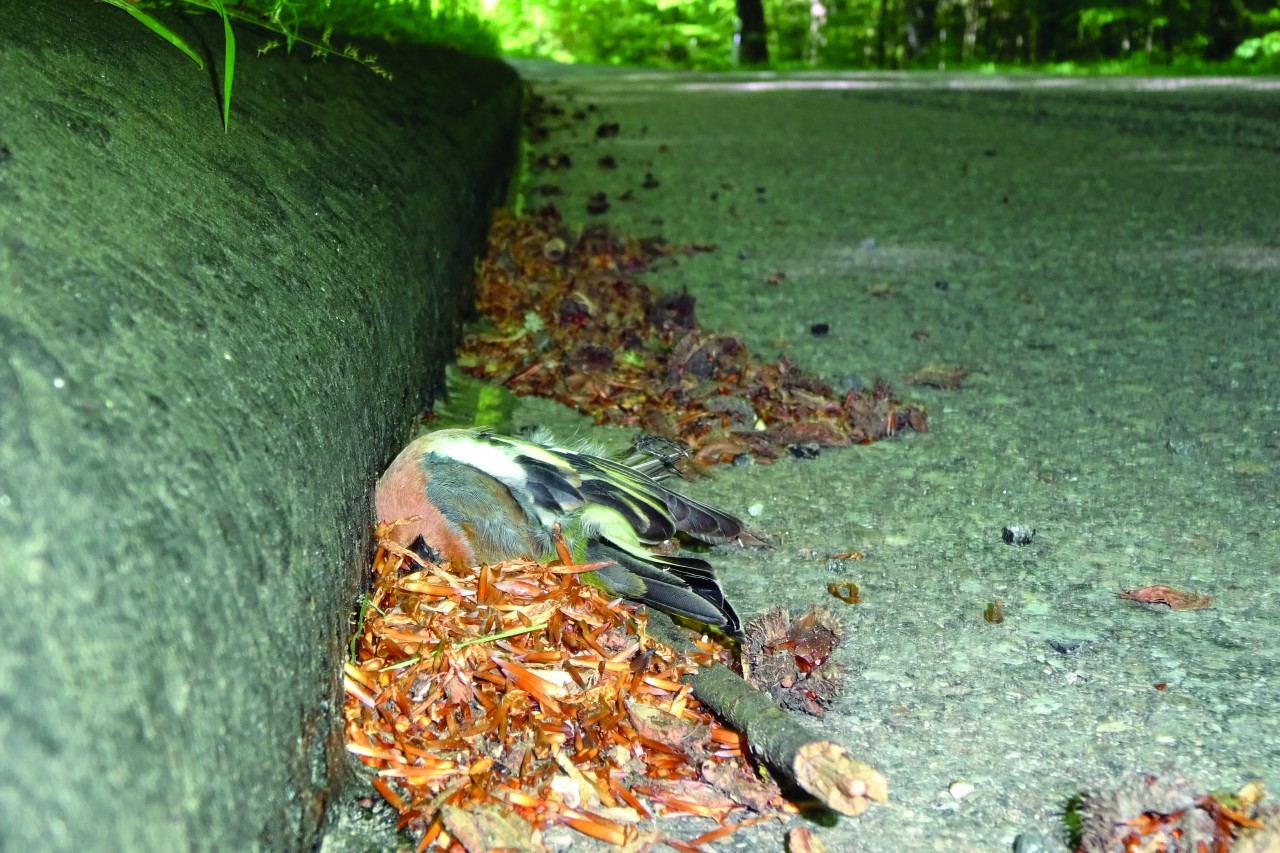
Homeowners, architects, municipal employees, and building managers are often unaware of how many traps and obstacles exist in residential areas that pose a threat to wildlife.
Most of these risks can be avoided with often very simple measures, saving many animal lives in the process.
Glass: a deadly trap

Glass surfaces cause high bird mortality every year. In particular, glass balcony railings, glass wind barriers, and corner windows are deadly traps for birds, as the animals cannot recognise glass as such and fly straight into it. The surrounding habitat is also often reflected in the glass, creating the illusion of additional bushes and trees for birds. Such traps should be avoided at the planning stage of a building. Where glass traps already exist, they should be covered with dense patterns — there is plenty of room for creativity here. The only important requirements are that lines are approximately 1 cm wide and no more than approximately 10–12 cm apart. Black bird silhouettes have too little effect.
Fences and visual or noise barriers extending all the way to the ground

Fences fragment habitat. It is important to include gaps of at least 15 cm in width so that animals can move through.
Photo: BirdLife Switzerland
Walls and fences are increasingly fragmenting habitat in gardens and preventing small animals from moving through. Fences and walls should therefore have a ground clearance of 15–20 cm. In noise barriers, passageways of 20×20 cm should be planned every 10–15 m. The best option, however, is to plant a hedge of native shrubs instead of fences and walls. It provides habitat, food, and passage all in one.
Considerate care of gardens and embankments
When maintaining gardens and embankments, small animals are often shredded or injured. Robotic lawnmowers should therefore never be left running at night, and the area should be checked for small animals beforehand. The same approach is also important when trimming edges along hedgerows, as hedgehogs and slow worms often hide there.
Unfortunately, embankments and roadsides are still being mulched in May and June. This not only destroys the vital supply of flowers for wild bees, but also kills nearly all animals living in the embankment. Embankments should only be mowed once in autumn, ideally using a scythe-bar mower. Part of the embankment can also be left standing as a wintering site for insects.
Hedgehogs, amphibians, or slow worms often fall into outdoor shafts and basement stairwells. Shafts can be covered with a very fine-meshed grille. A rough plank with crosswise grooves placed at the edge of the stairway allows small animals to climb out.