Against All Instincts: Animals Helping Other Species
How life on fur farms affects the daily lives of wild animals.

On 4 October, World Animal Day was observed, a day on which we reflect on the incredible animal kingdom and all the unique species with which we share our planet.
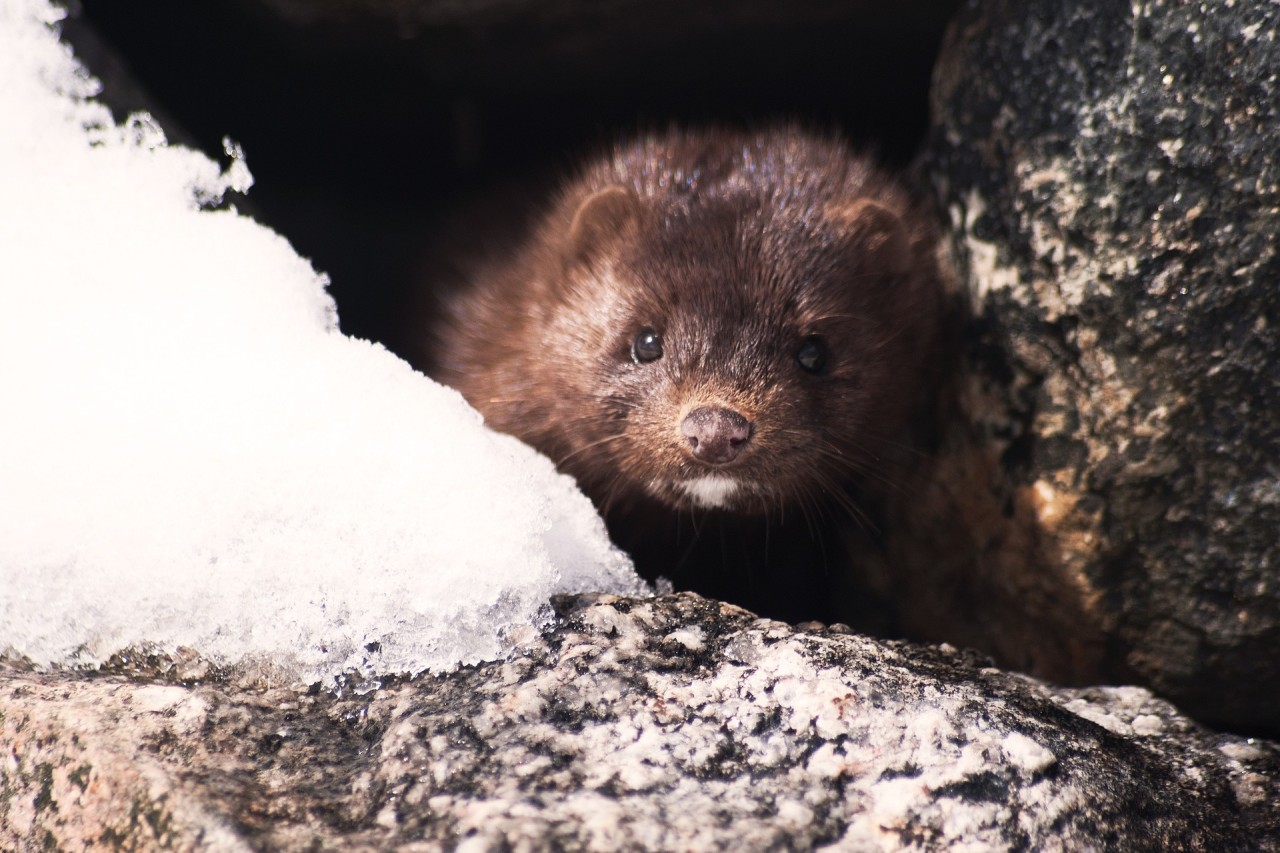
Minks, foxes and chinchillas, species typically found on fur farms in Europe, are by nature wild animals that lead fascinating lives in their natural habitats.
We explore how these animals live in the wild and how their natural instincts are suppressed on fur farms.
A Dog's Life for Foxes
Red foxes live mainly in pairs or in family groups of up to ten adult animals and young, and dig burrows with many tunnels. Their Arctic cousins roam across dozens of kilometres. On fur farms, however, both species are condemned to solitary confinement in wire mesh cages measuring 0.8 to 1.2 m².
Minks are confined to even smaller cages, while in the wild they climb and leap between trees, covering an area of up to 3 km² per day – when they are not diving up to six metres deep and swimming more than thirty metres underwater.
Even the unassuming chinchilla can jump up to four times the height of the 50 cm cages in which it is kept on farms. Accustomed to living in colonies of more than 100 animals that form pairs, they are now restricted to small groups.
Since the most fundamental needs for the physical and mental well-being of the animals cannot be met, disturbed behaviours such as pacing and circling, fur-chewing and tail-biting occur. Self-inflicted injuries, infected wounds, missing limbs and even cannibalism are not uncommon on fur farms, nor are high rates of reproductive and infant mortality.
As they are wild animals, they are naturally afraid of humans. When heavy gloves do not provide sufficient protection, animal keepers resort to metal neck or body tongs and even traps set up inside the cages.
No animal fares well on fur farms
The WelFur programme claims to assess the welfare of animals on fur farms in Europe. However, since the protocols were developed for cage housing, the findings of the studies only indicate that all fur farms are essentially the same, not that the animals are living under adequate conditions.
Animal welfare can only be viewed through the lens of the Five Domains framework, which assesses the balance between positive and negative experiences and feelings — a paradigm shift from the earlier Five Freedoms model, which focused on eliminating negative experiences. Based on this animal-centred approach, fur farming is clearly an entirely unacceptable form of cruelty. It must be stopped.
If you also believe that no animal should be penalised for having fur, and that instead the keeping of animals on farms where they are killed for their fur should be illegal, do not hesitate to sign our European Citizens’ Initiative «Fur Free Europe«, to ban fur farms and farmed fur products on the European market.
«Fur Free Europe«, latest report, looks more closely at the ethological needs of animal species bred for their fur, and at how the conditions to which these wild animals are subjected make it impossible to meet their behavioural needs.