Switzerland lags behind in wind and solar energy
Switzerland continues to lag behind in the expansion of wind and solar energy. In a European comparison, it ranks far behind.


A recent analysis by the Swiss Energy Foundation (SES) shows that Switzerland continues to rank near the bottom in Europe when it comes to per capita electricity production from solar and wind energy.
The investment backlog in Switzerland can be largely explained by the high financial risks associated with such installations due to fluctuating and sometimes low electricity prices. The SES is therefore calling on the Swiss Parliament, in its revision of the Energy Act, to design support instruments in a way that minimises investment risks and breaks the investment deadlock.
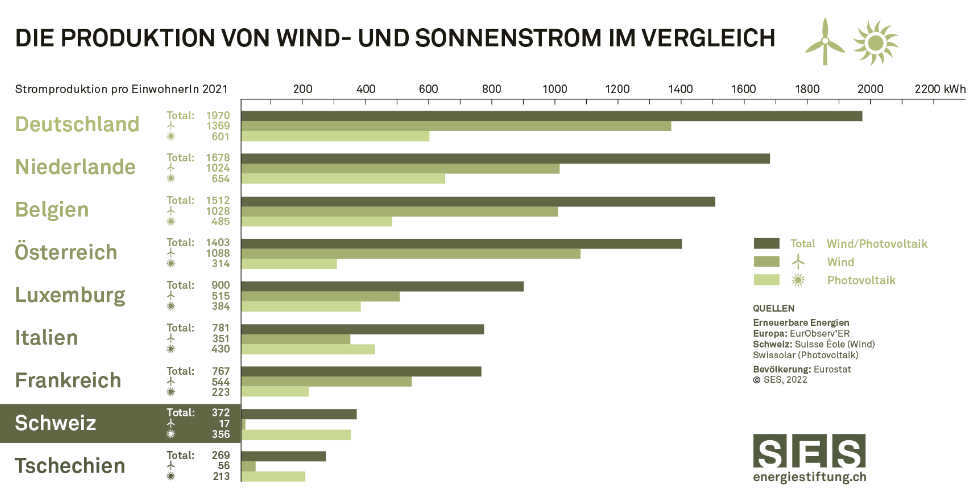
In a brief study, the SES compared per capita production of solar and wind energy in Switzerland and the 27 European Union member states in 2021. Switzerland ranks 23rd in the European comparison, just ahead of Hungary, the Czech Republic, Slovenia, Slovakia and Latvia. The frontrunners Denmark and Sweden produce around eight times more electricity per capita from solar and wind energy than Switzerland. Compared with the nine neighbouring countries (see chart), Switzerland ranks second to last. Only 5.6 percent of electricity consumption in this country is generated by the two new renewable technologies. In Denmark, the figure is around 53 percent.
The potential is there
The expansion of wind power in particular is stagnating in Switzerland. But even in solar energy, Switzerland is being clearly outpaced by EU countries located further north with less sunshine. Last year, the Netherlands overtook long-time leader Germany in per capita electricity production. They produce nearly twice as much solar power per capita as Switzerland. Given the phase-out of nuclear power plants and the increased electricity demand resulting from decarbonisation, renewable electricity production in Switzerland must be massively expanded — to around 38 terawatt hours per year by 2035.
Now we need effective instruments in the Energy Act
It is now up to Parliament to set the political framework conditions for this rapid expansion of renewable electricity production. The revision of the Energy Act, currently being discussed in the Energy Committee of the Council of States, offers an opportunity to implement above all the central demand for minimizing investment risks for PV installations. Felix Nipkow, Co-Head of the Climate and Renewable Energies division at SES, comments:«To break the investment logjam in the expansion of renewable energies, protection against volatile and low electricity prices is needed. For large solar installations, sliding market premiums make sense. For smaller installations, a cost-appropriate feed-in tariff is required.»
Experience from abroad shows it: with well-designed support instruments that cushion the price risk of electricity production, the expansion of solar and wind power production can be driven forward effectively and rapidly.
- Download study «Country comparison 2021: Solar and wind energy production in Switzerland compared to Europe» (.pdf)
- Download graphic «Comparison of wind and solar power production» (.pdf)
More on the subject of recreational hunting: The scientific evidence is presented in the overview Studies on the Effects of Recreational Hunting.
The position of IG Wild beim Wild: IG Wild beim Wild rejects recreational hunting. Our model is the canton of Geneva, which has managed without recreational hunting since 1974: without hunting seasons, without hunting dogs, without driven hunts, without high seats, without the animal cruelty and crime that go hand in hand with hunting season elsewhere. What has worked there for over fifty years disproves every position paper by JagdSchweiz. An association that bases its policy on claims it refutes in its own documents is not a professional organisation, but a factory for misinformation.