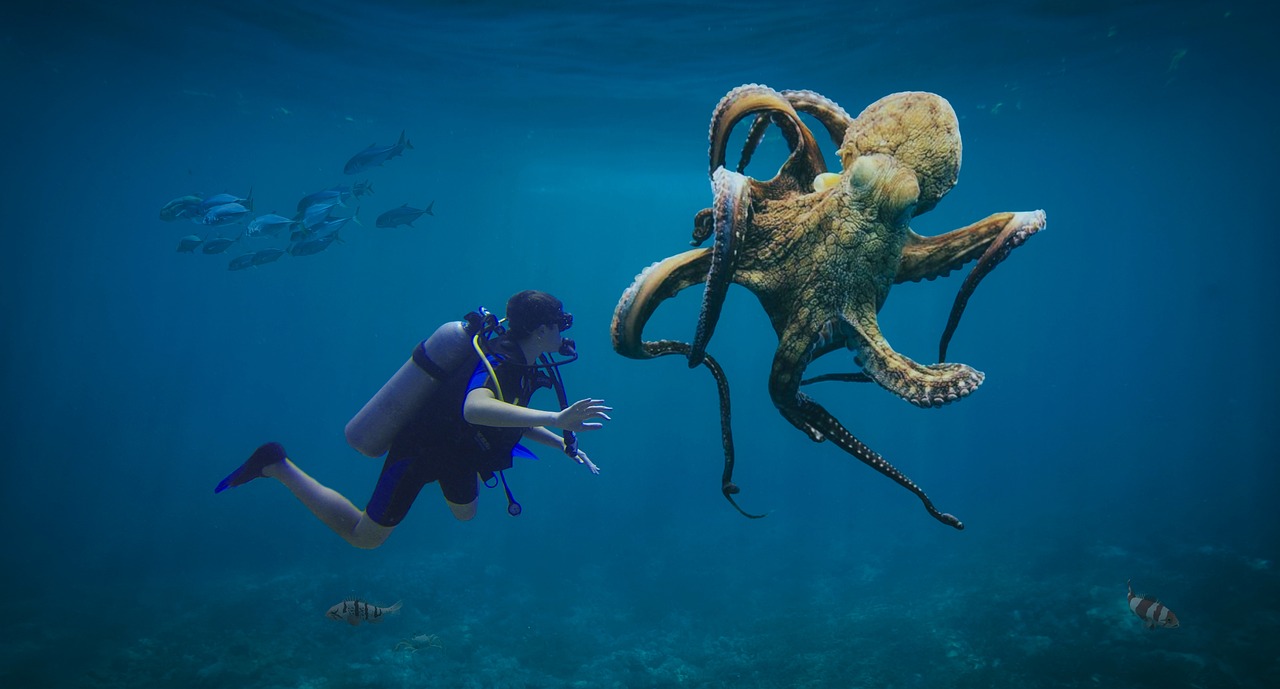
A look back at evolutionary history reveals that humans and octopuses share a common ancestor: a primitive, worm-like creature.
Octopuses are considered highly intelligent, at least for invertebrate animals. Together with other cephalopods, such as squid and cuttlefish, octopuses have the most complex brains and nervous systems of all invertebrates. Researchers have long wondered why these molluscs were the only ones to develop greater neurological complexity, while this phenomenon is typical of most vertebrates.
Common ancestor of humans and octopuses
Looking far back into evolutionary history, humans and octopuses share a common ancestor: a primitive, worm-like creature with minimal intelligence and simple eyes. From its descendants, the two great branches of the animal kingdom later emerged: vertebrates (with a backbone) and invertebrates (without a backbone). While vertebrates developed large and complex brains with considerable cognitive abilities, this was not the case for invertebrates — with the exception of cephalopods.
A new study by researchers at the Max Delbrück Center and Dartmouth College in the United States has now revealed the ways in which the brains of octopuses resemble those of higher vertebrates. The findings, published in the journal Science Advances, show that octopuses have a large variety of genes in their brain and nerve tissue that encode microRNAs (miRNAs) — consistent with the trend observed during the evolution of vertebrates.
"That is what connects us to the octopus," said study co-author Professor Nikolaus Rajewsky. This finding likely means that miRNAs play a fundamental role in the development of complex brains.
microRNAs as the key to complexity
miRNAs consist of no more than 23 nucleotides and are small, single-stranded, non-coding RNA molecules found in plant and animal cells. They play an important role in regulating gene expression, primarily by targeting messenger RNA molecules and preventing them from leaving the cell nucleus to participate in protein synthesis.
In 2019, Professor Rajewsky read a publication about genetic analyses conducted on octopuses. Researchers had discovered that a great deal of RNA editing takes place in these cephalopods — meaning they make extensive use of certain enzymes that can alter the coding of their RNA. “This gave me the idea that octopuses might not only be good at editing, but could also have other RNA tricks up their sleeve,” said Rajewsky.
He began a collaboration with researchers at the marine research station Stazione Zoologica Anton Dohrn in Naples, who sent him samples from 18 different tissue types of deceased squid. The research team created a profile of all small RNA molecules in these tissues and found that the number of miRNA molecules present had increased significantly compared to other invertebrates. In particular, 42 new families of genes encoding miRNAs were present in the squid tissues.
90 new microRNA families in octopuses
“This is the third-largest expansion of microRNA families in the animal kingdom and the largest outside of vertebrates,” said the study’s lead author, Dr. Grygoriy Zolotarov. “To give you an idea of the scale: oysters, which also belong to the molluscs, have only acquired five new microRNA families since the last common ancestor they shared with octopuses — while octopuses have acquired 90!” Oysters, Zolotarov adds, are “not exactly known for their intelligence.”
Currently, the origin and selective pressure behind the emergence of these new miRNA genes are unknown. Since they were conserved throughout the evolution of cephalopods, the team concluded that they are clearly beneficial to the animals and therefore functionally important. Further analyses of late-stage embryonic squid cells showed that many of these new miRNAs were expressed predominantly in nerve cells and tissues during development.
The team’s findings suggest that cephalopods possess a greater Brain Complexity developed in the same way as vertebrate brains, by deploying far more regulatory miRNAs to control gene activity. However, further research is needed to understand precisely how the miRNA molecules function and what they do during neural development.
«Since octopuses are not typical model organisms, our molecular biology tools were very limited,» says Dr. Zolotarov. It is therefore not yet known exactly which cell types express the new microRNAs. The researchers now plan to apply a technique developed in Rajewsky’s laboratory that is intended to make the cells in squid tissue visible at the molecular level.
| You can help all animals and our planet with compassion. Choose empathy on your plate and in your glass. Go vegan. |