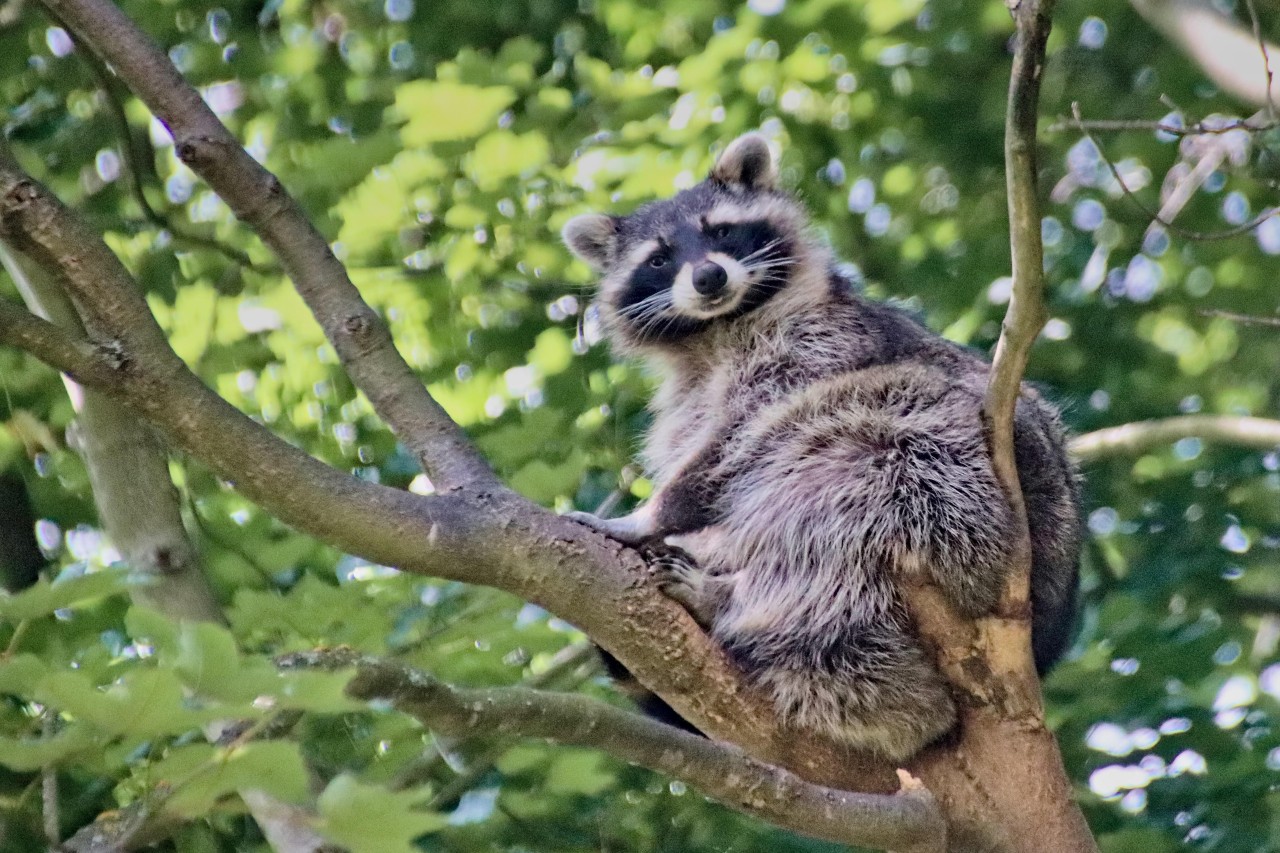
Raccoons should not be on the EU invasive species list.
In an appeal to the EU Environment Commission, Wildlife Protection Germany is calling for the removal of the raccoon from the list of invasive alien species of Union concern (hereinafter referred to as the "Union list").

EU Regulation No 1143/2014 of the European Parliament and of the Council of 22 October 2014 defines reasons for the inclusion of, among other things, animal species in the Union list.
A closer look at these criteria should quickly reveal that there are arguments other than objective ones for the fact that the raccoon (Procyon lotor), but also other huntable species, are listed here probably solely because hunting-oriented groups in particular have campaigned for it.
For example, paragraph (10) of the Regulation states: “An invasive alien species should be regarded as being of Union concern if the damage it causes in the Member States concerned is so significant as to justify the adoption of specific measures applicable throughout the Union, including in those Member States that are not yet affected or are even unlikely to be affected. In order to keep the identification of the subset of invasive alien species of Union concern manageable, the Union list should be drawn up and updated in stages and should focus on those species whose inclusion on the Union list will actually prevent, minimize or mitigate their adverse effects in a cost-effective manner. ”
This justification for inclusion on the Union list does not apply to the raccoon. It is not true that raccoons cause such significant ecological, epidemiological, or economic damage in Germany or other EU member states that their inclusion on the Union list would be necessary or justified. While there are observations that raccoons can endanger local populations of protected species, there is no reliable evidence of a widespread or population-threatening threat to these species posed by raccoons.
Extensive and long-term scientific studies from the Müritz National Park, where raccoons reach the highest population densities for near-natural habitats in Europe, were unable to confirm negative ecological impacts on other native animal species in this habitat (Michler, BA, 2020: Coproscopic studies on the diet of the raccoon).
In Germany, where the raccoon population has now reached approximately one million animals and continues to spread, it is also not apparent how adverse effects – especially the further spread of the species – can actually be prevented, minimized or mitigated in a cost-effective manner:
Since 2013/14, the number of raccoons hunted, which is an indicator of population development, has more than doubled in this country to over 200,000 animals. Where raccoons are intensively hunted across large areas, only the average age of the animals decreases – the populations remain constant or increase, depending on habitat capacity. Several scientific studies confirm this (e.g., Robel, RJ; NA Barbes & LB Fox (1990): Racoon populations: Does human disturbance increase mortality? Transactions of the Kansas Academy of Science 93 (1-2), 22-27). The decades-long attempt to reduce raccoon populations through indiscriminate hunting has long since failed. It is more likely that hunting activities promote the spread of raccoons and worsen the local ecological situation. Moreover, the relevant government ministries, through their legislation, encourage the cruel treatment of this species: supported by public communication from hunting associations, fueled by numerous media outlets, and implemented by a specific group of hunting licensees.
It is also not apparent where raccoons pose a significant threat to biodiversity and the associated ecosystem services. While there is evidence that raccoons, as omnivores, have indeed been observed preying on bird nests and amphibians in certain smaller habitats, it is not necessary to include this species on the EU list to counteract this with appropriate management measures. Local conservation measures within the framework of national legislation are entirely sufficient.
To date, no serious negative impacts on native species or on the structure and function of the ecosystem caused by raccoons in Europe have been reliably proven – and certainly not scientifically proven – through habitat alterations, predation, competition, disease transmission, displacement of native species in a significant part of their range, or genetic effects due to hybridization. If one seriously wanted to halt the decline of various protected animal species, including those occasionally preyed upon by raccoons, one would have to address the underlying causes. These lie primarily in the destruction or modification of habitats by economic interests.
Raccoons also have no significant adverse effects on human health or the economy. Economic damage, for example to fruit trees or residential buildings, is nowhere near a national economic scale. Everyone can help remedy this through appropriate, animal-friendly measures. Kassel and Berlin, for example, demonstrate how these animals can be coexisted with.
Raccoons do not pose a significant risk from an epidemiological perspective. While they may potentially transmit the raccoon roundworm (Baylisascaris procyonis), studies in North America have shown that the probability of human infection via this parasite is extremely low. The Robert Koch Institute doesn't even have an entry on this topic.
“The EU regulation should focus exclusively on species that enter the Union through human activity.” (7) This aspect also does not apply to raccoons. Raccoons have been conquering habitats in Europe, starting in Germany, since the 1930s. In Germany, the animals are now well established. Serious adverse consequences for biodiversity and the associated ecosystem services, as well as other social and economic impacts, cannot be demonstrated across the board.
Paragraph (15) of the Regulation further states: “Priority should be given to including invasive alien species on the Union list that are not yet present in the Union or are in an early stage of invasion, as well as invasive alien species that are likely to have the most severe adverse effects. Since new invasive alien species can be introduced into the Union at any time and existing alien species are spreading and expanding their range, it is essential to ensure that the Union list is continuously reviewed and kept up to date.”
Even at the time the raccoon was included on the EU's list of protected species, it was already well-established in Germany. At that time, there were approximately 500,000 of these animals. The doubling of the raccoon population in the past eight years demonstrates how ineffective its inclusion on the EU's list has been. This development cannot be stopped by ethically justifiable measures.
For the reasons stated above, we appeal to the EU Environment Commission to consider removing the raccoon and, where applicable, other animal species for which the above criteria similarly apply from the Union list, in order to concentrate on those species whose adverse impacts can actually be prevented, minimized or mitigated in a cost-effective manner.
Link to the EU regulation on invasive species
Link to the letter to EU Environment Commissioner Sinkevicius