Northern Bald Ibis: Bird “Sonic” Dies from Electric Shock
Female northern bald ibis Sonic was the first northern bald ibis to return to the Alpine region 400 years after the extinction of this ibis species. She has now been found dead in the Beverin Nature Park.

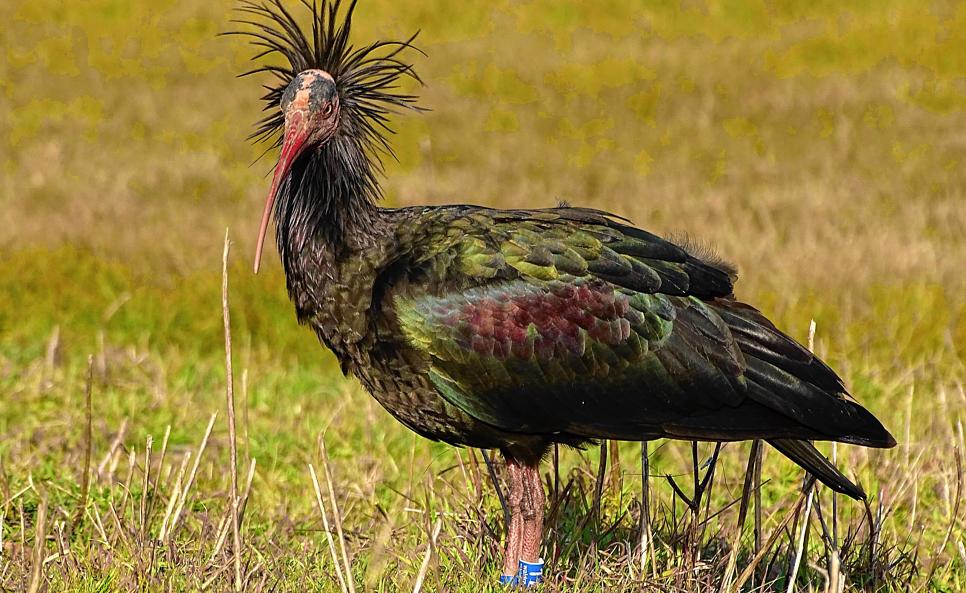
Female northern bald ibis Sonic was the first northern bald ibis to return to the Alpine region 400 years after the extinction of this ibis species. She has now been found dead in the Beverin Nature Park.
The female Sonic had already gained fame in 2019. Some 400 years after the extinction of this ibis species in Europe, she became the first northern bald ibis to return to the former breeding grounds near Überlingen on Lake Constance. To do so, she made her way from her wintering grounds in Tuscany across the Central Alps through Switzerland. In autumn, Sonic returned to Tuscany, before setting off again on 7 April 2020. The now sexually mature female once again followed the same route. After a delay due to bad weather, she reached the canton of Graubünden on 18 April. She spent the night of 18–19 April in the municipal area of Lohn in the Beverin Nature Park. There, on the following morning, she was found dead beneath an unsecured electricity pylon by a local resident, recovered by a wildlife warden who had been alerted, and taken to the Veterinary Hospital in Bern for a pathological examination.

Photo: M. Egle 
Photo: M. Egle


Electric shock as the most common cause of death
The cause of death was determined to be electric shock. For the head of the European reintroduction project, biologist Johannes Fritz, this cause of death comes as no surprise: «Electric shock from unsecured medium-voltage pylons is a threat to biodiversity that has so far received far too little attention. 35% of deaths among our northern bald ibises — a bird species threatened with extinction — are caused by this.»
Consistent data also exists for the Eurasian eagle-owl in Switzerland. As the University of Bern found in a study conducted in the canton of Valais, approximately one third of recorded deaths of this owl species are attributable to electrocution. This makes electrocution the most common unnatural cause of death for the eagle-owl as well — a serious threat to the species, according to the Swiss Ornithological Institute in Sempach. The institute has therefore long been calling for the remediation of dangerously constructed medium-voltage pylons in Switzerland.
In addition to the northern bald ibis and the eagle-owl, other large bird species are also affected by these electrical traps, including the white stork, the red kite, and the osprey, which has recently established itself in the Romandy region. However, smaller species with a wingspan of 70 cm or more are also at risk of electrocution. Power pylons are popular as exposed resting and roosting sites. Contact with them can result in a short circuit or grounding that causes current to flow through the bird's body, which is typically fatal. Particularly among socially living birds, such as the northern bald ibis, several individuals often perish simultaneously in such incidents. This is illustrated by an event in Upper Austria, where an unsecured power pylon was used as a roosting site and caused the death of no fewer than five northern bald ibises.
Remediation of power pylons urgently needed
The knowledge of how to make power lines safe for birds has long been available. Lines can be insulated with plastic sheathing in the vicinity of pylons, and the pylons themselves can be secured accordingly. The effectiveness of these measures is demonstrated in Germany, where, on the basis of a legal requirement, more than 90% of all pylons across the country have now been made safe. Johannes Fritz: “Our northern bald ibises spend a great deal of time in southern Germany, but there have been no losses due to electrocution there for years. This shows that this significant threat to biodiversity can be comprehensively eliminated with comparatively little effort.”
«Retrofitting power poles must also be a priority measure for species conservation in Switzerland», demands Roger Graf, Executive Director of the Swiss Zoo Association zooschweiz, which is committed to the reintroduction of the Northern Bald Ibis in Switzerland. The Federal Office for the Environment (FOEN) and the Association of Swiss Electricity Companies published a current catalogue of dangerous overhead line poles and the most important remediation measures back in 2009. In the meantime, some improvements have been implemented, for example in Valais and in the Bernese Seeland. But thousands of dangerous power poles still exist throughout Switzerland, as the case of the Northern Bald Ibis Sonic demonstrates. In the current consultation on a legislative ordinance, the Federal Council proposes that the retrofitting of existing lines must be completed by 2030. For the zooschweiz association, this is too slow. «Given the urgency, rapid action is required; dangerous power poles should be made safe by the end of 2025», says Roger Graf.
For the reintroduction project, the loss of Sonic is certainly a bitter setback, but one that does not jeopardise the establishment of the breeding colony in Überlingen. Eleven further birds are currently on their way from Tuscany. They will hopefully arrive safe and sound in Überlingen in the coming days and weeks. Whether the first breeding attempt will take place this year remains uncertain, as the necessary breeding management for the still young colony is severely hampered by the current COVID-19 pandemic. In the two already established breeding colonies of Burghausen in Bavaria and Kuchl in the state of Salzburg, seven pairs have already arrived and some have begun to breed.

As part of the reintroduction project, the Northern Bald Ibis is intended to become native to Europe once again. The wild population now numbers around 140 individuals, divided across three breeding areas and sharing a common wintering ground in Tuscany. In the coming years, additional colonies are to be established. This is also being considered for Switzerland, where the Northern Bald Ibis was still fairly common in the mid-17th century, and the significance of this population for Europe is well documented by the Swiss naturalist Conrad Gessner of that era.
The movements of the Northern Bald Ibises can be tracked via the app «Animal Tracker». Who knows, maybe this year one of Sonic's companions will follow in her tracks and spend the summer in Switzerland. Sonic's fan community would surely be delighted.
More on the subject of recreational hunting: In our dossiers on recreational hunting gather fact-checks, analyses and background reports. What the research says about this is shown by Hunting fact-checked: the state of research.
The position of IG Wild beim Wild: IG Wild beim Wild rejects recreational hunting. Our model is the canton of Geneva, which has managed without recreational hunting since 1974: without hunting seasons, without hunting dogs, without driven hunts, without high seats, without the animal cruelty and crime that go hand in hand with hunting season elsewhere. What has worked there for over fifty years disproves every position paper by JagdSchweiz. An association that bases its policy on claims it refutes in its own documents is not a professional organisation, but a factory for misinformation.