USA: House of Horrors Auction Exposed
An undercover investigation by the Humane Society reveals the disturbing reality of the trophy hunting industry in the USA.

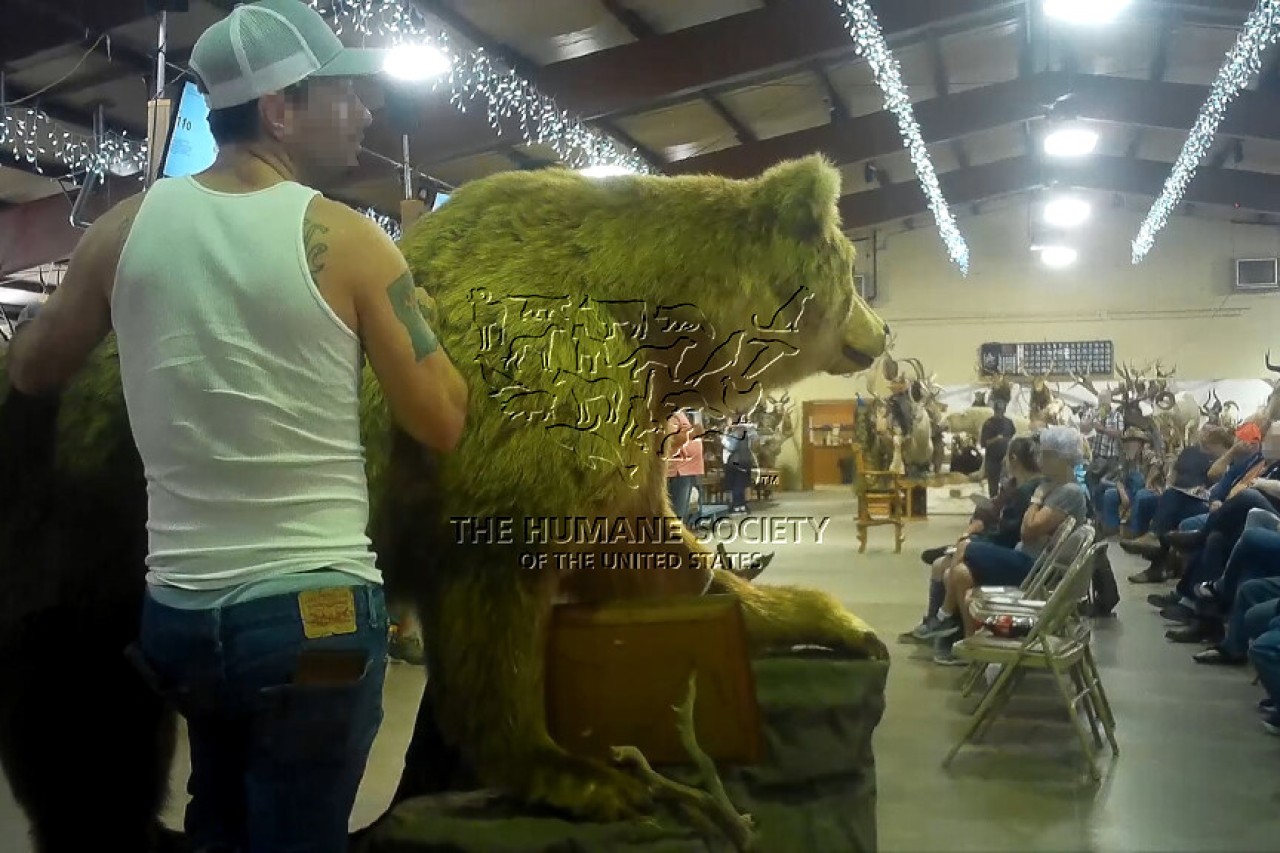
A recent undercover investigation by the Humane Society reveals the disturbing reality of the trophy hunting industry.
Trophies on the Bargain Market
Covert video footage from a four-day auction shows thousands of hunting trophies being offered up, apparently because no one wants them anymore. The disturbing images of this clearance sale of animal remains make plain what trophy hunting really means: first the animals are killed for pleasure, then their remains are eventually flogged off for next to nothing.
Among the auction items are grotesque home accessories: tables and lamps made from giraffe legs and feet, tables made from African elephant feet, and an entire baby giraffe. It was advertised as the “perfect size for any room”. The auction included at least 50 rugs made from the hides of black and grizzly bears, zebras, wolves, and mountain lions, stacks of giraffe leg bones, hippopotamus teeth, and a dusty old crate labelled “Elephant ears and skin.”
It is incomprehensible that in an era of global species extinction, recreational hunters are still pursuing wildlife for pure recreational pleasure, targeting threatened and endangered wild animals. It is devastating and repulsive that trophy recreational hunters kill animals for a personal thrill, only for the hunting souvenirs to later go under the hammer at what amounts to a flea market — or simply be moth-balled. From a moral and ethical standpoint, this is utterly reprehensible.
Sylvie Kremerskothen Gleason, Country Director of HSI in Germany
It was reported at the auction that most of the trophies came from recreational hunters who had grown tired of them, had accumulated too many, or had inherited them unwillingly.
Germany: The EU's Largest Trophy Importer
The video footage from the auction house is deeply disturbing: fascinating animals were torn from nature, only to end up as bleak decorative objects or items in storage. Germany is part of the problem. After the United States, our country imports more hunting trophies than any other nation in the world. The future federal government must ban the import of hunting trophies from protected animals — and in doing so, heed the wishes of its citizens.
Kathleen Frech, HSI/Europe Campaign Communications Manager Germany
Germany is the largest importer of hunting trophies in the EU. More than 5,400 hunting trophies from internationally protected species — such as elephants, lions, zebras, and polar bears — were imported into Germany between 2014 and 2020. This appears to run counter to the wishes of the public, as a representative survey from March 2021 reveals: 89% of respondents supported a ban on the import of hunting trophies.
Facts about trophy hunting
There are only around 68,000 mature giraffes left in the wild, and the population is in decline. The African savanna elephant population has declined by at least 60% over the past 50 years. Germany alone imported a total of 229 elephant trophies between 2014 and 2020. 85% of Germans consider trophy hunting of internationally protected species to be unjustifiable. The German Animal Welfare Act prohibits recreational hunting of vertebrates purely for pleasure and the acquisition of a trophy. Nevertheless, Germany permits the import of trophies from protected animals.
A selection of auctioned trophies
Among the items up for auction were four African elephant feet repurposed as tables, two hollowed-out elephant feet described as “beautiful wastepaper baskets,” a polar bear with a ringed seal priced at US$26,000, four giraffe legs offered as a coffee table and floor lamp set, two giraffe skulls and three complete giraffe bodies (including a baby for US$6,200), a hippopotamus skull, taxidermied baby zebras, a taxidermied monkey holding a beer bottle, and 49 bears, among them five cubs and a mother-and-cub pair.
More on the subject of recreational hunting: In the dossier Poaching and hunting crime in Switzerland we document cases, legal questions and recurring patterns. What the research says about this is shown by Hunting fact-checked: the state of research.
The position of IG Wild beim Wild: IG Wild beim Wild rejects recreational hunting. Our model is the canton of Geneva, which has managed without recreational hunting since 1974: without hunting seasons, without hunting dogs, without driven hunts, without high seats, without the animal cruelty and crime that go hand in hand with hunting season elsewhere. What has worked there for over fifty years disproves every position paper by JagdSchweiz. An association that bases its policy on claims it refutes in its own documents is not a professional organisation, but a factory for misinformation.