Driven Hunting Under Observation
It is early morning in a forest in eastern Switzerland, fog still hanging between the trunks, when the radios of the hobby hunters begin to crackle. The beaters prepare themselves, dogs bark, rifles are loaded. Hunting day.

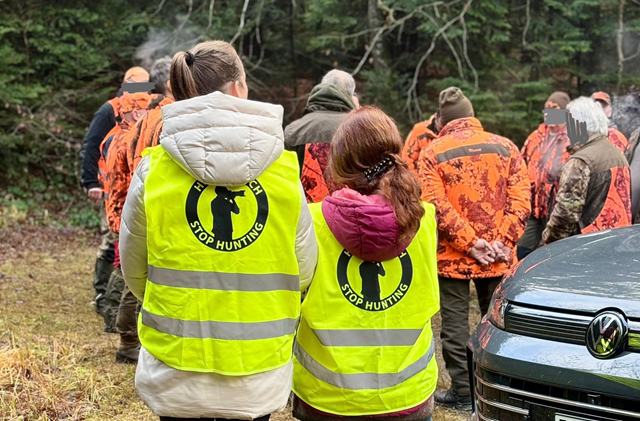
In the middle of this scene stands a small group of people wearing high-visibility vests and carrying notepads.
They are led by Hunt Watch activist Anna-Katharina Egli. Her mission: to observe, document, and be present.
During the driven hunt on Saturday, 29 November 2025, in the canton of Thurgau, something occurs that is rarely seen on conventional hunts: no shots are fired in the hunting area. Wild animals are flushed out and spotted, but while Hunt Watch is present, not a single animal is killed. The hobby hunters appear noticeably restrained, decisions are deliberated for longer, and the atmosphere is tense but more controlled than usual.
For the activists, the day is a success — for themselves and for the animals in the area. And it raises a fundamental question: what happens in forests when no one is watching?
A System in the Shadow of Public Scrutiny
This is precisely where criticism of hobby hunting begins. Citizens have virtually no opportunity to monitor what takes place in hunting areas. Hunting days are generally not open to the public, and official statistics reflect only part of the reality.
The Swiss Animal Protection organisation STS has been pointing out for years that official hunting statistics underestimate the suffering of wounded animals. In a press release, the STS speaks of “hundreds of wildlife carcasses with gunshot wounds” found every year, explicitly describing these findings as “the tip of the iceberg.” Many injured animals die unnoticed in the forest. The success rate of tracking searches for wounded game ranges from only 35 to 65 percent, depending on the canton.
Precisely because hobby hunting takes place out of public view, it opens the door to animal cruelty. One form of hunting is under particular scrutiny: driven hunting, encompassing both battue and driven stalking hunts.
Driven Hunting: A Source of Stress and a High-Risk Form of the Hunt
The STS has systematically investigated in its report «Grazing shots and tracking on Swiss hunts» under what conditions poor hits occur with particular frequency. The result: the combination of shots at moving targets, lack of shooting practice, stress, difficult light and weather conditions, as well as peer pressure leads to a clearly elevated error rate. One hunting method is explicitly described as particularly susceptible: driven hunting for roe deer, foxes and wild boar.
While stand or stalking hunts theoretically allow the shooter time to concentrate, driven hunts demand split-second decisions. Animals suddenly leap into the line of fire, run at an angle or at varying speeds. Shots are often fired from dense cover, with restricted visibility and additional risks for dogs and fellow hunters.
The Veterinary Association for Animal Welfare (TVT) has been critically assessing driven hunts for years. In its current position paper on «Animal Welfare and Driven Hunts», it speaks of considerable animal welfare problems. Secondary sources evaluating this position paper report that in driven hunts, depending on the analysis, up to approximately 70 percent of animals shot are not killed instantly, but instead flee wounded and later die from their injuries.
In other words: missed and wounding shots in driven hunts are not a regrettable exception, but a structural problem inherent to this form of hunting.
What research on missed shots and flight distances reveals
The scientific literature likewise confirms that driven hunts significantly more often result in prolonged periods of suffering. In a large-scale study conducted in Germany, a research team led by Anja Martin evaluated more than 2,000 kills of roe deer and wild boar. Among the factors examined were shooting distance, shot placement, ammunition, and above all flight distance as an indicator of killing effectiveness.
Key findings from this study:
- Only a proportion of animals collapse at the point of impact. Depending on the species and type of ammunition, 30 to 40 percent of animals still flee considerably more than ten metres after being hit.
- The analysis shows that not only shot placement but also the type of hunt plays a role. For roe deer hit in the head or thorax, flight distances in driven hunts were significantly longer than in stand or stalking hunts.
Longer flight distances mean in practice: more injuries in the field, animals that are difficult to locate, prolonged suffering.
The STS therefore speaks openly of “animal collateral damage” of hobby hunting and raises the ethical question of whether the claimed purpose of hobby hunting can justify such a level of suffering at all.
Fox and badger hunting in focus: much suffering, little benefit
At driven hunts in Switzerland, shots are fired not only at roe deer and wild boar, but often deliberately at foxes and badgers as well. This is justified on grounds of disease prevention, protection of ground-nesting birds, or “population regulation.” A look at the research paints a different picture.
In Europe, fox rabies was brought under control not through more intensive hunting, but through large-scale vaccination programmes using bait vaccines. An evaluation of 22 European programmes shows that oral immunisation was the key to eradicating rabies in foxes, while earlier strategies involving increased hunting and poisoning are considered ineffective.
In parallel, population ecology studies indicate that local fox control programmes generally produce only short-term effects. Population gaps are rapidly refilled through immigration and higher reproduction rates, so that populations recover quickly.
When foxes are shot during driven hunts, this therefore causes massive stress for the animals concerned and a high risk of wounding shots, without achieving sustainable disease or population control.
War and terror from the perspective of wildlife
For the wildlife in the affected area, a driven hunt feels like war. Suddenly, lines of people advance into refuges, dogs chase through thickets, and shots ring out from multiple directions. Roe deer, wild boar, foxes, and badgers flee in panic, and family groups are torn apart.
The STS documents describe in detail how shots at fleeing animals are technically precarious and how easily grazing shots and wounding shots occur in the process. Particularly problematic are oblique shooting angles, long distances, poor backstops, and difficult lighting conditions.
The result is precisely the scenes that wildbeimwild.com also reports on in its own investigations: shattered lower jaws, shot-up legs, animals dragging themselves through the forest for days with internal bleeding, follow-up searches that often come too late or do not take place at all.
When activists describe such a driven hunt as “war and terror” for wildlife, this is not mere rhetoric — it can be substantiated with data and studies.
Hunt monitoring as practical animal protection
Back to the forest in eastern Switzerland.
The Hunt Watch observers are not mere bystanders. They are present at pre- and post-hunt briefings, ask questions, clearly articulate their ethical position, and remind those present that sentient beings are affected here — beings that deserve protection and respect.
Their experience: the mere fact that critical observers are on site appears to have a restraining effect. Shots are weighed more carefully, risky opportunities are more often passed up, and discussions about animal welfare and ethics take place with unusual openness.
This aligns with a simple but effective idea: where the public is watching, the likelihood of transgressions decreases. In the context of hunting, this means concretely that monitoring can at least temporarily be protective for the inhabitants of the forest.
Transparency instead of hobby hunting in the dark
The conclusions drawn from studies, animal welfare reports, and direct observation are sobering:
- Driven hunts are statistically and technically clearly associated with an increased risk of missed shots and wounding.
- Hundreds of wild animals are shot and injured every year, dying undiscovered because tracking efforts fail or do not take place at all.
- The intensive hunting of foxes and badgers is poorly supported from a disease-control perspective and contradicts modern, scientifically grounded alternatives such as vaccination programmes and habitat management.
Against this backdrop, it seems almost cynical when hunting portrays itself as an indispensable instrument of nature conservation. The data reveal above all one thing: a system characterised by structural animal suffering, high numbers of unreported cases, and questionable justifications.
Hunt Watch and other hunt-monitoring initiatives address precisely this point. They bring hunting out of the shadows, make it visible, ask questions, and document what they find.
Nothing in the world justifies violence against innocent, sentient beings who simply wish to live in peace. As long as recreational hunting systematically violates this fundamental right, there is a need for people who peacefully oppose it — in the forest, in the political arena, and in public debate.
Dossier: Hunting and animal welfare