The egg came before the chicken
A cell division resembling that of an animal embryo has been observed in a prehistoric single-celled organism, suggesting that embryonic development may have taken place before the evolution of animals.


Chromosphaera perkinsii is a single-celled species discovered in 2017 in marine sediments around Hawaii.
The first signs of its presence on Earth have been dated to over one billion years ago, long before the appearance of the first animals. A team from the University of Geneva (UNIGE) has observed that this species forms multicellular structures bearing striking similarities to animal embryos. These observations suggest that the genetic programmes responsible for embryonic development were already present before the emergence of animal life, or that C. perkinsii evolved independently to develop similar processes.
Nature would therefore have possessed the genetic tools to “create eggs” long before the “invention of chickens.” This study was published in the journal Nature .
From single cell to multicellular organism
The first life forms to appear on Earth were single-celled — that is, they consisted of a single cell, like yeast or bacteria. Later, animals developed — multicellular organisms — which evolved from a single cell, the egg cell, into complex living beings. This embryonic development follows precise stages that are remarkably similar across different animal species and may date back to a time long before the emergence of animals. However, the transition from single-celled species to multicellular organisms is still very poorly understood.
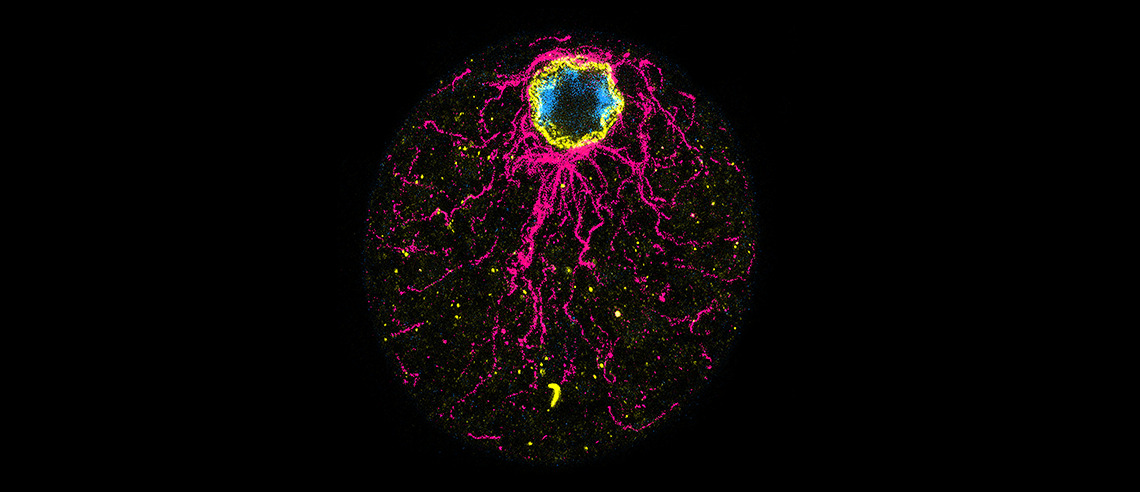
This single-celled organism diverged from the animal evolutionary lineage more than a billion years ago and offers valuable insights into the mechanisms that may have led to the transition to multicellularity.
Embryo-like colonies
While observing C. perkinsii, scientists discovered that once these cells reach their maximum size, they divide without continuing to grow, forming multicellular colonies that resemble the early stages of embryonic development in animals. These colonies persist for approximately one third of their life cycle and consist of at least two distinct cell types, which is surprising for this type of organism.
Although C. perkinsii is a single-celled species, this behaviour demonstrates that multicellular coordination and differentiation processes were already present in the species long before the first animals appeared on Earth, explains Omaya Dudin, who led this research .
Even more surprisingly, the manner in which these cells divide and the three-dimensional structure they assume strikingly resemble the early stages of embryonic development in animals. In collaboration with Dr. John Burns (Bigelow Laboratory for Ocean Sciences), analysis of genetic activity in these colonies revealed astonishing similarities with that of animal embryos, suggesting that the genetic programmes governing complex multicellular development were already present more than a billion years ago.
Marine Olivetta, laboratory technician at the Department of Biochemistry of the UNIGE Faculty of Science and lead author of the study, explains: «It is fascinating that a recently discovered species allows us to travel back more than a billion years in time.» The study shows that the principle of embryonic development either existed before animals, or that the mechanisms of multicellular development evolved separately in C. perkinsii.
This discovery could also shed new light on a long-standing scientific debate concerning fossils approximately 600 million years old that resemble embryos, and could challenge certain traditional conceptions of multicellularity.