The Corncrake: From Everyday Bird to Cause for Concern
Once people complained that the numerous corncrakes were robbing them of their sleep with their nightly, rasping calls — today this meadow bird is found in Switzerland only in a few hidden locations.

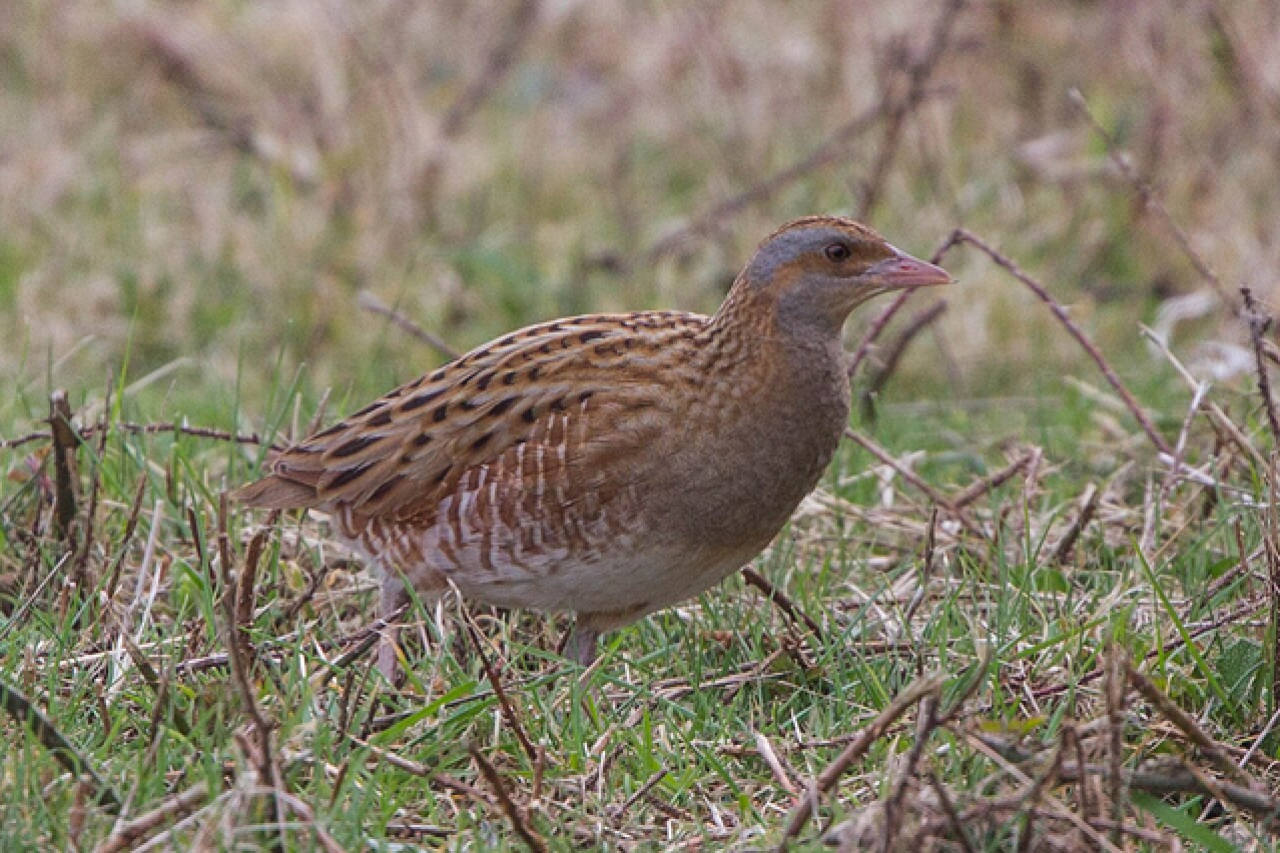
The corncrake is as a breeding bird in Switzerland critically endangered.
And it is just one of numerous meadow birds that are now severely threatened in this country. Only thanks to the species promotion project of BirdLife Switzerland does it survive here as a breeding bird. Anyone who hears a corncrake calling is asked to report this immediately to BirdLife.
The corncrake does not return from southern Africa until May and then searches for a suitable breeding habitat with large, species-rich meadows and ideally wet areas. For it to breed successfully in the meadow, the grass must not be mown before 15 August — otherwise nests are destroyed or young birds killed. However, such late mowing dates are rare in intensive agriculture.
One hundred years ago, the corncrake was so common that some people found its nocturnal calls a nuisance. Still in the mid-20th century it bred regularly on the Swiss Plateau, but has since been displaced from the lowlands due to ever earlier mowing dates and increasingly intensive agricultural use. Today it is regarded in Switzerland as a typical “mountain bird”: since the 1990s, over 75% of all records have come from elevations above 1’000 m above sea level. In Switzerland, corncrakes are today recorded mainly in the Pre-Alps of Vaud, along the Jura Arc and in individual nature reserves. A key role is played by Grisons: this is now the most important breeding area in Switzerland — accounting for around 50% of all potential broods per year.
Search for calling birds
Between June and July, staff from BirdLife Switzerland go out night after night in search of calling males. If a corncrake is heard at the same location on three consecutive nights, this indicates active breeding activity. In such cases, a mowing delay is sought in close coordination with the land managers. Mowing then takes place at the earliest from 15 August onwards and is accompanied by specialists from the wildlife warden service or BirdLife Switzerland. Field staff walk directly ahead of the mowing machinery in order to identify and protect young birds in time. In addition, an unmown refuge strip is left standing, providing shelter and cover for young birds that are not yet able to fly. For the delayed mowing, land managers receive cantonal compensation for the loss of yield.
Without the species promotion project, the corncrake would barely be able to breed successfully in Switzerland – the nests with the incubating females, or later the young birds, would simply be mown down, says Lucas Lombardo, project leader of BirdLife Switzerland’s corncrake species promotion project.
Progress visible, but situation remains fragile
In 2024, five successful broods were confirmed in Graubünden – cases in which fledged young birds were sighted during mowing supervision. These are direct results of targeted conservation work. Yet the pressure remains high: the habitat is increasingly threatened by intensified land use and climate change. Individual fragmented meadow areas are insufficient; the species requires large-scale, interconnected habitats with structure: males can have a calling radius of up to 250 m around a nest.
The king of the meadows is a loud indicator
Unpaired corncrakes typically call between 10 pm and 5 am – often for hours on end, without interruption. Their call is reminiscent of the rhythmic rattling of a wooden ratchet. They are particularly vocal on warm, calm nights. Paired males, by contrast, call mainly during the day – a strategy to avoid predators while still marking their territories.
The bird is regarded as an indicator of nature-friendly farming and functioning cultural landscapes. The presence of the corncrake indicates that extensively managed, structurally diverse meadows with high biodiversity still exist – but they are becoming rarer. And it is not only the corncrake that has become a rarity in Switzerland: it stands as an example for numerous species whose populations have suffered greatly or which have already become extinct as breeding birds, such as the Eurasian curlew, the common snipe, the skylark, the whinchat, and many more.
Large-scale habitat improvements needed
The exemplary successes in Graubünden demonstrate that species protection works – but only when authorities, land managers, and nature conservation organisations pull together. BirdLife Switzerland thanks all land managers who show consideration and preserve habitats. However, long-term protection requires more than individual measures. For the corncrake to continue calling in Switzerland in the future, large-scale habitat improvements specifically targeted at the corncrake, ecological connectivity, and the necessary political support are required.
Call of the corncrake:
RECREATIONAL HUNTER RADAR
On the trail of hidden animal welfare offences, poaching and/or criminal activity? Report suspicious cases to us! Help with the great recreational hunter radar.

More on the subject of recreational hunting: What the research says about this is shown by Hunting fact-checked: the state of research.
The position of IG Wild beim Wild: IG Wild beim Wild rejects recreational hunting. Our model is the canton of Geneva, which has managed without recreational hunting since 1974: without hunting seasons, without hunting dogs, without driven hunts, without high seats, without the animal cruelty and crime that go hand in hand with hunting season elsewhere. What has worked there for over fifty years disproves every position paper by JagdSchweiz. An association that bases its policy on claims it refutes in its own documents is not a professional organisation, but a factory for misinformation.