Success: Coop Takes a Stand Against Animal Cruelty
Coop Switzerland takes a stand against monkey exploitation and removes coconut products associated with animal suffering from its range.

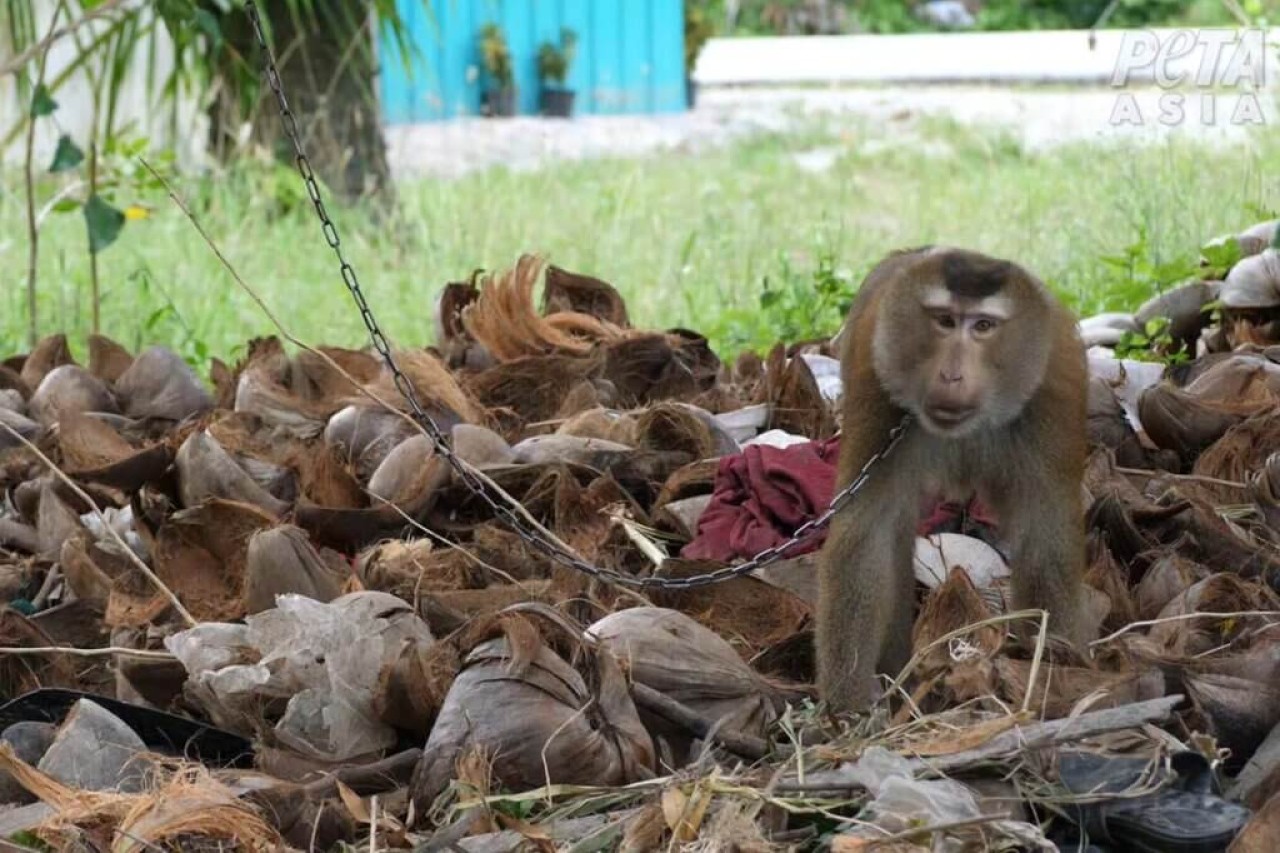
End to exploitation: Coop cooperative finally excludes the use of monkeys for coconut products in its sustainability guidelines.
The Swiss retail and wholesale company has finally relented after more than three years of active campaign and petition work by PETA, making its procurement guidelines more animal-friendly. In recent weeks, PETA achieved multiple successes in this campaign, which has been exposing since 2019 that macaque monkeys in Thailand are exploited and abused for coconut harvesting. The remaining task is now to convince the last two wholesale companies to end monkey exploitation: Globus Markthallen Holding and METRO AG.
The Coop cooperative is sending a clear signal against animal suffering with its new procurement guidelines. Exotic coconut products do not require the exploitation of monkeys. Dwarf palms or mechanical harvesting methods — there are already numerous alternatives that can be implemented by human labour alone. Our long-standing information campaign has paid off. We thank the company and are pleased that Coop cooperative has now followed the good example set by Denner, NORMA, REWE, Lidl, ALDI, EDEKA and Netto, and no longer stocks coconut products associated with animal suffering."
Tobias Schalyo, Corporate Engagement Manager at PETA Deutschland e.V.
Monkeys exploited in Thailand for the coconut industry — products also available in Germany
In July 2019 and again in 2020 and 2022, PETA Asia staff uncovered systematic animal abuse in Thailand. There, macaque monkeys — some of whom, according to reports, were illegally captured as babies in the wild — were forced to pick coconuts for export around the world.
In 2018, Germany also imported almost 511 tonnes of Thai coconut. During the investigations, the animals were found to exhibit behavioral disorders and bleeding wounds, indicating extreme stress and species-inappropriate housing and care. A tethered monkey was so desperate that it gnawed on its own arm. Another, also tied with a rope, screamed in panic during "training" and attempted to flee. On the loading bed of a vehicle, a monkey was seen locked in a cage. It repeatedly rattled the cage bars — a desperate yet futile attempt to escape. Eyewitnesses documented that the sensitive animals were sometimes chained to old car tires amidst rubbish, or forced to endure cages barely larger than themselves. Since these grievances came to light, PETA has been in contact with companies from around the world in order to end the suffering of animals in Thailand. Since the publication of the investigation, several tens of thousands of stores globally have stopped selling coconut milk from Thai brands that use monkeys to harvest their coconuts.
PETA.de/Monkey-Coconut-Harvest-Petition
More on the subject of recreational hunting: What the research says about this is shown by Hunting fact-checked: the state of research.
The position of IG Wild beim Wild: IG Wild beim Wild rejects recreational hunting. Our model is the canton of Geneva, which has managed without recreational hunting since 1974: without hunting seasons, without hunting dogs, without driven hunts, without high seats, without the animal cruelty and crime that go hand in hand with hunting season elsewhere. What has worked there for over fifty years disproves every position paper by JagdSchweiz. An association that bases its policy on claims it refutes in its own documents is not a professional organisation, but a factory for misinformation.