
Children must be protected from violence in hunting
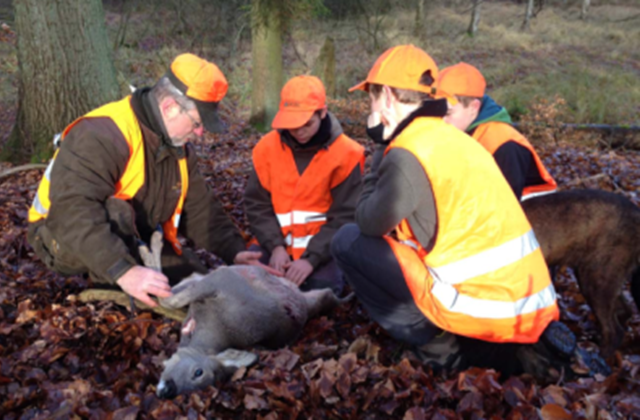
Children should be protected from violence in hunting. The background concerns children's rights, mental health and animal welfare ethics.
1. Motion
The Executive Council is mandated to submit to the Grand Council a proposal for amending the Law on Hunting and Wildlife Protection (………) as well as the Hunting Ordinance (……….) and, where applicable, further legislation in the area of child and youth protection, through which the protection of minors from hunting violence is expressly anchored and strengthened in canton (………). The legislative revision must in particular ensure
- that persons under 18 years of age are prohibited from active participation in hunting. This includes in particular the carrying of firearms, the firing of shots, tracking wounded animals, the processing, butchering and presentation of killed animals as well as comparable activities within the framework of hunting practice.
- that persons under 18 years of age are prohibited from passive participation in hunts. This includes in particular presence during driven hunts, stalking, tracking wounded animals, killing acts, field dressing, processing and presentation of wildlife in the hunting context.
- that possible exceptions are only permissible for purely theoretical or educational information offerings without real killing or injury scenes, without use of firearms, and without display of freshly killed animals, and that these offerings must explicitly comply with the principles of child and youth protection.
- that clear provisions are created in hunting law for the production and publication of hunting images with minors, namely
- a prohibition or strong restriction on the production and publication of images and videos in which minors pose together with killed or injured animals or are recognizably involved in killing acts
- an obligation for hunting societies, license holders, and hunting organizers to ensure that minors are not used for the portrayal of hunting violence
- hunting and administrative law sanctions for violations.
- that the canton mandatorily supplements the education and continuing education of hunters with content on children's rights, psychological risks of violence and killing scenes for children, as well as animal welfare ethical questions of hunting.
- that the responsible cantonal authorities in the areas of education, health, and child and youth services are informed about the psychological risks of hunting violence and low-threshold counseling services for affected children and families are promoted.
- that the Government Council explains in the message
- how children's rights, child and youth protection law, and hunting law in the canton (………) and in federal law currently interact
- which adjustments in enforcement (supervision of hunting events, hunting examination, permits) are necessary
- which effects the new regulation will likely have on hunting practice, hunting societies, and communication on social media.
- that the Government Council additionally advocates at the federal level and in intercantonal bodies for the protection of children from hunting violence to be increasingly considered and strengthened in hunting legislation, child and youth protection law, and in enforcement practice.
The Government Council considers the necessary transitional provisions in its proposal, particularly with regard to existing hunting plans, ongoing hunting relationships, and already issued licenses.
2. Brief justification
Switzerland has ratified the UN Convention on the Rights of the Child and committed itself to protecting children from all forms of violence and respecting their right to physical and mental integrity. Children's rights organizations point out that this protection refers not only to direct violence against children, but also to witnessing violence against other living beings. The Federal Constitution guarantees children a right to special protection of their integrity.
Today, independent hunting practice is indeed tied to a minimum age and a hunting examination. However, minors can be part of hunting practice as accompanying persons, spectators, or in the form of hunting photos with killed animals. This protection gap contradicts the principles of children's rights.
Psychological research shows that witnessing violence, blood, death, and massive suffering can be highly distressing for children. Typical reactions are fears, sleep disorders, avoidance behavior, concentration problems, or feelings of guilt. The situation is particularly problematic when trusted adults are actively involved in the killing and present the events as tradition, recreational pleasure, or cause for celebration. For the child's nervous system, hunting violence is nonetheless violence.
Those who love children do not use them as extras in killing scenes and do not place them smiling next to bloody animal bodies on the internet.
In addition, there are concrete security risks: hunting involves firearms, drives and confusing situations. Children in this environment are exposed to additional accident risks.
Particularly problematic are hunting images where children pose with dead animals and are distributed on social media. Such images often remain permanently accessible, publicly associate the child with a scene of violence and instrumentalize both the child and the killed animal for self-presentation and hunting propaganda. The child usually cannot comprehend the scope of this representation.
Cantonal hunting law exists in tension with children's rights, animal welfare law and mental health. The cantons have considerable scope for design in hunting systems, hunting planning and additional protective provisions. Within this scope, the canton (………) can draw clear boundaries when children are affected.
According to federal law, no canton in Switzerland is required to provide for recreational hunting. It is the right of the cantons to decide whether hunting is permitted or not. If a canton decides against or even only partially against hunting, it can freely do so according to the federal constitution. The canton of Geneva has long chosen this exemplary path.
With this motion, the government council is tasked with creating modern, child-rights-compliant regulation. It ensures that minors are neither actively nor passively involved in hunting violence, that their instrumentalization in images and videos is prevented and that the responsible professional bodies are sensitized to the psychological risks.
Thus the canton (………) brings its hunting legislation into alignment with children's rights and sets a clear signal for the protection of children and for a culture of non-violence toward animals.