Rare sighting: Black wolves filmed in Poland
Wildlife researchers capture rare black wolf pair on camera in a Polish forest.

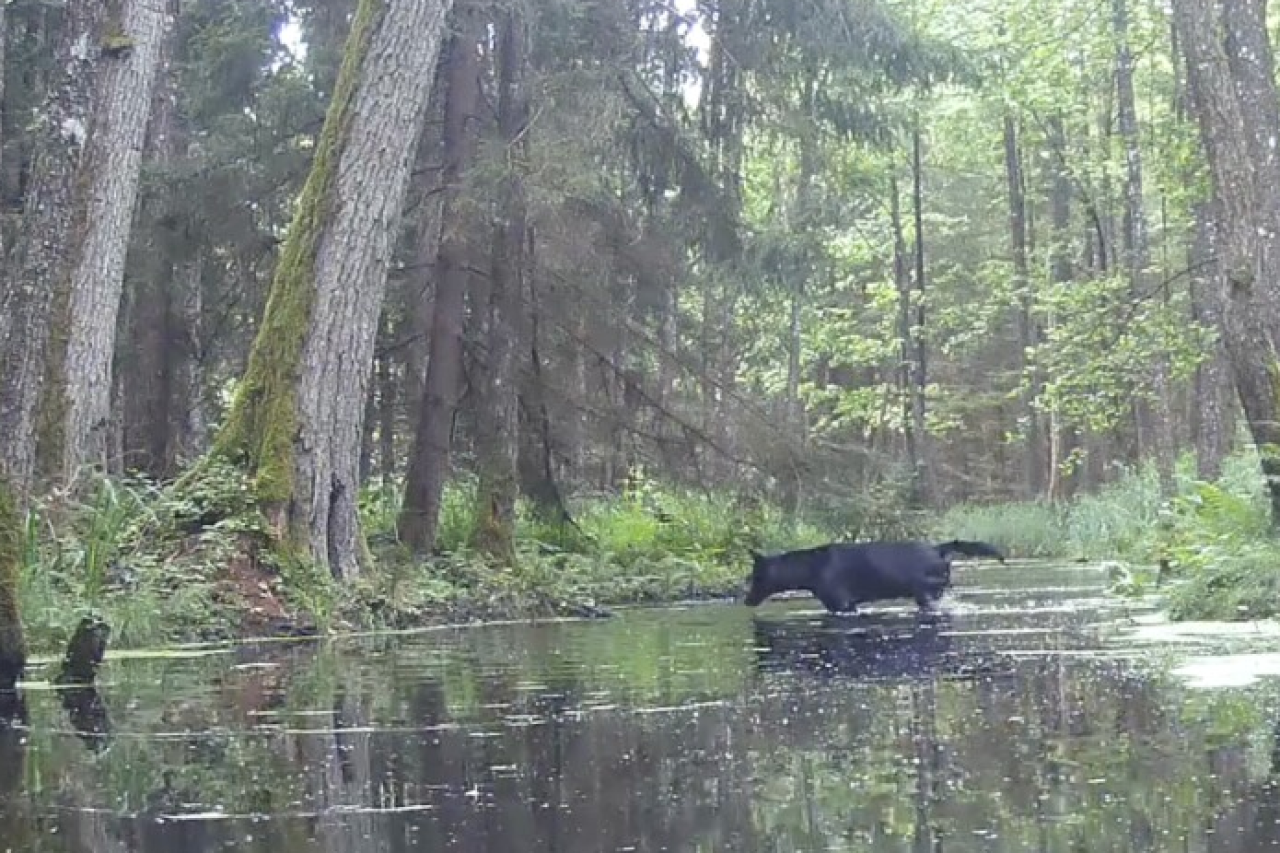
As reported by a conservation organisation, two rare black wolves, likely siblings, were captured on camera crossing a stream in a Polish forest.
The unusual sighting, recorded last year by a camera trap set up by the project coordinator of the SAVE Wildlife Conservation Fund Poland, prompted the organisation to collect scat in the forest in hopes of learning more about the genetics of the black wolves.
Camera trap captures black wolves
«This is something new and unusual,» said Joanna Toczydłowska.
Toczydłowska initially placed the camera to observe beavers. When she noticed it was recording wolves instead, she kept the camera in place and collected footage of the black wolves a few weeks ago.
In one clip, a black and a grey wolf slowly cross a stream in the forest, the water nearly reaching their bellies, before they leap onto the bank. A second clip, recorded last autumn, shows two black wolves and one grey wolf crossing the same stream.
Most of the 2’500 to 3’000 wolves in Poland are grey, with red or black markings. The black coat is the result of a genetic mutation that likely occurred in domesticated dogs thousands of years ago. Dark colouring is rare in Europe due to lower genetic diversity, but at least half of the wolf population in Yellowstone National Park in the United States has black coats. The genetic diversity in wild animals is declining worldwide.
Wolf population in Poland recovering
As wolves travel in families and the two black wolves weigh approximately 30 kilograms, Toczydłowska said they are likely siblings and about one year old. At least one is male.
The conservation organization, which has been monitoring wolves in Poland for 13 years, does not disclose the location of the forest in order to protect the wolves from poaching and to prevent the spread of false information about wolves. In Switzerland, too, the absurd hobby hunting of wolves is causing controversy.
In the 1950s, wolves were virtually eradicated in Poland, but in recent years the population has returned, particularly in the central part of the country in the early 2000s. Toczydłowska and her colleagues educate the public on how to live safely in areas inhabited by wolf packs.
«For people, this is a new phenomenon,» said Roman Gula, head of the organization's wolf monitoring project. «Education is one of our most important goals.»
The conservation fund had announced the sighting on Facebook last week and appealed for financial support to pay for the genetic analysis of the droppings and to learn more about the black coat mutation.
Unterstütze unsere Arbeit
Mit deiner Spende hilfst du, Tiere zu schützen und ihrer Stimme Gehör zu verschaffen.
Jetzt spenden →