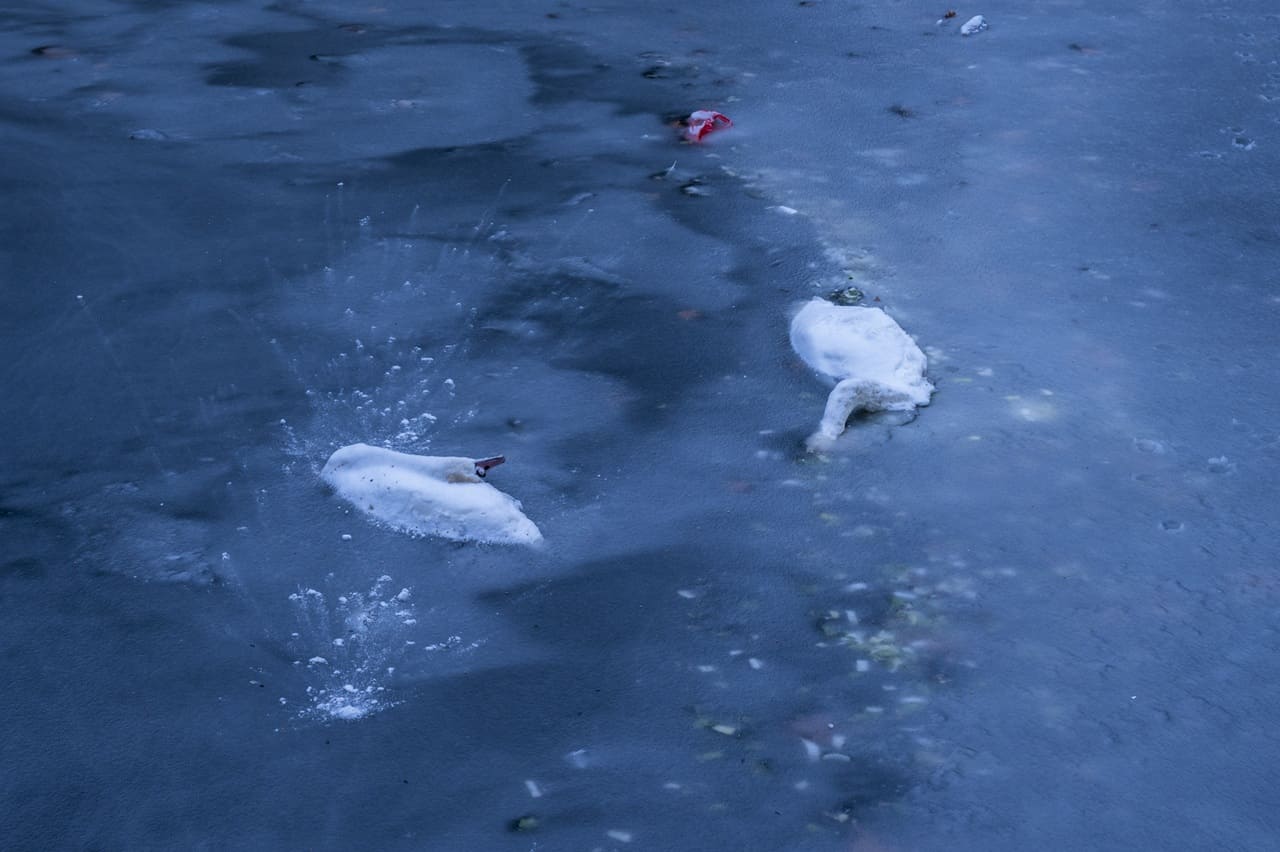
Neozoa
The pseudobiological, non-ecological condemnation of foreign species, with its expressions and arguments, promotes general xenophobia.

Many conservationists consider neozoa a threat to native nature.
However, distinctions between "foreign" and "native" species are purely artificial. Is there a completely different problem behind the biological debate?
“They come like an enemy army.” Like “a cancerous growth,” they infest our natural world, “infiltrating, metastasizing.” With such language, a concerned conservationist denounced the invasion of alien plant and animal species in the magazine Nationalpark a few years ago. One might consider this mere verbal slip-ups. But for many conservationists, probably for most, “the aliens” are still considered the greatest threat to native nature, second only to climate change. Or even more so, because their proliferation and impact are already visible and not merely predicted. The ecologist Wolfgang Nentwig expresses this view quite clearly. In his book Uncanny Conquerors: Invasive Plants and Animals in Europe, he calls for “a unified institution at the European Union level… responsible for invasive species and coordinating the necessary activities.” He suggests that “blacklists… offer themselves as a proven tool…for eradication measures.”
So, these invasive species in our native environment are a serious problem. Countless articles, commentaries, and numerous symposia have been "dedicated" to them. The flood of pronouncements about them corresponds more to the sensationalist formulations quoted at the beginning than to the few conspicuous alien species themselves. This raises the suspicion that what is presented with such vehemence might be concealing and even conveying deeper issues. But what is the actual problem? What are "the aliens," and what damage are they causing? Why have they (and how many of them) become invasive?
Neozoa: Which species are foreign?
Surprisingly, there is no clear answer to this seemingly simple question. Common definitions refer to animals that are foreign to a region as "neozoa" and foreign plants as "neophytes." It is obvious that such terminology does not provide clarity. For when do species become "new" (neo-) and at what distance from their original habitat? The (natural) distribution areas of species, called ranges, vary in distance. They are neither fixed by nature nor by law. Ranges expand or contract depending on how living conditions change. Only national borders are fixed, and their permanence is notoriously short-lived. However, since these borders define the scope of nature conservation laws and regulations, species that occur naturally beyond the border are considered new and potentially invasive when the border is "crossed." This makes no sense in relation to natural living conditions. Administrative action is required when the "new" species are desired. The most significant natural changes to these areas began with the end of the last ice age, around 10,000 years ago. Since then, the distribution and abundance of most animal and plant species have been shifting, even globally, because the cold periods in the tropics meant dry periods, while the warm periods meant wet periods. This process is still ongoing. By nature, there is no "correct" state, but rather only intermediate states dictated by time, within long-term changes on a timescale of millennia.
"In Germany, this means that non-native plants grow on 99 percent of the land area."
Josef H. Reichholf
These naturally occurring changes have now been greatly accelerated on the shorter timescale of centuries since humans developed agriculture and animal husbandry after the Ice Age, transforming a large part of the Earth's surface to meet the resulting needs, including the exploitation of marine resources. This process is also in full swing. It accelerated even further after World War II with the massive use of fertilizers and pesticides, as well as the expansion of the cultivation of non-native crops, especially maize. Maize has now become the dominant crop in Central Europe.
For more than a millennium, since the medieval deforestation, there has been no natural landscape in Germany; not even in the meager remnants that have been designated as such and placed under nature protection to an even lesser extent. In Germany, non-native plants grow on 99 percent of the land area. They cover almost all agricultural fields, populate the planted forests (which are not naturally grown), and fill gardens and green spaces in residential areas. Even German national parks are covered with non-native vegetation. The largest areas are occupied by corn, wheat, spruce, home gardens, potatoes, permanent grassland, barley, and urban parks. Corn and potatoes originate from America, wheat and barley from the Near East, spruce (forests) from high altitudes in the low and high mountains, and the plants in gardens and parks from all over. The most numerous animals living in Germany, domestic chickens, live in their wild forms in Southeast Asia. Pigs and cattle were not domesticated here, but in the Near East, as were sheep and goats. Even honeybees, whose survival in the cultivated landscape is currently threatened, do not originate here. And yet they have become indispensable. The majority of free-living animals and wild plants migrated here after the early medieval clearing of Central European forests. The settlement of the land by farmers created new, suitable habitats for them, which they have since utilized in a continuous stream of migration. These once-foreign species include the brown hare, grey partridge, skylark, poppy, and cornflower, along with almost the entire other diversity of animals and plants found in the fields. The greatest surge in recent times occurred in the 18th and 19th centuries. At that time, due to a rapidly growing population, the land was extremely overexploited and depleted. In this unproductive state, it offered many species a means of survival, especially those that could cope with scarcity. Our notions of native and foreign are now based on this "historical biodiversity" of the 19th century, even though specialists (rightly) emphasize that globalization began with the European discovery of America. The boundary between (ancient) native and new is drawn in 1492. Anything that has arrived since then belongs to the new species. What arrived after 1900 belongs to the truly new species, and what only arrived in our time (or became noticeable even though the species have been in the country for over 100 years!) is considered "alien."
"Foreigners should not simply be placed under initial suspicion just because we do not know them or their behavior."
Josef H. Reichholf
So, which species are considered foreign? According to the Munich satirist Karl Valentin, "Foreigners are only foreign in foreign lands!" In concrete terms: whether a species is classified as "foreign" or (already) native depends on the chosen space and time. Any classification is inevitably arbitrary because changes are processes occurring in space and time. All boundaries are therefore artificial. Perhaps the most sensible definition would be that what we don't yet know well enough is foreign to us. This is a statement, not a value judgment. The point is precisely to recognize that foreign and familiar are related to experiences and knowledge, but should not be linked to preconceived judgments. Foreigners must not simply be placed under suspicion just because we don't know them or their behavior. Anyone who does so is acting like a small child, displaying stranger anxiety. For a small child, stranger anxiety is a survival mechanism, as we can conclude from the findings of behavioral research, but only for the infant stage. Once we outgrow this, we consider our engagement with the foreign to be our defining(!) curiosity when we ourselves travel to foreign lands to learn new things.
The "problem" of non-native species should therefore resolve itself through familiarization with them. That this is fundamentally the case is evident not only from the numerous conservation efforts to preserve formerly foreign and invasive species, but also directly from the EU agricultural budget's expenditures on maintaining arable weeds. These once-foreign plants, once successfully controlled for centuries with hoes and manual labor, and then, since the development of herbicides, with great success using chemicals, are currently being preserved and "saved" through costly compensation payments from the agricultural fund. A particularly "charming" example from the recent past is the struggle over the plane trees in the area of the expansion and renovation of Stuttgart's main train station. The plane trees are not native, but rather foreign trees, in which the (geographically) even more foreign rose-ringed parakeets, parrots from India, nest, and in which the larvae of the hermit beetle, a species protected throughout the EU, also live. For this reason, the plane trees should be preserved and the "Stuttgart 21" project should be scrapped.
The distinction between native and non-native species is not only fraught with difficulties in argumentation in such cases. Other cases have also been costly. For example, Deutsche Bahn had to spend several million euros to protect the great bustard in Saxony-Anhalt, so as not to endanger the remaining population of this undoubtedly impressive, yet threatened, bird species with its high-speed ICE trains. The bustards live there on a completely artificial, entirely alien agricultural steppe. In a similar situation, some European hamsters are blocking the construction of buildings or roads in Lower Franconia. For centuries, recreational hunters have intensively persecuted native birds of prey, keeping their numbers in check until they were regionally extinct, in order to preserve the pheasant, an artificially introduced species they had brought in at the end of the 19th century purely for hunting pleasure. Since then, the pheasant has enjoyed the protection of German hunting law as small game. The recently returned moose, poised to migrate to Germany's eastern borders and undoubtedly native to the region, are viewed with suspicion. The native bear is also (at least for now) barred from returning. The otter's quiet comeback has angered fishermen, while amateur hunters are trying to prevent the lynx's return. Apparently, being native doesn't automatically grant one the right to remain. The deliberately introduced foreign species were granted this right automatically! A Blue Card was deemed unnecessary for pheasants and rainbow trout, just as it was for elephant grass and hybrid corn. More on the topic of species conservation and biodiversity .
"Our immediate neighbors were – and, apart from exceptional circumstances, are – always more welcome than complete strangers, because we already knew them well enough."
Josef H. Reichholf
The concepts of "foreign" and "native" have thus proven to be highly subjective. However, any debate on this topic would be academically meaningless if it concerned only the timing of recognition or the perceived proximity and distance of origin. Immediate neighbors were—and, barring exceptional circumstances, are—always more welcome than complete strangers, because they were already well-known. Wherever the "eastern" penduline tit nests west of its current main distribution area, ornithologists are enthralled. Its highly elaborate nest is admired. The fact that cranes are once again spreading westward elicits no complaints, even though air traffic control must prepare for significantly more crane flights during migration seasons and much larger numbers overall. After all, Germany's number one airline bears the crane (stylized beyond recognition) as its symbol. That the metal crane-shaped aircraft must cope with half a million or more real cranes in the airspace is taken for granted. But what's going on in the airspace between the treetops in the parks of the Rhine cities when Indian parakeets and South American Amazon parrots nest in the hollows of old trees? Are they allowed to do that, when native starlings, sparrows, and bats could use these tree cavities? One might suspect something amiss. However, no evidence has been found of them displacing the native cavity-nesting birds.
This only intensifies the emphasis placed on the widely suspected and feared negative effects of these invasive species on native wildlife. North American raccoons have been branded as vermin that prey on the eggs and young of native species, "steal" fruit, make noise, and have generally eluded control by hobby hunters. The fact that anything other than raccoons inhabits their North American homeland should be surprising. Even more surprising, however, is the fact that the habitats most rich in wildlife and densely populated with wild animals in our region are precisely those where raccoons are found. These are the cities, especially large cities. In these cities, Canada geese (from North America) foul the lawns with their droppings, just as native greylag geese and swans, which have been kept as ornamental birds for centuries, do. The Canada geese shouldn't be allowed to foul, but the greylag geese should be—or should they? The park mallards, descended from native mallards, are tolerated to varying degrees, currently less so, but must at least be kept purebred. This means, in plain terms, that anything visibly deviating from this purity must be eliminated. So that at least "the duck" remains pure, especially when all sorts of colorful waterfowl, unfamiliar to the purists, are already disfiguring the city ponds. Or even venturing out into the wild!
"The accusation that foreign species displace native species is particularly common against them. This is still true, and all the more so the less truth there is to the accusations."
Josef H. Reichholf
The fact that they displace native species is a particularly common accusation leveled against invasive species. This perception persists, and all the more so the less truth there is to the accusations. For example, the European (native) mink had already been largely eradicated in Europe when, towards the end of the 19th and into the 20th century, the American mink escaped from mink farms or was forcibly released. It is now blamed for the much earlier extinction of the European mink. A similar situation occurred with the crayfish, aptly named the noble crayfish. When it had practically disappeared as far north as the Beskid Mountains, American crayfish were introduced and released as a replacement. Embarrassingly, they brought crayfish plague to the fishing industry, because it was the fishing industry that wanted crayfish (again) and that also introduced the American rainbow trout after the European brown trout could no longer survive in the polluted, poisoned streams and rivers. For decades, fishing, including recreational fishing, has relied on artificial stocking measures. These measures, covered by fisheries law, are not only permissible but also above any ecological considerations, while organisms spread via canals and river shipping in recent decades are considered "causing concern," even though they are preyed upon by the released fish as well as by native herons, cormorants, and other waterfowl. In fact, there is hardly a body of water left with a fish population that even remotely resembles natural conditions, i.e., those unaffected by fishing. The situation in waterways is therefore no different than on land. Everything, with only the tiniest remnants, is artificial. This means that anything that any species alters in this "man-made nature" cannot be judged on an ecologically neutral basis. This is because it always involves conflicts with users. Therefore, species that somehow conflict with the interests and expectations of users are labeled "invasive." The remaining species, present in far greater numbers, go unnoticed or, as the example of the penduline tit mentioned above suggests, delight nature lovers. These enthusiasts are concerned about the loss of species, which is indeed taking place. However, the cause is not the few new species that successfully establish themselves, but rather the large-scale changes in land use. These changes have led to the almost bizarre situation that in large regions of Central Europe, more species, in greater diversity, live in cities than "in the countryside." The few species that manage to become more common and spread "in the wild" are suspected of being somehow wrong with them. After all, "native species" are supposed to be rare or declining in their populations these days. An increase, on the other hand, suggests something is amiss.
This stance guarantees that the periodic assessments of the state of species in our natural environment will continue to be negative. This is because "the newcomers" are either not included in the assessments at all, or cleverly excluded, since "they don't belong here." In this way, they are relegated to second-class status. They are not factored into the gains, while conversely, every "highly endangered" species, because it is (equally) rare but was previously native, is particularly burdened by the negative balance. This has nothing to do with ecology in the scientific sense. But it has a great deal to do with ideology. The realm of ecology also excludes actual or perceived damage caused by non-native species, because such damage is considered an economic issue. It is therefore more than peculiar when ecologists emphasize economic damage and use it to justify the ecological danger posed by non-native species. Their field of expertise should be the shifts in the local, regional, or supra-regional spectrum of existing species caused by newly arrived, spreading species. When assessing these changes, it is important to consider that no state is "the right one," and therefore not every change should automatically be judged negatively. Rather, the focus should be on identifying the observed consequences, or those predictable with sufficient and verifiable certainty, of the spread of individual species. Based on these findings, a secondary discussion—depending on the perspectives and objectives of the users—can then take place regarding acceptance or countermeasures (objectively). This applies to all species, whether native, newly introduced, or recently arrived! Damage is damage, provided it can be proven. However, changes are only relevant to the perspective of those who refuse to accept any change whatsoever because it would disrupt their established perceptions.
The attitude behind the attitude
Nevertheless, invasive species do exist, along with the problems they cause, albeit for reasons other than those usually presented. Without going into detail here, they thrive best where the soil is over-fertilized. And the most invasive of these plants represent the visible, highly undesirable reaction to the conditions that have prevailed in fields and forests since the 1980s, enabling mass biomass production through fertilization. What this means, however, is that anyone who wants to fight giant hogweed and Himalayan balsam is welcome to do so. Like all the other species that benefit from over-fertilization, they cannot be eradicated. Raccoons and gray squirrels are also too clever for complete annihilation; insects, in any case, evade control through their temporary scarcity. This applies to the corn rootworm just as much as to Oriental or American cockroaches. The solution to the malaria problem will not lie in eradicating the mosquitoes that transmit it—which, incidentally, have always existed in our region, even during the cold centuries of the Little Ice Age up until the late 18th century, because Anopheles , the malaria mosquito, is widespread as far north as the Arctic Circle—but rather in combating the pathogens themselves, that is, in the medical treatment of humans. Thus, one could leave those interested in this to their petty battles so they can celebrate victories in battles that cannot be won in the medium and long term. If only there weren't something more dangerous lurking in the background. The pseudobiological, non-ecological condemnation of foreign species, with its rhetoric and arguments, fosters general xenophobia. It is all too easy to invoke "ecology" and misuse it to provide seemingly natural justifications for rejecting foreigners. Biology has already been far too abused for us to risk following its stance toward foreign species without question. Even less so than with peoples and individuals can one define and determine what is "European" and what is not when it comes to "nature." Purely political entities, shaped by historical events, such as the European countries, are entirely unsuitable. Not a single one has natural boundaries in a biological sense, not even the British Isles. For several millennia after the end of the last Ice Age, until the North Sea began to rise, they were part of mainland Europe. The true, "permanent" islands in the Mediterranean lost their independence in terms of flora and fauna as early as prehistoric times. The current state of Europe (and the entire Earth) will not last.
Far more important than combating the new, the unknown, would be a deep dive into that truly forward-looking task characterized at the 1992 Rio Earth Summit by the term " sustainable development." Its fundamental idea is not the rigid adherence to a particular state favored for whatever reason, but rather sensible, because sustainable, change. Sustainable means creating and maintaining imbalances that are productive enough to meet demand, but also sufficiently stable to prevent spiraling out of control. Sustainable development means that the world of tomorrow will be different from today's, also for the plants and animals that live with and around us. All of them are worth preserving for the future. None is "evil" simply because it is foreign or because it reacts to what humans have prepared for it. For in the plant and animal kingdoms, too, supply determines demand, and people congregate where there is abundance.

Josef H. Reichholf
Josef Helmut Reichholf (born April 17, 1945, in Aigen am Inn) is a German zoologist, evolutionary biologist, and ecologist who has repeatedly caused a stir as an author of provocative theses. For Reichholf, science thrives on critical dialogue; it must constantly re-examine itself and, if necessary, reconsider and correct even long-held, irrefutable theses. He is critical of supposed alliances between science and politics or industry, for example, regarding climate protection or third-party funding for research, as these jeopardize the independence of science.
| You can help all animals and our planet with compassion. Choose compassion on your plate and in your glass. Go vegan. |