Marmots and Climate Change: Migration Upward
Marmots today live on average 86 metres higher than they did 40 years ago. However, according to a study, their absolute upper limit has not changed: they do not exceed an altitude of 2,700 metres.

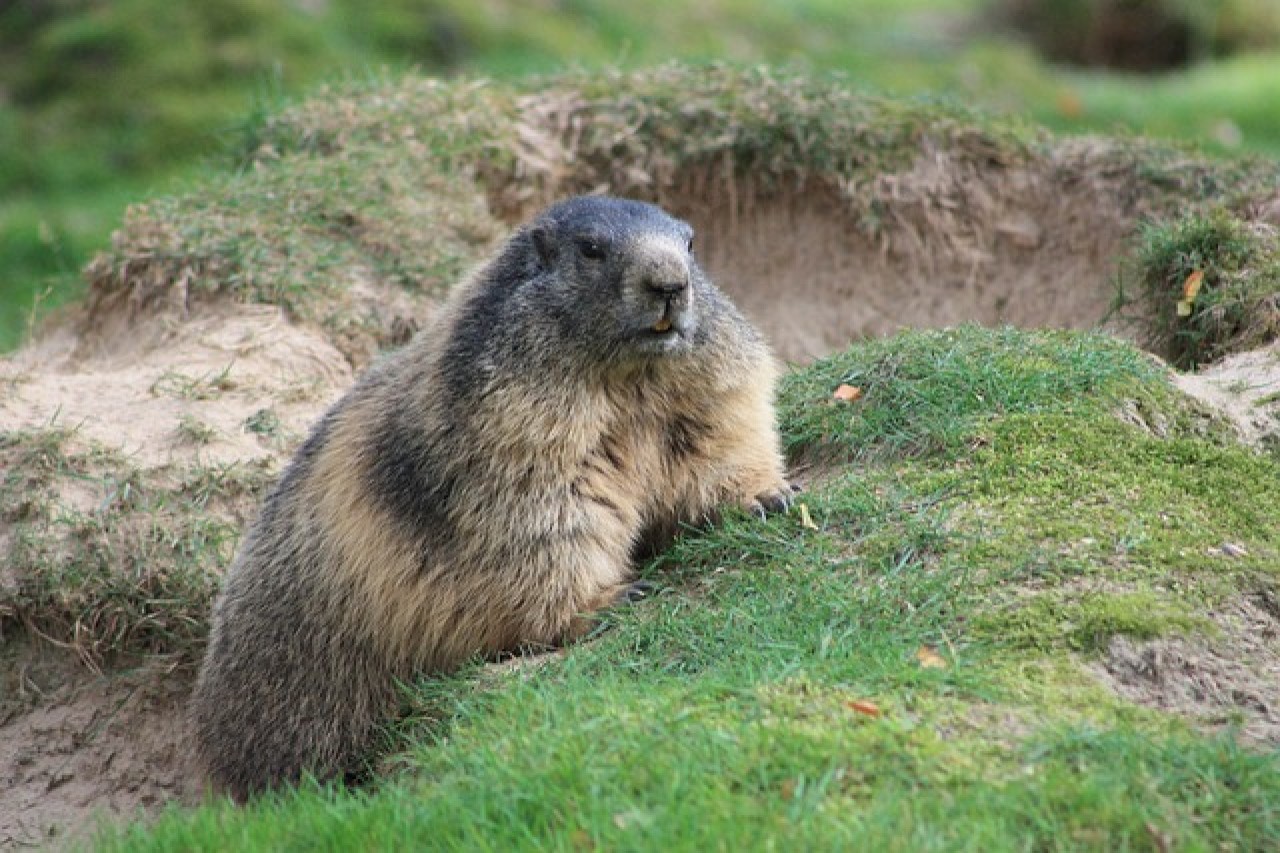
Marmots are migrating due to climate change, but not very far, as a study by Anne Kempel, biologist at the WSL Institute for Snow and Avalanche Research (SLF), shows.
The researcher examined the altitude at which marmots live today and compared her results with data from 1982. The finding: the majority of the animal families she observed in the Dischma Valley near Davos now live around 86 metres higher than they did 42 years ago, at approximately 2,500 metres above sea level.
“The absolute upper limit, however, has not changed,” the scientist explained in a press release from the SLF on Tuesday. It ends at an altitude of 2,700 metres — as was already the case in 1982.
“Other factors probably play a more important role than higher temperatures,” Anne Kempel notes. Temperatures that are too high would not provide the animals with sufficient soil in which to dig their extensive burrow systems.
In addition, they require as thick a snow cover as possible during hibernation in order to insulate the ground from the cold. “It is precisely where most groups live today that we find the maximum of these parameters,” the biologist states.
Furthermore, plants containing linoleic acid are an important component of their diet. This unsaturated fatty acid regulates body temperature in winter. “These plants may have shifted their distribution slightly upward,” Anne Kempel surmises.
The Same Methods as in 1982
Anne Kempel and her team used the same methods as their predecessors in 1982. For one to two hours, they observed 25 areas on the slopes of the Dischma Valley using binoculars and telescopes, counting the marmots. Statistical computer models then extrapolated the probable marmot population and arrived at this result.
However, this observation applies only to the Davos region and possibly comparable areas. In the lower-lying Alps, the situation could become difficult for the animals. At temperatures above 25 degrees, marmots suffer from heat stress.
In the Dischma Valley, there are currently only six days per year with temperatures averaging above 25 degrees Celsius — too few to cause negative effects. However, the situation has already worsened, as the tree line is slowly but surely rising.
“Marmots prefer open environments; they do not adapt to forest, and since they cannot move to higher elevations, their habitat is shrinking,” concludes Anne Kempel. The study has been published in the journal Ecology and Evolution.