Is recreational hunting in Switzerland necessary?
Science, Geneva model and the question of who profits from recreational hunting


Recreational hunting is not absolutely necessary for wildlife regulation in Switzerland.
This statement sounds provocative to many – but it is scientifically well-documented. The Canton of Geneva has proven for over 50 years that wildlife populations can regulate themselves stably without recreational hunting. And this example does not stand alone: Luxembourg has also maintained an extensive hunting ban for numerous species for decades. The claim that ecosystems would collapse without hunting is a lobby narrative without reliable ecological foundation.
What does science say about the necessity of hunting?
Ecosystems regulate themselves through natural mechanisms: food competition, diseases, predators and habitat limits constrain animal populations. Research shows that in hunting-free or low-hunting areas, wildlife populations do not explode at all, but settle at a level that the habitat can sustain. Biologist Paul Errington described this effect as early as the 1940s: populations are subject to natural regulation through resources, not through culling. More recent studies, such as those by Stewart Breck and colleagues (published in 'Frontiers in Ecology and the Environment'), further show that predator culling increased rather than reduced livestock damage in 43 percent of cases – because it destroys pack structures and triggers uncontrolled reproduction.
The Geneva Model: 50 Years of Assessment
Switzerland's most important experiment has been running since 1974 in the Canton of Geneva. At that time, around two-thirds of Geneva's population voted for a complete ban on recreational hunting – a globally unique step. Since then, twelve cantonal professional hunters from the 'Police de la nature' have taken over all necessary wildlife interventions. The assessment after five decades is clear:
- Brown hare density rose to 17.7 animals per 100 hectares – well above the Swiss average.
- Up to 30,000 waterfowl winter annually in Geneva – a sign of intact habitats.
- The grey partridge, nearly extinct in other cantons, survives in Geneva through active habitat management.
- Wild animals became tamer and behaviourally more relaxed because hunting pressure was eliminated.
- In 2005, 90 percent voted against reintroducing recreational hunting in a referendum.
- In 2009, the cantonal parliament rejected reintroduction by 70 to 7 votes.
The cantonal professional hunters achieve an instant kill rate of 99.5 percent – far higher than with militia hunting, where wounding and agonising death are not uncommon. The Geneva model is analysed in detail in the dossier 'Geneva and the Hunting Ban'.
Luxembourg as a Second Example
Luxembourg has severely restricted hunting of numerous species and increasingly relies on professional wildlife management. The Grand Duchy shows that even in densely populated Central European countries, a retreat from recreational hunting is possible without wildlife populations getting out of control. The political debate in Luxembourg is more objective because the hunting lobby there possesses less institutional power than in Switzerland.
Hunting Myths Fact-Checked
The Swiss hunting lobby bases the necessity of recreational hunting on a series of arguments that do not withstand objective scrutiny. The dossier 'Hunting Myths' analyses these narratives in detail. The most common arguments:
- 'Without hunting, populations explode.' False: In Geneva and other hunting-free areas, populations stabilise within a few years at an ecologically sustainable level.
- 'Hunters finance nature conservation.' Misleading: Hunting fees fall far short of covering state costs for game wardens, accident insurance and administration.
- 'Hunting is sustainable use.' Distortion: The term 'sustainable use' in hunting law is an economic, not an ecological term.
- 'Game management and care require hunters.' Circular logic: Wildlife plots and feeding stations artificially increase game density – thereby creating the regulatory need that recreational hunters cite as justification.
Ecological Self-Regulation: What Science and Practice Show
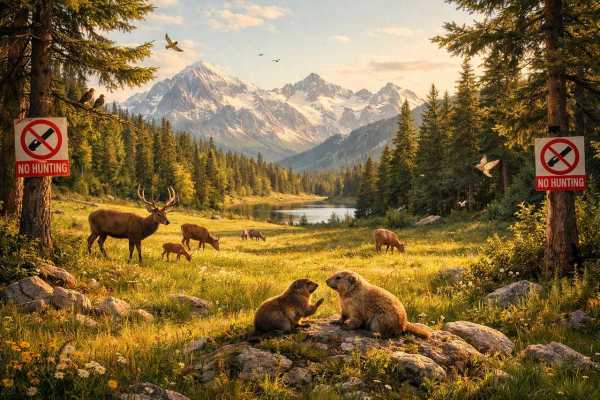
In national parks – such as the Swiss National Park in the Lower Engadin – hunting has been completely abolished. The result after decades: deer populations fluctuate seasonally but adapt to the available habitat. Wolves and lynx, which have been returning since the 1990s, take on a regulatory function as natural predators. The return of these predators is ecologically highly effective: it creates a 'landscape of fear' that keeps wildlife away from sensitive biotopes and thus reduces browsing damage in forests – without a single shot.
The costs of hobby hunting
The economic justification for hobby hunting is weak. The dossier 'What hobby hunting really costs Switzerland' calculates what no one officially presents:
- Around 3.6 million francs are spent annually on UVG-recognized hunting accidents alone.
- The costs for cantonal wildlife management, hunting administration and control authorities amount to additional millions.
- Lead ammunition used by hobby hunters contaminates soils and endangers scavengers like the golden eagle – an external cost factor that is rarely quantified.
- The value of hunted game meat does not even remotely cover these costs.
In contrast, a professional wildlife ranger corps based on the Geneva model would work more targeted, cheaper and more animal welfare-compliant. The dossier 'Arguments for professional wildlife rangers' provides the political and technical arguments for this system change.
Immunocontraception as an alternative
Where wildlife populations are actually locally too high, non-lethal alternatives exist. Immunocontraception – the vaccination of wildlife with an antigen that inhibits reproduction – is successfully used in the USA, Germany and other countries, particularly for wild boar and deer in urban areas. The method is more expensive to apply than culling, but has no negative effects on ecosystems and pack structures. In Switzerland, immunocontraception is discussed in the dossier 'Alternatives to hobby hunting' as a long-term option whose potential has so far been politically ignored.
BAFU data and political context
The Federal Office for the Environment (BAFU) operates national wildlife monitoring and publishes annual culling statistics. These data show that in Switzerland annually over 120,000 animals are killed through hobby hunting – roe deer, red deer, chamois, hares, waterfowl and small game. BAFU itself formulates as its goal 'sustainable management' of populations – a term that frames hunting as economic utilization, not as ecological necessity. The dossier 'Hunting ban Switzerland' examines what a nationwide model based on the Geneva example could look like and what political hurdles exist.
Hobby hunting in Switzerland: recreational activity with state legitimation
In Switzerland, around 30,000 recreational hunters hunt – predominantly as a leisure activity. A hunting license costs between 500 and several thousand francs per year, depending on the canton. The social habitus of hobby hunting – trophies, hunting societies, media images – is firmly anchored in rural milieus. This makes it politically difficult to attack, but changes nothing about the ecological reality: hobby hunters hunt because they want to – not because the ecosystem demands it. The dossier 'Hunting in Switzerland – numbers, systems and the end of a narrative' shows how the current system functions and why it needs reform.
Further content on wildbeimwild.com
- Dossier: Geneva and the hunting ban
- Dossier: Alternatives to hobby hunting
- Dossier: Hunting myths
- Dossier: What hobby hunting really costs Switzerland
- Dossier: Hunting ban Switzerland
- Dossier: Arguments for professional wildlife rangers
- Dossier: Hunting and biodiversity
- Dossier: Introduction to hunting criticism
More background on current hunting policy in Switzerland can be found in our dossier on wildbeimwild.com.