Golden jackal spreads across the DACH region
While politicians in Switzerland and the EU are still wrestling with the wolf, the next predator has long since arrived: the golden jackal. Having quietly migrated from southeastern Europe, it has been spreading for several years across the Balkans, Hungary and the Czech Republic into Germany, Austria and Switzerland.

The reactions are familiar. Where experts speak soberly of a medium-sized wild dog that poses virtually no danger to humans, hunting and farming lobbies are already crafting the next problem-animal narrative.
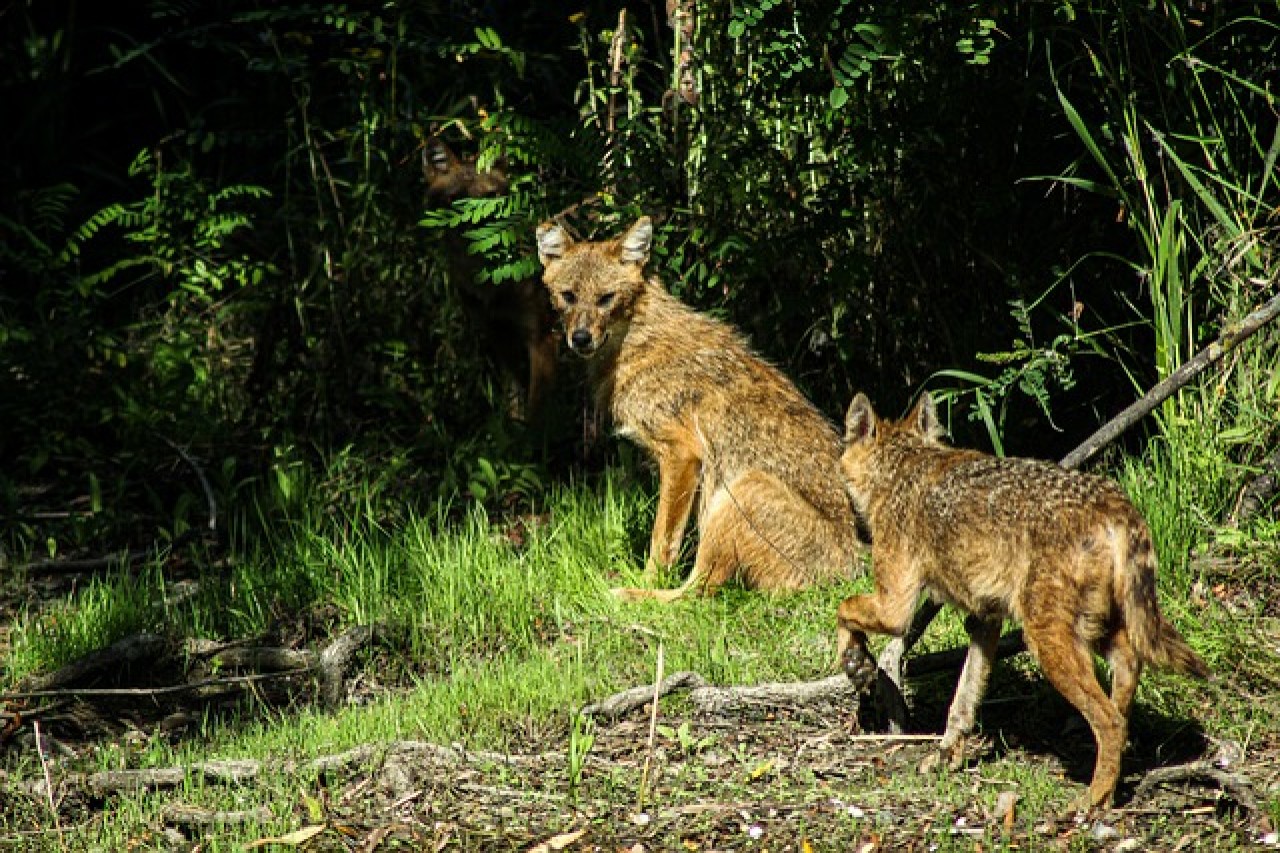
The golden jackal is considerably smaller than a wolf and slightly larger than a fox. Its coat is yellowish to reddish-brown with grey tones, its body more compact, its tail shorter. Confusion with foxes or small wolves is common, particularly in poor visibility conditions.
Ecologically, it occupies a similar niche to the fox and raccoon dog. It feeds primarily on small mammals, carrion and occasionally the young of roe deer or ground-nesting birds, is active at dusk and during the night, and avoids humans. Based on current data, it poses no danger to people.
Switzerland: Still rare, but on the advance
In Switzerland, the golden jackal was first recorded in winter 2011/12 in camera traps used for lynx monitoring in northwestern Switzerland.
Since then, sightings have been accumulating. KORA reported several confirmed records for 2024, including in the vicinity of larger residential areas. At the end of March 2025, the first documented camera-trap record in the canton of Lucerne was obtained between Neuenkirch and Hellbühl. The Lucerne authorities emphasise that the golden jackal is protected throughout Switzerland and may not be hunted.
In parallel, KORA is launching a national golden jackal project for the years 2025 to 2026. The aim is a forward-looking, scientifically grounded approach to the species before symbolic political gestures create facts on the ground. The focus is on monitoring, ecological interrelations and the early identification of potential areas of conflict.
Instead of shooting first and asking questions later, Switzerland has so far relied on data, monitoring and protection when it comes to the golden jackal. A contrast to the approach taken with the wolf.
Germany: Immigration has long been a reality
In Germany, the first golden jackal was documented as early as 1997. By 2020, there were at least 25 confirmed sightings; since then the number has continued to rise, and there are now confirmed records in almost every federal state.
Examples:
- In Baden-Württemberg, the Wildlife Institute has documented several confirmed sightings, including two adult golden jackals near Donaueschingen in 2023.
- In Schleswig-Holstein, several golden jackals were confirmed between 2017 and the observation year 2024/25; experts assume that the species will establish itself in the north within the next ten years.
Legally, the golden jackal in Germany is not yet a uniformly regulated subject. At the federal level, it is not listed as a huntable species under § 2 of the Federal Hunting Act and is therefore not technically subject to hunting. However, Lower Saxony has incorporated it into its state hunting legislation. In a particularly controversial case, a shooting permit was granted for the first time nationwide on the island of Sylt in 2025, after a golden jackal was held responsible for attacks on sheep.
Austria: Shoot first, ask questions later
In Austria, the species is not protected and may be hunted. In Upper Austria, a summer closed season is enshrined in law, with shooting permitted from October to March.
This repeats the familiar logic of hunting policy: instead of accompanying the natural return of a species strictly listed under Annex V of the Habitats Directive through monitoring, preventive measures and public education, it is preemptively placed in the crosshairs. The golden jackal is listed in Annex V of the Habitats Directive, which obliges member states to permit removals only in a manner that maintains a favourable conservation status.
Against this backdrop, aggressive hunting at an early stage of settlement is difficult to justify on scientific grounds.
Switzerland: Confusion as a pretext
Here too, there is already a precedent. In January 2016, a recreational hunter in the canton of Graubünden shot a young golden jackal, claiming to have mistaken it for a fox. The animal was the first golden jackal in Switzerland whose body could be scientifically examined.
The case illustrates several problems associated with recreational hunting:
- Lack of species knowledge and identification ability under real-world recreational hunting conditions
- The fact that rare and strictly protected animals are particularly at risk in a landscape over-exploited by hunting
- A culture in which mistaken kills are formally reported but structurally tolerated
When a species such as the golden jackal is confused in the field with a fox or a dog, the question arises as to how many mistaken kills are not even recognized as such.
The golden jackal as a test case for a different approach to wildlife
How we deal with the golden jackal is a litmus test for whether Europe has learned anything from the wolf debate.
Facts that are often lost in public discourse:
- The golden jackal is a returning wild canid, not a released “problem species”. Its spread is linked to changes in land use, climate change, and the persecution of wolves and lynx in the 20th century.
- The species is legally embedded in EU law and cannot be “released” for hunting at the whim of individual lobbying groups.
- According to current knowledge, the golden jackal poses no danger to humans. Conflicts with livestock can be addressed using the same protective measures that would be demanded in the case of the wolf — rather than with a rifle.
While in Germany environmental organizations and experts are calling for consistent monitoring and a legally sound classification, the hunting lobby is already preparing its familiar chain of arguments: from the alleged “disease carrier” to the competitor of recreational hunters, all the way to a supposed threat to ground-nesting birds. The fact that the greatest enemies of ground-nesting birds remain agriculture, drainage, and intensive recreational hunting naturally goes unmentioned in this narrative.
An opportunity rather than a scapegoat
The golden jackal offers the opportunity to develop a new, rational approach to wild-living predators:
- Protection and monitoring first
- Clear public information instead of fear campaigns
- Prevention in the livestock sector instead of reflexive calls for culling
- Recognition that wildlife has its own ecological roles, which are not aligned with hunters’ wish lists
For Switzerland, it is crucial that the currently existing protected status is not quietly eroded the moment the first headlines about “problem jackals” begin to circulate. For Germany and Austria, the question is whether the right to intact biodiversity will finally be given greater weight than the recreational hunters’ desire for ever new targets.
More on the subject of recreational hunting: In our dossiers on recreational hunting gather fact-checks, analyses and background reports. What the research says about this is shown by Hunting fact-checked: the state of research.
The position of IG Wild beim Wild: IG Wild beim Wild rejects recreational hunting. Our model is the canton of Geneva, which has managed without recreational hunting since 1974: without hunting seasons, without hunting dogs, without driven hunts, without high seats, without the animal cruelty and crime that go hand in hand with hunting season elsewhere. What has worked there for over fifty years disproves every position paper by JagdSchweiz. An association that bases its policy on claims it refutes in its own documents is not a professional organisation, but a factory for misinformation.