Chamois in Climate Change: Adaptation or Decline
Climate change is putting increasing pressure on chamois in the Alps. The animals must adapt to rising temperatures and less snow.

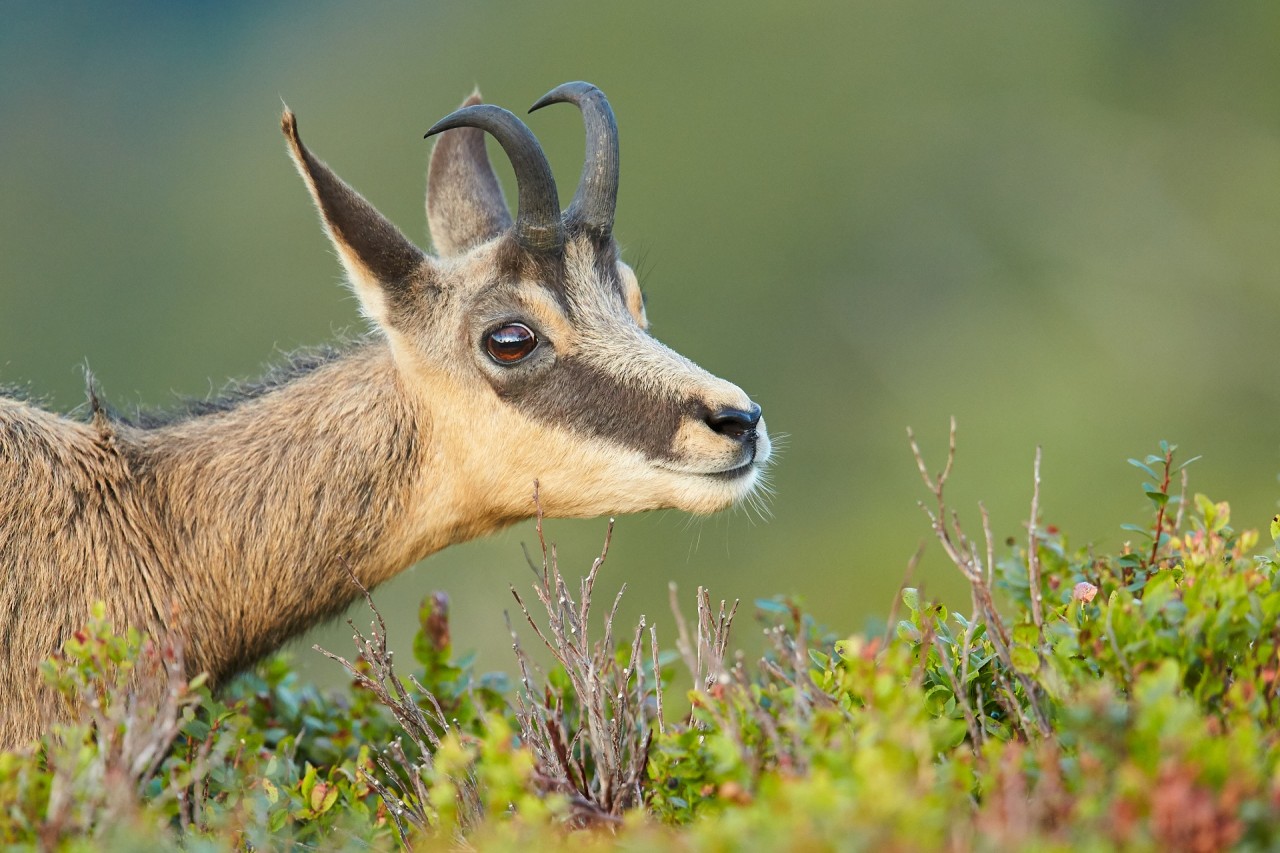
Since the last Ice Age, chamois have been colonising ever higher elevations.
This is shown by a study from the Swiss Federal Institute for Forest, Snow and Landscape Research WSL, in which researchers combined genetic data from the animals with computer models. The resulting simulations could in future also reveal how the animals respond to advancing climate warming.
Chamois are found in Switzerland today in the Jura, in parts of the Mittelland, and above all in the Alpine region. But this was not always the case: 20,000 years ago, during the last Ice Age, the Alps were completely covered by glaciers. At that time, chamois lived in areas of steep terrain to the north and south of this mass of ice.
How the animals’ habitat has shifted from then to now, and what factors played a role, has been investigated by environmental scientist Flurin Leugger in his Master’s thesis at the WSL Using genetic analyses and computer simulations, he traced what had limited the chamois on their dispersal routes. This method will also allow researchers in future to look ahead — and predict, for example, how the animals might respond to today’s climate warming.
A look into chamois genes
Leugger first examined, together with researchers from the Universities of Grenoble Alpes and Savoie Mont Blanc (France), how closely the various chamois populations in the Alpine region are genetically related to one another. The researchers used blood samples and tufts of fur collected by various hunting authorities, nature parks, and NGOs. In total, the researchers analyzed the genetic information of 449 chamois from France, Austria, Italy, Slovenia, Croatia, and Switzerland.
This revealed that the Alpine chamois population consists of two main genetic groups. One group lives in the western Alps as far as the Rhône Valley in Valais, and the other to the east of the Rhône Valley.

From the Ice Age to the present day
In a second step, Leugger reconstructed the characteristics of the ideal chamois habitat from the current distribution of chamois and from climate and topographical data. "Above all, the slope gradient, temperature, and precipitation levels influence whether chamois feel at home", says Leugger. Using these characteristics, the researcher trained various machine learning models, which he then applied to the climate conditions of 20’000 years ago. This produced a detailed map of the possible distribution of chamois at the end of the last Ice Age.
In a final step, Leugger simulated the distribution of chamois populations over the following 20,000 years up to the present day, based on changing climate conditions. The simulations showed how chamois progressively colonised the Alpine region as temperatures rose and glaciers retreated. The researcher varied certain parameters of the simulations — such as the average migration speed of the chamois — and introduced artificial geographical barriers. He then compared the result of each simulation with the current genetic distribution of the animals. In this way, Leugger gained an ever-deeper understanding of the factors driving the spread of chamois populations.
The future of the chamois
One of the findings: chamois migrate only over short distances — most spend their lives in the immediate vicinity of their birthplace. There are also geographical barriers that the animals do not cross, particularly large rivers and wide, flat valleys. "Chamois apparently avoid flat valley terrain, where they would be exposed to their predators such as wolves and lynx", explains Leugger. This is likely why they so rarely spread beyond these geographical boundaries.
These findings can now be used to investigate future developments. Much as his models were applied to Ice Age climate conditions, Leugger's models can equally be applied to climate projections — and could thus show, in further research, how chamois will respond to increasing climate warming. "This could make it possible in future to identify particularly isolated and therefore vulnerable populations that should be hunted with restraint», says the environmental researcher. His cooperation partners are also working on refining the model to investigate smaller-scale influences as well. This will even make it possible to predict whether and how new structures — roads, for example — will affect chamois.