Fabio Regazzi: Wolf Policy of Snap Decisions
Why the new motion on wolf population caps is a dangerous breach of taboo. When Fabio Regazzi speaks about the wolf in the Federal Palace, it has long ceased to be about individual cases. With his new motion, the Centre Party Council of States member seeks to fundamentally restructure Swiss wolf policy: away from case-by-case assessment, towards politically determined population caps. From the perspective of animal and nature conservation, this represents a paradigm shift with explosive potential.

Regazzi's parliamentary initiative demands that the Federal Council create a legal basis for a “controlled wolf hunt when a population threshold is exceeded”. The principle would be straightforward:
- Politicians set a cap on the wolf population.
- Everything above this number is regulated.
- It is no longer the specific behaviour of a pack that matters, but the statistics.
This effectively abandons the previous logic of case-by-case assessment. Until now, the questions were:
Are there damages, have protective measures been taken, is there problem behaviour?
In future, only one question is to be decisive: Is the population above or below the politically desired number?
What would not be accepted for domesticated livestock is to become the norm for a protected wild species: every animal that “exceeds” the target figure is declared surplus.
Sweden as a model that itself stands on shaky ground
Regazzi presents Sweden as a reference. In a country with roughly eleven times the area, a similar number of wolves live as in Switzerland. The Swedish government wants to reduce this number to 170 animals and presents this as a favourable conservation status.
Critics, however, point to several issues:
- 170 wolves represent a minimally viable remnant population, not a robust, genetically healthy population.
- Experts cite significantly higher minimum numbers when inbreeding, habitat loss, and climate risks are taken into account.
- The European Commission has since written to Sweden formally requesting that this reference number be revised, as it meets neither the biological nor the legal requirements.
Anyone who imports this model uncritically is operating in a legal grey zone and, ecologically, on the edge of an eradication strategy. Such a policy does not aim at conservation, but at controlled minimization.
Bern Convention: Downlisting is not a free pass
Wolf opponents are fond of citing the Bern Convention. The wolf was moved there from “strictly protected” to “protected.” That is correct, but it changes little about the core mandate: even for protected species, the obligation to ensure a favorable conservation status remains.
This is precisely where the concept of fixed upper limits contradicts itself:
- A politically determined maximum number sits poorly with a dynamic, wide-ranging pack animal.
- A permanent cap promotes genetic impoverishment and increases the pressure to repeatedly “clear out” the population as soon as numbers grow slightly.
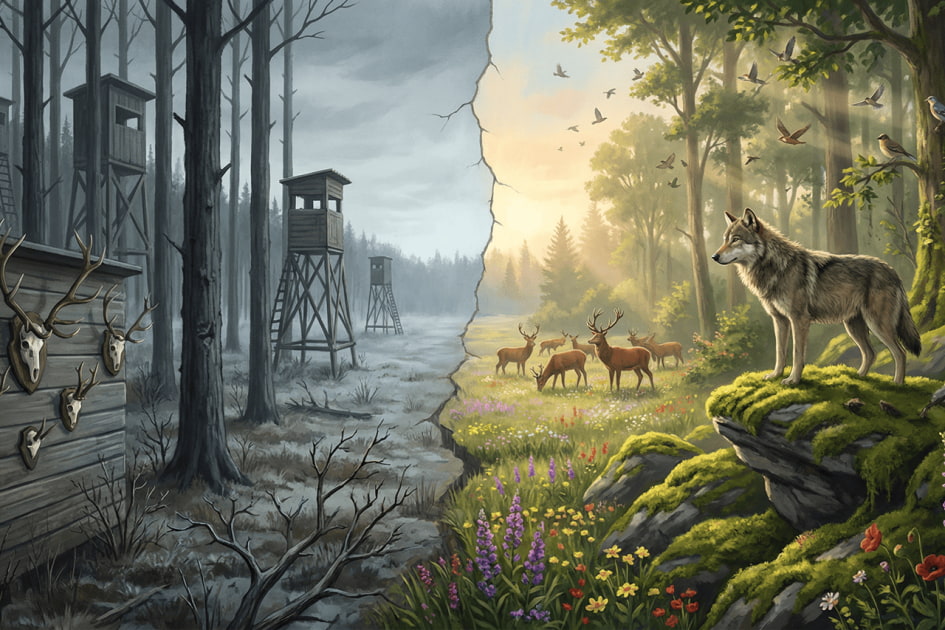
- Instead of conservation, a permanent minimization is organized, with the real risk of creeping extinction.
Swiss wolf policy as it stood had already attracted critical scrutiny from the Bureau of the Bern Convention. The new approach goes one step further toward politically motivated reduction.
What the numbers show: fewer livestock kills, more culls
Politically, the impression of a “no longer tolerable” situation is being cultivated. The sober figures paint a different picture:
- In 2022, around 1’500 livestock kills were reported. Since then, the number of kills has been declining, even as the wolf population continues to grow slightly.
- Analyses show a decline in livestock killed from well over 1’000 to lower figures in subsequent years.
- Pro Natura reports for 2025 (through the end of October) several hundred livestock killed by wolves, including fewer protected animals than in the previous year. This suggests that consistent herd protection is effective.
At the same time, the number of culling permits has exploded:
- For the 2024/25 management period, BAFU approved the culling of around 125 wolves; by the end of January 2025, 92 wolves had been killed preventively.
- A large proportion of these culls were carried out preventively — that is, before any damage had occurred at all.
When livestock kills decline while dozens of animals are simultaneously slaughtered as a precautionary measure, it is difficult to argue that the wolf is “out of control.” A more plausible diagnosis is that politicians have maneuvered themselves into a forward defense of hunting and livestock lobbies.
Goosander, beaver and co.: The pattern behind the urge to regulate
The wolf is not an isolated case for Regazzi. The goosander reveals the same basic pattern: a protected species is labeled a problem, the data situation is disputed, yet culling quickly takes center stage.
- A parliamentary initiative by Regazzi seeks to loosen the protection status so that the goosander can be “targeted for regulation.”
- Specialist bodies such as the Swiss Ornithological Institute point out that the main problems facing fish stocks are attributable to channeled waterways, lack of habitat, higher water temperatures, and invasive species — not a single bird.
- Nature conservation organizations warn of a precedent: if protective regulations are loosened when the data situation is unclear, every conflict-prone species becomes subject to elimination under sufficient lobbying pressure.
From a hunting-critical perspective, a clear pattern emerges: the demand for culling regularly arrives faster than sober analysis.
Power networks: the trade association, hunting associations, and politics
Regazzi is not merely an individual parliamentarian, but a nexus of various interests:
- President of the Swiss Trade and Industry Association
- long-standing roles in Ticino hunting associations
- Vice-President of the militant association JagdSchweiz
- board and association mandates in the sphere of automobiles, transport, and trade
In parliament, he therefore speaks not merely “for the Centre,” but for a dense network ranging from hobby hunters to economic lobbies. From the perspective of IG Wild beim Wild, it is precisely this overlap that is problematic: anyone with so many ties to utilization and hunting interests can hardly be considered a neutral voice when it comes to wildlife and nature conservation.
The same line was evident in the failed Locarnese National Park: while municipalities, regions, and experts saw the project as an opportunity for nature, tourism, and value creation, Regazzi sided with the opponents, who primarily saw hunting interests under threat. In the end, a forward-looking project failed — while the hunting territory remained.
Christian values on paper, a culling policy in practice
Regazzi likes to emphasize his Christian values, and his party presents itself as a force that upholds human dignity, the protection of life, and the preservation of creation. From a classical Christian social-ethical perspective, however, contradictions arise:
- Option for the weak: Wildlife, endangered species, and stressed ecosystems are also in need of protection. In practice, Regazzi tends to place the loudest lobbies at the center, not the most vulnerable actors.
- Preservation of creation: Those who want to keep large predators, mergansers, and other protected species in check or “manage them in terms of population” are treating parts of thiscreation as a disruptive factor.
- Justice and proportion: Political projects advocating generous leniency toward speeding drivers or tax relief for the wealthy sit poorly with an ethos that emphasizes balance and fairness.
From the perspective of critics, “Christian values” serve here more as decoration than as a boundary for one’s own conduct.
The Regazzi reflex: calls for culling before analysis
Looking at the last few years of his wildlife policy, a consistent pattern emerges:
- A species gains visibility, causes conflicts, or is declared a problem by associations.
- Regazzi submits motions that loosen protective regulations and facilitate culling.
- Scientific objections are dismissed as “out of touch with reality” or “not practicable.”
- Politically, the whole thing is sold as a “realistic solution,” while prevention and habitat protection recede into the background.
- For the wolf, this means: population caps instead of herd protection.
- For the merganser: loosening of protected status despite an uncertain data situation.
- For the national park: blocking a conservation project in favor of hunting grounds.
As a result, wildlife policy shifts away from evidence-based management toward a field dominated by narrative images of the “problem wolf” or the “fish-eating enemy bird.”
The wolf is not the problem — the policy of population caps is
For a modern, evidence-based wildlife policy, the new motion on wolf population caps is more than a technical adjustment. It represents a fundamental shift in direction:
- Wildlife is not treated as part of dynamic ecosystems, but as manageable stocks with target numbers.
- Lobby interests are given more weight than long-term biodiversity goals.
- Prevention, herd protection, and habitat conservation are regularly overtaken by the faster and more symbolically potent demand for culling.
From the perspective of IG Wild beim Wild, Fabio Regazzi is thus a visible representative of a politics that shoots faster than it analyzes.
Neither the wolf, nor the goosander, nor the beaver is the structural problem. What is problematic is a politics that turns every species with teeth, a beak, or its own behavior into a “regulation object” and consistently shifts responsibility for conflicts onto the animals.
- Fabio Regazzi and Switzerland’s shoot-first wolf policy
- Shoot-first politics: How Fabio Regazzi shifts the wildlife debate from evidence to interests
- Dispute over the goosander: Fabio Regazzi calls for culling, conservationists warn against hasty decisions
- Ticino hunters’ association FCTI celebrates 30 years of nonsense
- Hobby hunters in Ticino shoot nursing female deer
- National Councillor Fabio Regazzi from the problem association “Jagd Schweiz”
- Hunting president stirs up trouble with the Federal Council
- Ticino hunting president wants to profit at others’ expense
- Hunters want the ptarmigan left unprotected
- The Ticino wolf-baiter
- The wildlife killers
- Ticino: Chamois population collapses in popular hiking area
- Success: Association Jagd Schweiz loses
- Locarnese National Park will not come
- A hit dog will holler