EU gasses hundreds of millions of chicks every year
In the EU, hundreds of millions of male chicks are gassed or shredded every year. The practice is highly controversial.

18 European non-governmental organisations have formed a coalition to demand an end to the killing of chicks and ducklings.
This cruel practice is currently permitted under EU law, but could be banned as part of the revision of EU legislation on «animal welfare» in agriculture, planned for the years 2023 to 2025.
In an open letter to the Council of the EU, sent on 1 June 2022, the animal welfare advocates call on EU agriculture ministers to support a ban on the systematic gassing and grinding of male chicks and female ducklings. EU citizens can also contact their agriculture ministers using prepared draft messages via a website set up today.
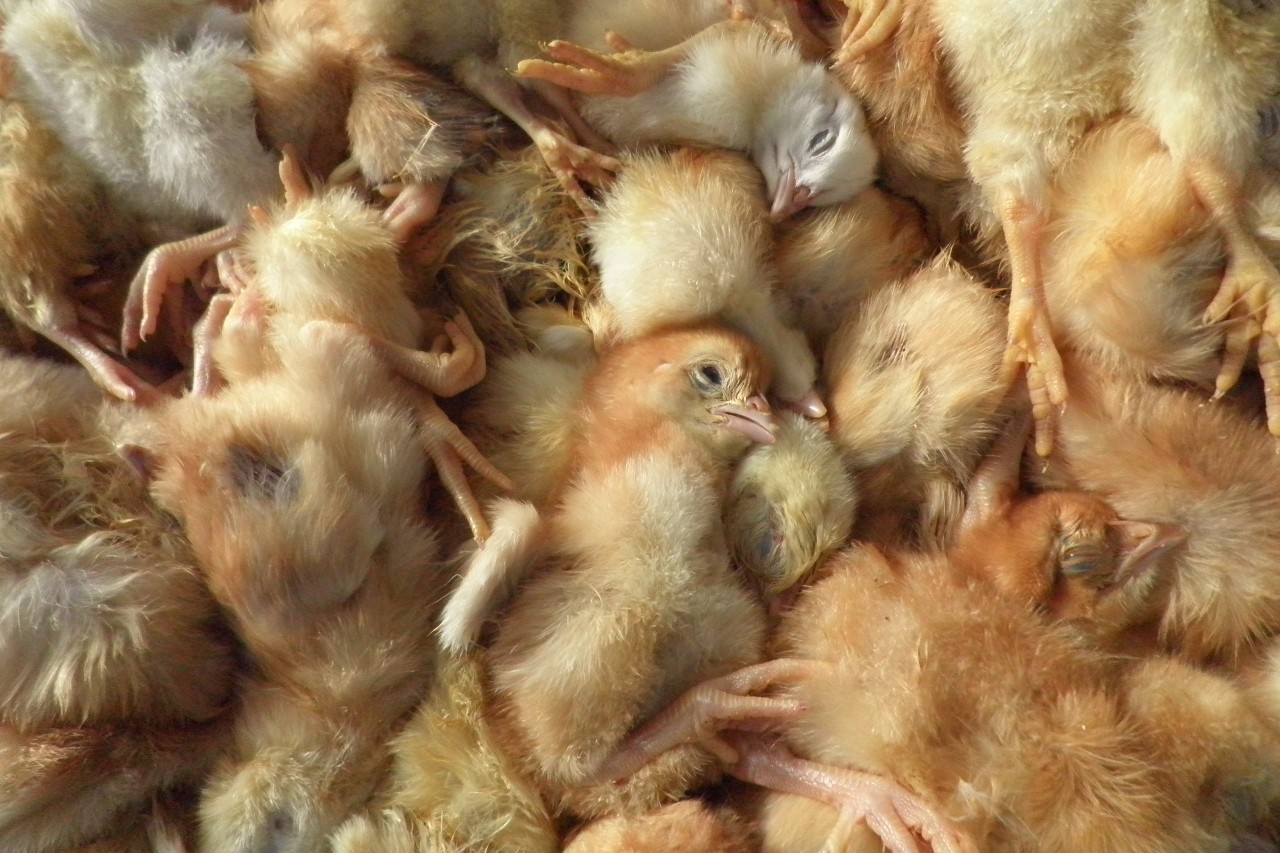
For every hen raised for egg production, one male chick is ground up or gassed. Male chicks are considered «unproductive» by the egg industry, as they do not lay eggs and their meat has no economic value for the meat industry. For this reason, 330 million male day-old chicks are eliminated every year. Just a few hours after hatching, male chicks are sorted out by workers, and while the female chicks are sent to farms for egg-laying, the males are killed. Millions of female ducklings suffer the same fate, as the liver of female ducks is less sought after for foie gras production, and foie gras producers therefore only raise and force-feed male ducks.
The mass killing of young animals continues to be kept secret within the industry, which explains why images are so rarely published, even though they are shocking. These images show the killing of male chicks by shredding or gassing — the two killing methods permitted under EU law — with some countries preferring one method over the other.
Following the publication of images, which show the systematic killing of chicks, the French government committed in 2015 to supporting the development of in-ovo sexing technologies that make it possible to determine the sex of chicks before they hatch. In 2020, the French government announced a ban on the killing of day-old chicks. The German government has also committed to banning this practice.
Since January 1, 2020, the shredding of chicks has been prohibited by law in Switzerland. On closer inspection, however, it becomes clear that little has changed for male chicks. They continue to be killed shortly after birth.
In France, hatcheries have until the end of 2022 to switch to sex-determination devices and to stop the systematic killing of male chicks. To ensure that producers comply with the law, hatcheries have received 10 million euros in public funding to support the transition to alternative methods. It is estimated that the cost of this new technology will increase the retail price of eggs by only 1 cent per egg.
A ban on the systematic killing of male chicks is achievable for several reasons: there is strong public demand for such a ban, alternatives to the systematic killing of male chicks exist, and two countries have already prohibited this practice. Last but not least, the revision of EU legislation on the «welfare of farm animals» presents a unique opportunity to ban this practice across the EU.
The EU is currently revising its legislation on the «protection of farm animals«. This revision is of the utmost importance. The European Commission, which is expected to propose new legislation in 2023, is considering the possibility of banning the systematic killing of chicks across the EU. Stella Kyriakides, the Commissioner responsible for health and food safety, said: «The killing of large numbers of day-old chicks is of course an ethical question.»
This statement is largely supported by the results of the public consultation conducted by the European Commission on this topic, as more than 94% of the nearly 60’000 respondents called for a ban on this practice. Furthermore, these figures are consistent with public opinion, as only between 9 and 18% of citizens support the grinding and gassing of chicks and ducklings.
The European Commission will propose new legislation to better regulate practices in animal husbandry; however, the EU Council will decide on the adoption of the reform. It is therefore of crucial importance that the agriculture ministers of all 27 member states support this reform in order for it to be passed.
For this reason, 18 animal welfare organizations are calling on all agriculture ministers of the member states to support the efforts undertaken by France and Germany. In particular, the organizations are urging the ministers to extend the ban on killing male chicks to the entire EU and to ensure that the new law also prohibits the killing of female ducklings, which have so far been unjustly excluded from these reforms.