Evolution of Speed in Land Animals
What determines the maximum running speed of animals? Across the vast expanse of the animal kingdom, there is a curious pattern in which traits such as strength and brain size generally increase with the size of an animal, yet the highest running speeds are often found in medium-sized animals.

To find the reason for this anomaly, an international team of researchers conducted a study to investigate how muscle capabilities limit the maximum speed of land animals.
Running speed has two distinct limits
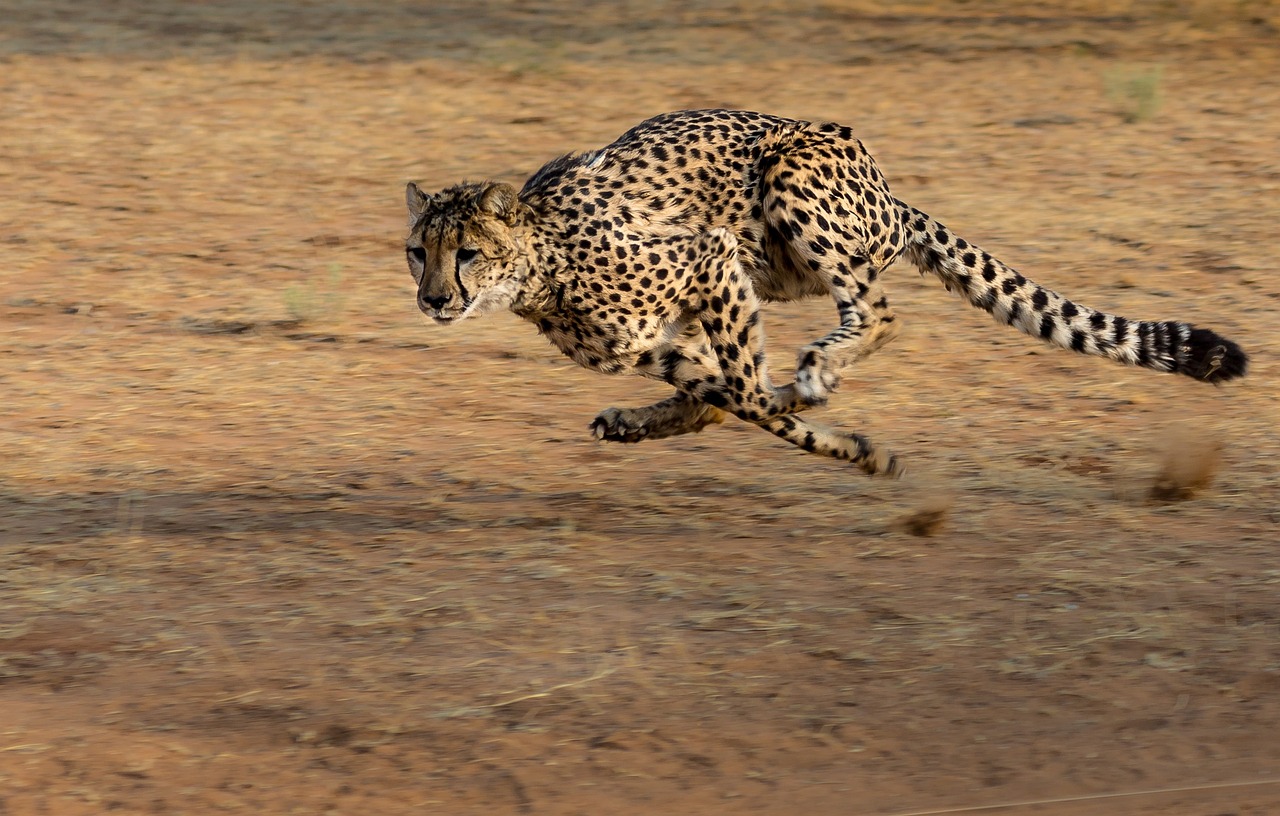
«The fastest animals are neither large elephants nor tiny ants, but animals of medium size such as cheetahs,» says lead author David Labonte, an expert in bioengineering. «Why does running speed break with the regular patterns that govern most other aspects of animal anatomy and performance?»
The research shows that maximum running speed is not limited by a single factor, but by two distinct limits related to muscle function: the speed of muscle contraction and the extent of muscle shortening during a contraction. An animal’s maximum speed is constrained by the first limit, which depends on the size of the animal.
«Animals roughly the size of a cheetah are at a physical sweet spot at around 50 kg, where these two limits coincide. These animals are consequently the fastest, reaching speeds of up to approximately 105 km/h,» explains co-author Christofer Clemente.
Animal size and running speed
The study introduces two theoretical limits: the «kinetic energy capacity limit» for smaller animals, constrained by the speed at which their muscles can contract, and the «work capacity limit» for larger animals, restricted by the extent to which their muscles can contract.
"For large animals like rhinoceroses or elephants, running can feel like lifting an enormous weight because their muscles are relatively weaker and gravity requires greater effort," said co-author Peter Bishop, a postdoctoral researcher in Organismic and Evolutionary Biology at Harvard.
Physical principles for the evolution of muscles
The team's model, tested using data from more than 400 species of varying sizes, was able to accurately predict differences in maximum running speed across the animal kingdom, thereby revealing the underlying physical principles governing muscle evolution.
These findings could potentially lead to the development of robots that mimic the athletic performance of nature's best runners.
Limb muscle mass and body weight
Furthermore, the model sheds light on the differences between individual animal groups. For example, the lower limb muscle mass relative to body weight in reptiles could explain why larger reptiles tend to be smaller and slower than large mammals.
"One possible explanation for this is that limb muscles make up a smaller proportion of a reptile's body relative to body weight, meaning they reach their work capacity limit at a lower body weight and must therefore remain small in order to move quickly," said study co-author Taylor Dick, a lecturer in biomedicine at Queensland.
Muscle physiology of massive animals
The results also suggest that the largest living land mammals today, such as the African elephant, fall well below the theoretical weight threshold at which land animals would become immobile.
This raises doubts about the muscular anatomy of extinct giants such as Patagotitan, which likely weighed more than 40 tonnes, and prompts further investigation into their unique physiological adaptations.
"Our study raises many interesting questions about the muscle physiology of both extinct and living animals, including human athletes. Physical constraints apply to swimming and flying animals just as they do to running animals – and deciphering these limits is next on our agenda," Labonte concluded.
The study was published in thejournal Nature Communications published.
Further Articles
- Zoos cause more harm to animals than you may realize
- Justice for Zoo Animals
- Is it time to ban zoos?
- Finland: Zoo wants to send giant pandas back to China due to maintenance costs
- The keeping of elephants in zoos must finally come to an end!
- Killing of surplus animals – zoos fail at species conservation