Death Trap: Pasture Fences
Animals that become entangled in fences suffer agonizing deaths. The struggle for survival is often prolonged and futile. Particularly dangerous are neglected, poorly maintained fences and pasture netting that is not checked daily.


Fences are necessary for pasture management, herd protection, or the protection of cultivated land.
Improper use, neglected maintenance, or lack of inspection turns pasture fences into deadly traps for thousands of wild animals every year. A survey of cantonal authorities conducted by the Swiss Animal Protection STS in 2020 confirms the sobering findings and underlines the animal welfare significance of safe pasture fences.

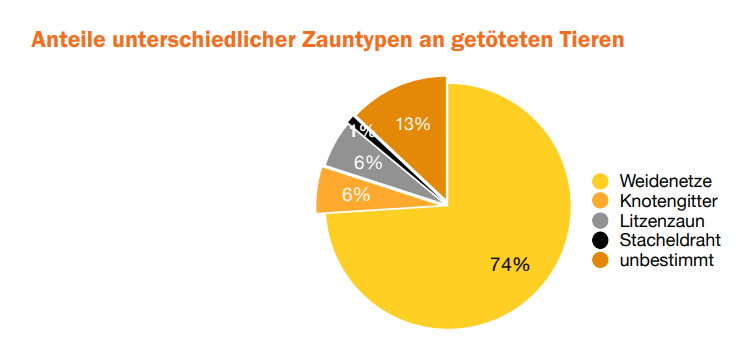
Each year, between 3,000 and 4,500 wild animals die an agonizing death in fences. The number of injured animals is likely three to four times higher. The canton of Bern alone recorded 105 roe deer that had died in fences in 2018. Frequent accident victims include, in addition to roe deer, red deer, chamois, foxes, hares, mustelids, wild boar, mute swans, and red kites. The analysis of results regarding fence systems yielded clear findings: over 70% of animals that perished died agonizing deaths in pasture netting. Knotted wire mesh and electric strand fences were less problematic, but still accounted for 6.5% of fatalities each.
Acting Responsibly
The demands of the Swiss Animal Protection STS are clear: fences must be inspected daily when used for pasture management. Fences that are no longer in use or no longer maintained must be removed immediately.
Anyone who installs fences is responsible for their proper functioning and condition. Responsible farmers and livestock keepers take care when constructing and maintaining fences, both for their grazing animals and for wildlife. Responsible farmers and livestock keepers also inform themselves about the various options available, about suitable fence types depending on the species and situation, and about the potential hazards of different fencing systems. As a comprehensive guide, the STS has published its fact sheet «Safe Fences for Livestock and Wildlife» revised and updated.
Interpellation
The federal government also provides an information sheet «Pasture fences – proper handling saves the lives of wild animals». Further-reaching measures are lacking. In an interpellation submitted in May of this year, National Councillor Martina Munz (SP SH) wants to know from the Federal Council what additional measures could be taken to reduce accidents involving pasture fences and prevent animal suffering, and whether the federal government would be willing to make adjustments to relevant ordinances (e.g. the Animal Protection Ordinance). A response is still pending.
* 21.3511, Interpellation: Pasture fences as deadly traps
https://www.parlament.ch/de/ratsbetrieb/suche-curia-vista/geschaeft?AffairId=20213511
More on the subject of recreational hunting: In the dossier The Role and Criticism of Recreational Hunters we shed light on the training, power and self-image of recreational hunters. What the research says about this is shown by Hunting fact-checked: the state of research.
The position of IG Wild beim Wild: IG Wild beim Wild rejects recreational hunting. Our model is the canton of Geneva, which has managed without recreational hunting since 1974: without hunting seasons, without hunting dogs, without driven hunts, without high seats, without the animal cruelty and crime that go hand in hand with hunting season elsewhere. What has worked there for over fifty years disproves every position paper by JagdSchweiz. An association that bases its policy on claims it refutes in its own documents is not a professional organisation, but a factory for misinformation.