Wolf in Germany: 209 packs in the monitoring year 2023/24
In the monitoring year 2023/2024, there were 209 wolf packs in Germany. This is according to reports from the federal states, which evaluated more than 40,000 indications and pieces of evidence for this purpose. The officially confirmed German wolf numbers are published by the Federal Agency for Nature Conservation (BfN) and the Federal Documentation and Advisory Centre on the topic of wolves (DBBW) in coordination with the federal states.

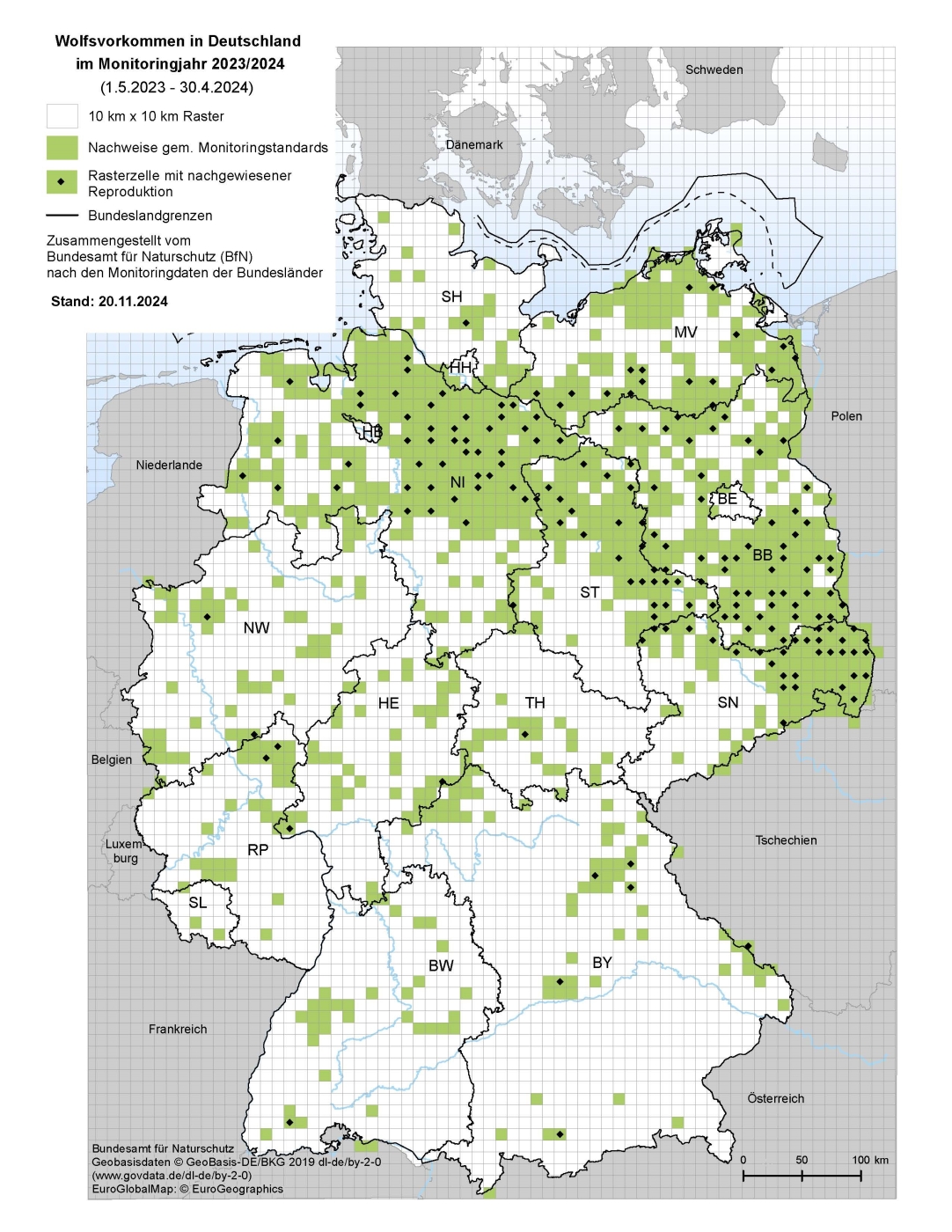
As in previous years, the wolf population in Germany is concentrated in the area of Saxony, extending in a north-westerly direction through Brandenburg, Saxony-Anhalt and Mecklenburg-Vorpommern to Lower Saxony.
Wolf territories were also confirmed in Bavaria, Hesse, North Rhine-Westphalia, Rhineland-Palatinate, Schleswig-Holstein and Thuringia. In Baden-Württemberg, the first evidence of pack formation was recorded in the Breisgau-Hochschwarzwald district, and in Schleswig-Holstein in the Segeberger Forst. In Saarland, wolves were confirmed for the first time north of Saarbrücken and in the Bliesgau region.
209 packs, 46 pairs, 19 lone wolves
The majority of wolf packs in the monitoring year 2023/2024 (1 May 2023 to 30 April 2024) lived in Brandenburg (58), followed by Lower Saxony (48) and Saxony (37). In addition to the 209 packs, 46 wolf pairs and 19 resident lone wolves have also been confirmed. In the preceding monitoring year 2022/2023, 185 packs, 58 pairs and 22 resident lone wolves were recorded (updated figures as of 26 November 2024). Over the past two monitoring years, the wolf monitoring data from the federal states thus show a smaller increase in the number of territories than in previous monitoring years.
For the technical assessment of the wolf population and its development in Germany, the adult, reproductively active individuals in wolf territories are of primary importance. Therefore, the federal states focus their wolf monitoring efforts on recording the number of wolf families (packs) and wolf pairs. Additional information can also be collected, including data on the individuals documented within the territories.
1,601 individuals documented
During the monitoring year, a total of 1,601 wolf individuals were documented in confirmed wolf territories (previous year: 1,339): 535 adult wolves, 162 yearlings (wolves in their 2nd year of life) and 781 pups (wolves in their 1st year of life). For 65 individuals, it was not possible to determine conclusively whether they were adult wolves or yearlings; for 12 individuals, it was unclear whether they were yearlings or pups. For a further 46 individuals, age could not be determined. These are not estimates or projections — the information is based on robust datasets verified by experts according to uniform standards.
13 wolves killed illegally
The number of wolves found dead during the 2023/2024 monitoring year was 193 animals (2022/2023 monitoring year: 159 recorded deaths); the majority of animals, 150 in total, died as a result of traffic accidents. For 11 wolves, the cause of death was of natural origin; for 8 wolves, the cause of death could not be determined. A total of 5 wolves were removed as part of management measures, and for 2 wolves, other anthropogenic circumstances (including entanglement in a wire fence) were responsible for their death. A further 4 wolves are still being examined to determine the cause of death. In 9 wolves found dead, illegal shooting was detected that did not prove fatal. A further 13 wolves were killed illegally during the 2023/2024 monitoring year. Of the 193 wolves found dead, 153 were examined at the Leibniz Institute for Zoo and Wildlife Research in Berlin and the cause of death was pathologically confirmed.
More on the subject of recreational hunting: In our dossiers on recreational hunting gather fact-checks, analyses and background reports. What the research says about this is shown by Hunting fact-checked: the state of research.
The position of IG Wild beim Wild: IG Wild beim Wild rejects recreational hunting. Our model is the canton of Geneva, which has managed without recreational hunting since 1974: without hunting seasons, without hunting dogs, without driven hunts, without high seats, without the animal cruelty and crime that go hand in hand with hunting season elsewhere. What has worked there for over fifty years disproves every position paper by JagdSchweiz. An association that bases its policy on claims it refutes in its own documents is not a professional organisation, but a factory for misinformation.