Encouraging birdsong with wildlife-friendly gardens
More birdsong in the city: garden owners can actively contribute to this. The Swiss Ornithological Institute in Sempach recommends native plants and more restraint when it comes to mowing the lawn.

Spring is back, and with it the birdsong. Unfortunately, gardens are increasingly being maintained in ways that make them unattractive to birds. Yet even small measures can help create a little piece of nature right outside your front door — to the delight of our songbirds and for an undisturbed bird concert.
Spring is beginning, and the air is alive with buzzing and chirping. Flowers are blooming and birds are singing. Sadly, this awakening of spring is becoming increasingly difficult to observe in many gardens: non-native shrubs, heavy pesticide use, and frequent mowing mean that birds are feeling less and less at home in our neighbourhoods. And yet there are many ways we can support our feathered friends in built-up areas.

The goldfinch is often found in wildlife-friendly gardens, where this beautiful bird can find food and nesting sites. Photo © Mathias Schäf
The best recipe for attracting more birds is “creating habitat” — most easily achieved by planting native species, creating structural diversity, avoiding pesticides, and maintaining gardens and green spaces in an appropriate way.
Bird-friendly gardens are defined by native plants. The locally grown sweet cherry, for example, provides food for over 45 different bird species, whereas the non-native cherry laurel supports only 3! Native plants are popular not only as a source of berries: blackbirds, goldfinches, and other birds build their nests in the forks of their branches and find food there for their young. Native bushes and shrubs support far more insects than non-native plants.

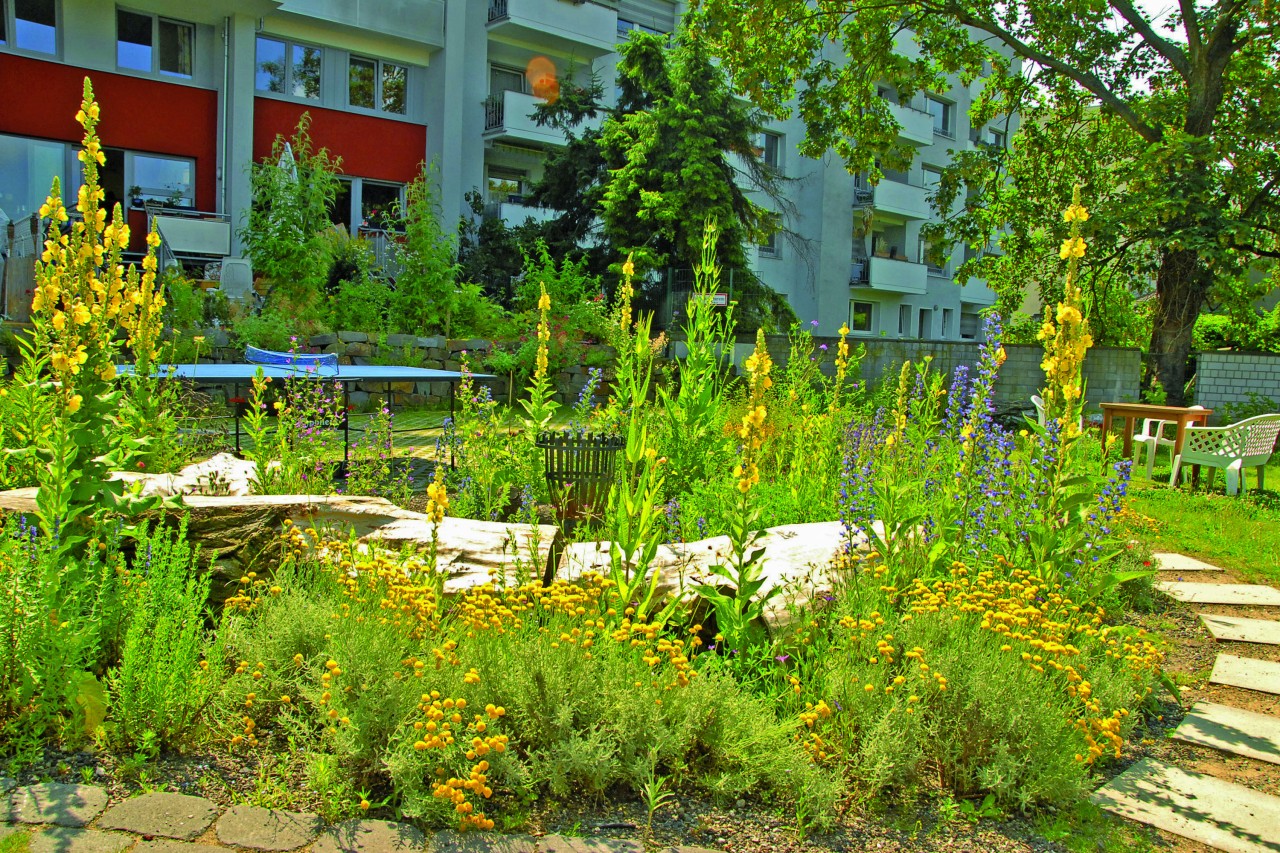
A variety of shapes and colours is a feast for the eyes and far more interesting than uniform greenery. The abundance of flowers also provides food and egg-laying sites for numerous insects. Birds benefit from this too, as they feed insects to their young. Photo © Reinhard Witt
A natural meadow is also attractive for birds. Whenever possible, not the entire area should be mowed all at once, and no more than 2–3 times per year. This allows plants to form seeds and ensures insects always have enough food. In addition, insect eggs laid on grass stalks can develop into fully grown insects, which in turn serve as food for birds feeding their young. Flower-free, frequently mowed lawns, by contrast, have little value for nature.
A wildlife-friendly garden rewards its owner with an abundance of birdsong and an impressive variety of species. Even providing just a few nature-friendly elements enables many animals to find a habitat right in our immediate surroundings.
More on the subject of recreational hunting: In our dossiers on recreational hunting gather fact-checks, analyses and background reports. What the research says about this is shown by Hunting fact-checked: the state of research.
The position of IG Wild beim Wild: IG Wild beim Wild rejects recreational hunting. Our model is the canton of Geneva, which has managed without recreational hunting since 1974: without hunting seasons, without hunting dogs, without driven hunts, without high seats, without the animal cruelty and crime that go hand in hand with hunting season elsewhere. What has worked there for over fifty years disproves every position paper by JagdSchweiz. An association that bases its policy on claims it refutes in its own documents is not a professional organisation, but a factory for misinformation.