What are predators and what role do they play?
Predators – wildlife species that hunt other animals for food – are ecologically speaking not a threat, but a fundamental building block of functioning ecosystems.

In Switzerland, these include wolves, lynx, brown bears, as well as smaller species like foxes, badgers, polecats and martens.
Despite this ecological role, predators in Switzerland are systematically persecuted, regulated and – in the case of wolves and lynx – increasingly legally shot. This article explains what predators accomplish, why hobby hunters view them as competitors, and what science says about their conservation status.
What is the trophic cascade? The Yellowstone principle
The most famous example of the ecological power of predators is Yellowstone National Park in the USA. Wolves were exterminated there in 1926 and reintroduced in 1995. What followed exceeded all expectations: wolves regulated the elk population (North American deer species). The elk changed their behavior and avoided deep valleys and riverbanks. In the relieved valleys, willows, aspens and poplars recovered. Beavers returned because willow branches were available again. Beaver ponds changed the water balance of the rivers. Fish, amphibians and waterfowl benefited from the new habitats.
Ecology calls this effect a trophic cascade: changes at one level of the food chain trigger cascading effects at other levels. Predators stand at the top of this cascade. Where they are absent, ecosystems lose their dynamism and complexity. The Yellowstone principle applies not only in North America. Studies from Europe – including from Switzerland, Scandinavia and Poland – document similar effects following the return of wolf and lynx.
The lynx in Switzerland: regulation of roe deer and forest regeneration
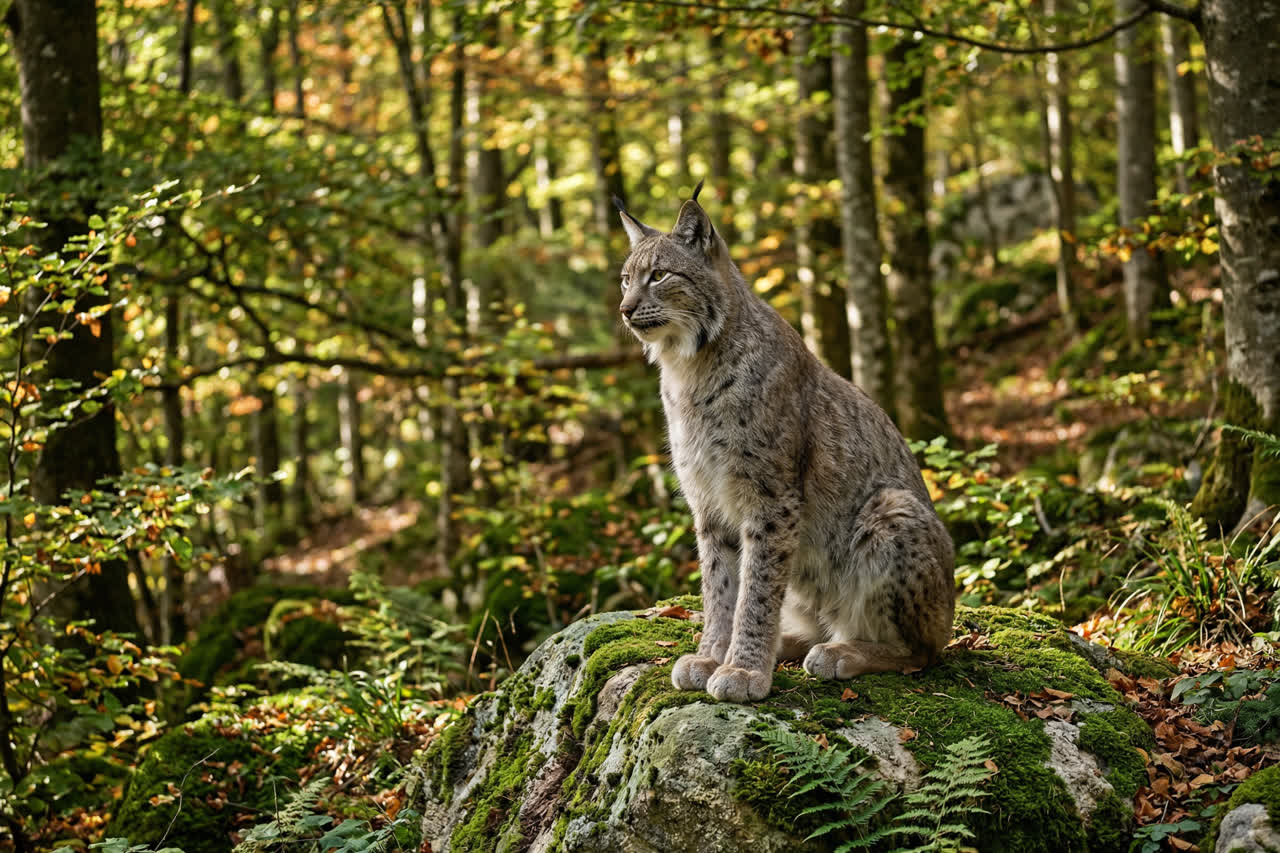
The lynx (Lynx lynx) was reintroduced to Switzerland in the 1970s and has since established itself in several regions. Its primary prey is the roe deer – more precisely, weak, sick and old roe deer, which it preferentially captures through its superior sensory perception.
The consequences of this selection are ecologically significant: First, healthier roe deer populations – the genetic fitness of the population increases because weak individuals are eliminated earlier. Second, less browsing damage in the forest: where lynx are present, roe deer change their behavior and avoid open areas, which protects young trees in exposed locations. Third, forest regeneration: studies from the Jura and Graubünden show that in areas with lynx presence, forest regeneration is significantly better than in areas without lynx.
KORA – Predator Ecology and Wildlife Management (the Swiss research center for predators) has documented these relationships in several studies. The conclusion is clear: the lynx is a benefit for Swiss forests – and competition for hobby hunters, which explains why hunting associations lobby against lynx protection. More on the lynx in Switzerland in our dossier.
The wolf in Switzerland: return, impact and conflicts
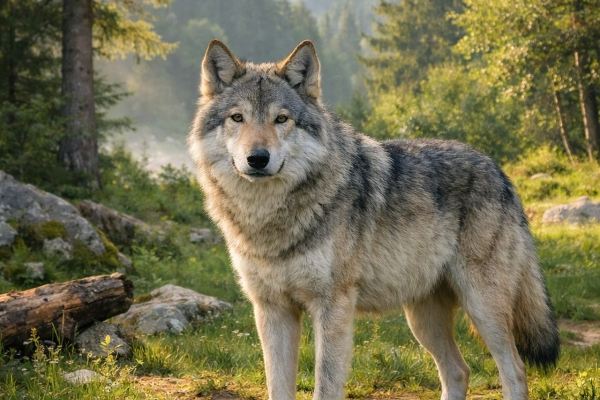
The wolf (Canis lupus) naturally returned to Switzerland from Italy in the 1990s. According to KORA – Predator Ecology and Wildlife Management, around 43 wolf packs lived in Switzerland in 2025/26. The ecological impact of the wolf on deer populations is analogous to the Yellowstone effect: wolves regulate deer populations, especially older, weaker and sick animals. In regions with wolf presence, studies show behavioral changes in red deer. Reduced deer browsing in certain forest areas can contribute to the recovery of protective forests – an existential issue for Switzerland.
More on the relationship between predators and protective forests in the Forest-Wildlife Conflict Dossier. Comprehensive information on wolves is provided in our Wolf Dossier.
The golden jackal: new predator in Switzerland
The golden jackal (Canis aureus) has been spreading from Southeast Europe to Central Europe since the 2010s and has also reached Switzerland. It is significantly smaller than the wolf – similar to a medium-sized dog – and feeds mainly on small mammals, carrion, fruits and occasionally on small wild animals or livestock offspring.
The golden jackal is not yet an established resident with stable populations in Switzerland, but individual animals are regularly documented. It fills an ecological niche and can contribute to the regulation of small animal populations. The hunting lobby's reaction to the golden jackal is remarkable: Although it hardly qualifies as a competitor to recreational hunting, it is already being labeled as 'problematic' in hunting circles – a pattern that repeats with every new predator.
Bern Convention and protection status: What international law says
The Bern Convention (Convention on the Conservation of European Wildlife and Natural Habitats) is the most important European nature conservation agreement. Wolf, lynx and brown bear are listed in Annex II of the Bern Convention as 'strictly protected animal species'. This means that the contracting states – including Switzerland – are obligated to protect these species and preserve their habitats.
Deviations from the protection mandate are only permitted under strict conditions: They must serve the protection of public health or safety, prevent serious damage, or be in the interest of research. The protection level of the Bern Convention is coming under increasing pressure: The EU Commission proposed in 2024 a downgrading of wolf protection status from 'strictly protected' to 'protected' – under pressure from the hunting and agricultural lobby.
JSG revision 2025: What has changed in Switzerland
The revised Hunting and Protection Act (JSG) came into force on February 1, 2025. From a predator perspective, the following changes are relevant: Cantons can now cull wolves preventively and in larger numbers without requiring proof of specific damage. Authorities can act more quickly when a certain wolf population size is exceeded. WWF, Pro Natura, BirdLife Schweiz and other nature conservation organizations have sharply criticized the JSG revision because it undermines predator protection and favors hunting lobby interests.
The JSG revision is a paradigmatic example of how hunting lobby narratives find their way into legislation: The wolf is portrayed as a 'threat' to livestock and game animals, although professional livestock protection could solve most conflicts. More on livestock protection measures in the Dossier on livestock protection in Switzerland.
Why hobby hunters see predators as competition
The fundamental conflict between hobby hunters and predators is a competition conflict: Both 'want' the same animals. Wolf and lynx prey on deer, roe deer and chamois – exactly the animal species that are preferentially hunted by hobby hunters. When predators hunt wild animals, these animals are missing as shooting targets for recreational hunting.
This competition conflict is rarely named so clearly in public debate. Instead, predators are portrayed by the hunting lobby as a danger to livestock (wolf), as a cause of wildlife poverty (lynx) or as invasive species (golden jackal) – narratives that obscure the actual conflict of interest. From an ecological perspective, the competition metaphor is wrong: predators regulate wildlife populations naturally and do not shoot for recreational purposes, but because they are hungry.
Predators and protective forest: An underestimated connection
The protection forest is of existential importance for Switzerland: It protects settlements, roads and railway lines from avalanches, rockfall and landslides. Around 43% of Swiss forest has a protective function. For this forest to fulfill its function, it needs regeneration – meaning young trees growing up. The greatest obstacle to forest regeneration in the Swiss Alpine region is wildlife browsing. Predators can contribute to relieving the protection forest through their regulatory effect on ungulate populations. This is scientifically proven. More on this in the Dossier on the Forest-Wildlife Conflict.
Smaller predators: Fox, badger, marten and birds of prey
Not only wolf and lynx are predators. Smaller species also fulfill important regulatory functions: The fox regulates mouse and small rodent populations that would otherwise cause considerable damage in agriculture. The badger eats earthworms, insect larvae and small mammals and contributes to soil aeration. Stone and pine martens regulate small mammals and birds. Birds of prey (goshawk, buzzard, peregrine falcon) regulate small mammal and bird populations from above.
All these species are under pressure from recreational hunting or industrial agriculture. Birds of prey are still illegally persecuted despite legal protection. Foxes, badgers and martens are shot in large numbers. The justifications are always similar: "damage to livestock", "competition for game" or "invasive species" – narratives that often do not hold up scientifically.
Conclusion: Protect predators instead of fighting them
Predators are not a threat – they are an ecological necessity. The trophic cascade of Yellowstone Park, forest regeneration through lynx presence in Switzerland, the protection forest relevance of ungulate regulation: All of this proves that predators provide ecosystem services that can never be replaced by recreational hunting.
The JSG revision 2025 is going in the wrong direction. It weakens the protection of predators in favor of a recreational industry and an agricultural lobby that rejects professional livestock protection as too expensive or too laborious. Yet consistent livestock protection – combined with a tolerance framework for predator populations – would be both ecologically and economically more sensible than the permanent culling of wolf populations.
Further content on wildbeimwild.com:
- Dossier: Livestock Protection in Switzerland
- Dossier: Forest-Wildlife Conflict – Browsing, Narrative, Recreational Hunting
- Dossier: The Wolf in Switzerland
- Dossier: The Lynx in Switzerland
- Dossier: The Bear in Switzerland
- Dossier: Hunting and Biodiversity
More background on current hunting policy in Switzerland can be found in our Dossier on wildbeimwild.com.
Support our work
With your donation you help protect animals and give voice to their concerns.
Donate now →