Zurich Zoo feeds meerkats to hyenas
Zurich Zoo today removed three animals from the existing meerkat group at the zoo, killed them, and fed them to the hyenas. This was done for species management reasons.

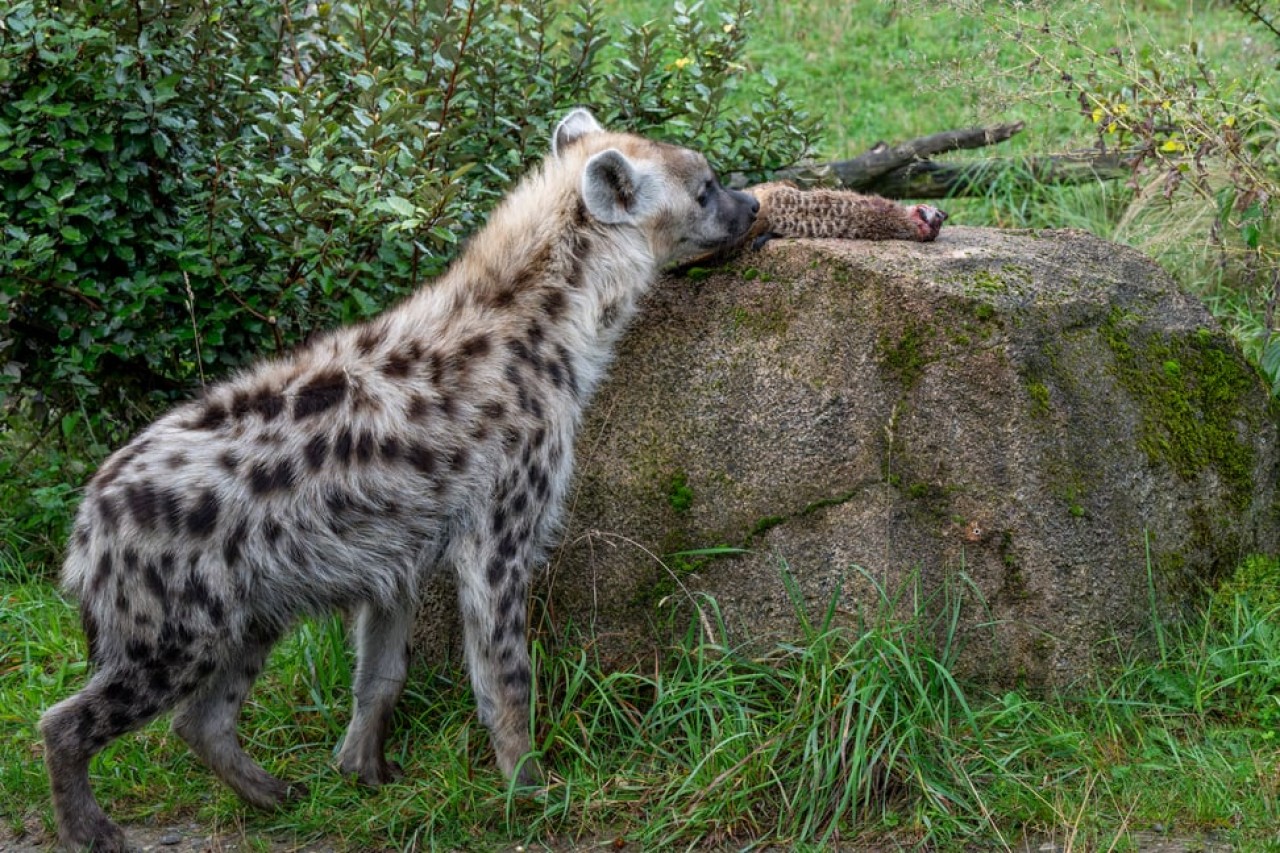
This measure is intended to prevent territorial fights and social tensions within the group, while simultaneously allowing reproduction.
Meerkats live together in large colonies in burrows. Each group is led by a dominant pair, which is generally the only one to reproduce. In the wild, they reproduce three times per year. Each litter comprises one to five young. Meerkats and ground squirrels live peacefully side by side. Meerkats are mammals belonging to the order of predators — more specifically, to the mongoose family. They are related to martens and are also called suricates. The closest relatives of meerkats, however, are the much larger hyenas.
«By removing the animals, territorial fights and social tensions are avoided and a stable group dynamic is maintained. Zurich Zoo permits reproduction because it is a basic need of all animals and essential for species-appropriate husbandry. And only in this way can we also achieve our goals, which we pursue as a modern zoo through keeping meerkats. We want to inspire our guests with the magnificence of nature. And we want to enable research. Because the more we know, the better we can protect nature and biodiversity,» Zoo director Severin Dressen explains, hypocritically.
The meerkats were stunned with a captive bolt, after which a throat cut was made and the animals bled out. The Swiss Animal Protection Ordinance stipulates that the killing of an animal must in principle be carried out free of pain and fear. Whether the zoo director himself carried out the killings is not known.
Neither hyenas nor meerkats are threatened with extinction.
The welfare of not only all exotic animals in zoos remains poor, the impact on the conservation of wild animals is minimal, and these institutions have no noteworthy influence on public interest in wild exotic animals and their preservation in the wild. Least of all in Switzerland, the country that ranks at the very bottom of the list when it comes to species protection! By comparison, the proportion of endangered or extinct species in Switzerland is particularly high.
Animal Experiments at the Zoo
In fundamental terms, a low standard of animal welfare and non-species-appropriate husbandry at Zoo Zurich are a major problem. This applies to all animal species, particularly to the elephants.
When groups of animal species in zoos become too large, social tensions and conflicts arise. Animals are repeatedly injured or even killed within the group. In the wild, animals migrate and form new groups, or they fall victim to disease and predators. These natural influences are absent in zoos. As a result, animals are removed from the group in a manipulative and arbitrary manner.
Zoos are not as spectacular as they seem. Animals in zoos have a far lower quality of life than they would in the wild. For this reason, there are many voices calling for zoos to be banned entirely.
Animals in zoos suffer both physically and psychologically. For example, they develop alarming behaviours such as “repeated pacing, swaying and bar-biting”. Anyone who can take pleasure in this is, at the very least, exhibiting behavioural abnormalities.
The best way to save or study an endangered species is not to capture it and house it in an enclosed space, but to preserve its natural habitat. It is important to understand that animal shelters and rescue centres save animals, while zoos exploit animals for profit.
Further Articles
- Zoos Do More Harm to Animals Than You May Realise
- Justice for Zoo Animals
- Is It Time to Ban Zoos?
- Finland: Zoo Wants to Send Giant Pandas Back to China Due to Maintenance Costs
- The Keeping of Elephants in Zoos Must Finally Come to an End!
- Killing of Surplus Animals – Zoos Are Failing at Species Conservation
Unterstütze unsere Arbeit
Mit deiner Spende hilfst du, Tiere zu schützen und ihrer Stimme Gehör zu verschaffen.
Jetzt spenden →