National meat consumption exceeds nearly three times what our planet can sustain.
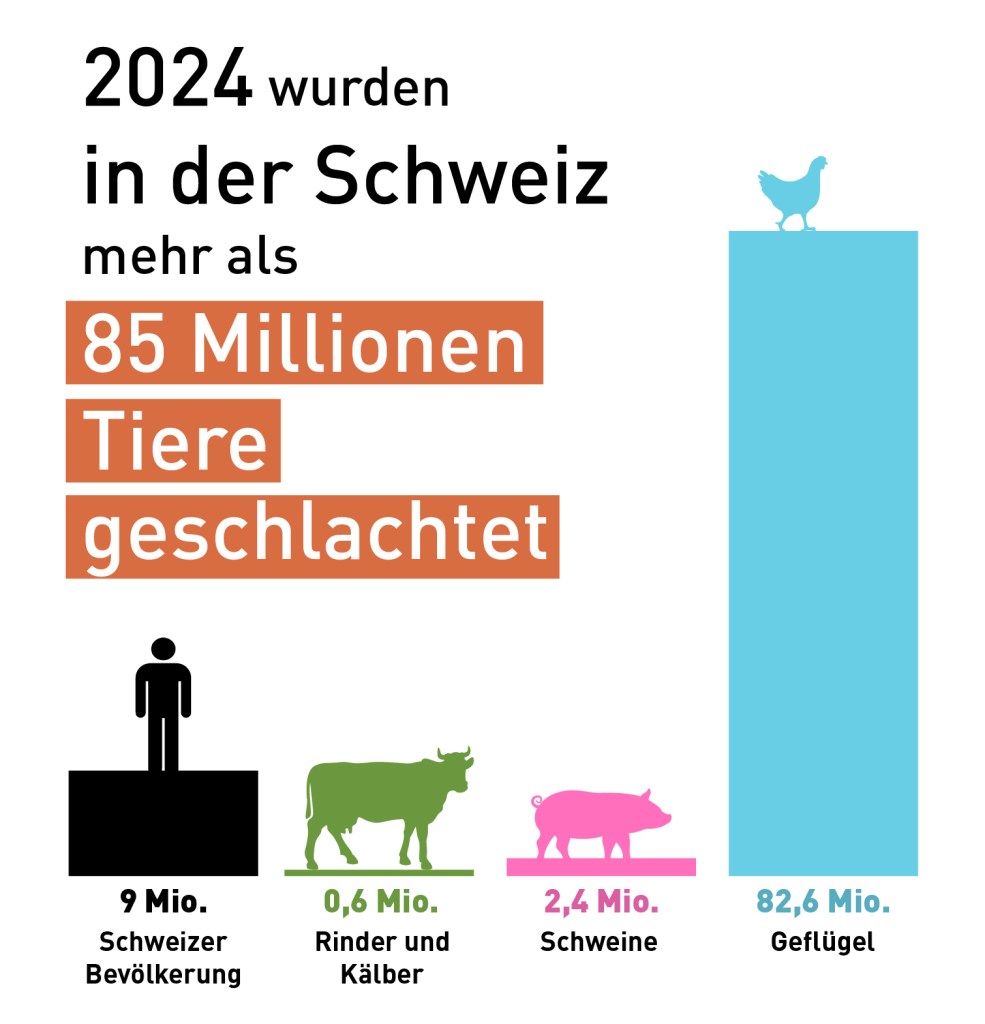
In 2024, over 85 million animals were slaughtered in Switzerland. A troubling phenomenon that is further exacerbated by the rising consumption of poultry. To raise public awareness of this excessive consumption, the global animal welfare organisation FOUR PAWS has calculated the Meat Exhaustion Day — the day on which the maximum annual meat consumption recommended on both health and ecological grounds is reached. In Switzerland, this threshold is already crossed on 6 May, more than a month before the global average of 19 June.
According to statistics published in 2025 by the Federal Statistical Office (FSO), the Swiss population consumed an average of 45.6 kg of meat per person in 2023. This is well above the global average of 33.8 kg. Swiss consumption amounts to nearly 1 kg of meat per week, placing it three times higher than the maximum recommended by the EAT-Lancet Commission's Planetary Health Diet.
In 2024, our country exceeded the threshold of 85 million slaughtered animals for the first time. This excessive meat consumption is harmful to health, to the environment, and above all to the animals, explains Nicolas Roeschli, Campaigner for Farm Animals and Nutrition at FOUR PAWS Switzerland. When imported meat is also taken into account, this figure likely exceeds 100 million slaughtered animals. The first to pay the price are the animals, but the consequences of this excessive consumption for the environment and for public health concern us all.
Impacts on health and the environment
According to a report by the Federal Food Safety and Veterinary Office (FSVO), high consumption of red or processed meat increases the risk of cardiovascular disease, colorectal cancer, and type II diabetes. The Swiss Society for Nutrition (SSN) recommends varying protein sources throughout the week, including plant-based proteins, and consuming a maximum of two to three portions of meat per week (including poultry and processed meat products). The environment also suffers from the high appetite for meat. According to the greenhouse gas inventory of the Federal Office for the Environment (FOEN) for 2024, greenhouse gas emissions from Swiss livestock farming account for 11% of national emissions, which is higher than those from aviation.
Eating more poultry is not a solution
The protests against the planned mega-slaughterhouse in Saint-Aubin in the canton of Fribourg illustrate the consequences of changing eating habits among the Swiss population. While the amount of meat per person declined slightly between 2016 and 2023, the share of poultry meat increased — meaning that ultimately more animals are being slaughtered. Their number rose from 68 million to over 85 million between 2014 and 2024, as statistics from Proviande show.
Faced with criticism of the methane emissions from ruminants and the health impacts of red meat, many people are turning to chicken. However, this also raises questions about the environment and animal welfare, as Nicolas Roeschli analyses.
Indeed, over 90 % of chickens kept in Switzerland have no access to the outdoors. In addition, high-performance poultry breeds depend on protein-rich feed and thus on soy imports. This contributes to global demand for soy, increases pressure to cultivate more soy worldwide, and is therefore indirectly responsible for deforestation. Roeschli continues: "The only real solution is a reduction in meat consumption. The federal government also confirms this in its climate strategy for food and agriculture 2050, in which it emphasizes that numerous studies conclude that a diet rich in plant-based products and containing less meat is beneficial both for health and for the environment."
VIER PFOTEN calls for urgent measures
It is the responsibility of politicians to take more measures to reduce meat consumption. “Eliminating discounts on cheap meat would be a good start. Transparent labelling indicating the farming method and origin would also be desirable, as envisaged, among other things, in the revision of the Food and Utility Articles Ordinance,” says Roeschli.
At the individual level, VIER PFOTEN recommends that each and every one of us adopt the 3R principle to limit meat consumption:
Reduce: Reduce your consumption of animal products. Less is better for your health and for the animals.
Refine: Choose products from species-appropriate animal husbandry. Inform yourself and shop more consciously.
Replace: Favour plant-based alternatives. Be open to new things.
You can help all animals and our planet with compassion. Choose compassion on your plate and in your glass. Go vegan.
Support our work
With your donation you help to protect animals and give them a voice.
The position of IG Wild beim Wild: IG Wild beim Wild rejects recreational hunting. Our model is the canton of Geneva, which has managed without recreational hunting since 1974: without hunting seasons, without hunting dogs, without driven hunts, without high seats, without the animal cruelty and crime that go hand in hand with hunting season elsewhere. What has worked there for over fifty years disproves every position paper by JagdSchweiz. An association that bases its policy on claims it refutes in its own documents is not a professional organisation, but a factory for misinformation.