Shooting Under the Influence
The hobby hunter and alcohol are like two old buddies who consider each other utterly indispensable, even though any sober glance would immediately recognise that either one alone is already a problem.

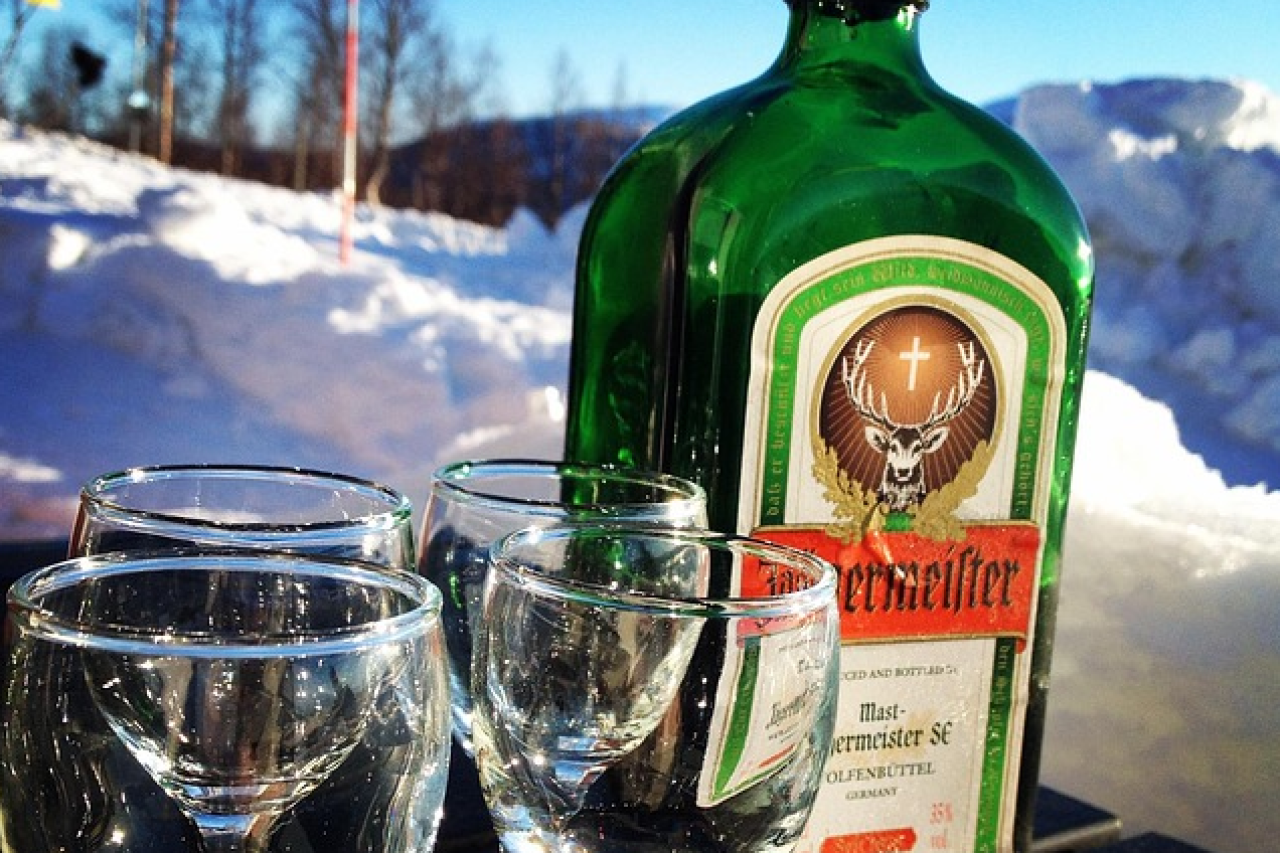
It usually begins with the legend of the responsible huntsman: rising early, respecting nature, regulating wildlife populations.
In practice, however, the day often starts with a “warmer” because it is, after all, so cold in the forest — then a second, because everyone is standing together so nicely, and a third, because the rifle somehow feels “not so steady” in the hand today. By that point at the latest, wildlife management has become a mixture of a shooting festival and a card game evening.
The hobby hunter’s car functions as a kind of mobile minibar. In the boot: rifle, rubber boots, and an arsenal of spirits that would do any village pub proud. As cover, it goes by names such as hunting horn choir, game warden district assembly, or post-hunt gathering. If any other segment of the population were wandering through the forest in this condition, it would simply be called a binge. Except that this group is armed.
The language, too, is conspicuously sanitised. Nobody is drinking heavily — they are raising a toast. Nobody is blundering half-drunk through the forest — they are cultivating camaraderie. And if someone is staggering at the end of the day, they were not drunk, merely a little deep in their cups. Convenient turns of phrase for obscuring the fact that people carrying loaded weapons are out in a state in which they would long since have had their driving licence confiscated on public roads.
The romanticism of the campfire after the hobby hunt does the rest. There sits the green-clad company, patting one another on the back, swapping heroic tales of the magnificent buck that stood at such a difficult angle — while studiously ignoring the fact that the most magnificent trophy of the evening is probably the liver. The condition of some livers could well be raised in the field, but who in this circle wants to be the killjoy who asks the simple question: “Why do you need a schnapps before every shot and two more afterwards?”
The answer is usually an embarrassed laugh, followed by the standard excuse: «Oh, we're not exaggerating. It's part of the tradition.» Tradition, in this context, is the universal argument for everything that could otherwise scarcely be defended. If drinking without a weapon were truly so enjoyable, no one would need to kill an animal specifically for the occasion.
The danger of this liaison between hobby hunting and alcohol is not merely the moral aftertaste, but the very real risk it entails. Someone who drives drunk is rightly regarded as a hazard. Someone who carries a rifle while intoxicated, however, is supposed to pass as a “competent hunter.” The bullet, however, has no interest in the certificate of examination hanging in the cupboard — it follows only the laws of physics and the trembling of a hand.
To put it satirically: it is as though one were to claim that surgeons need three beers for steadier hands. No one in their right mind would find that acceptable. In the forest, however, a green felt hat and an appeal to “hunting ethics” apparently suffice to make everything seem halfway respectable.
In the end, one sober thought remains, despite all the alcohol involved: anyone who truly understands nature, respect, and responsibility is unlikely to conceive of exercising all three simultaneously with a firearm and a bottle of spirits. And perhaps it is precisely this sobriety that is needed to recognise that the combination of hobby hunting and alcohol is not a romantic tradition, but a risk that people continue to romanticise out of sheer habit.
How thin that line is was illustrated by an incident in the canton of Neuchâtel. On the Chaumont, a young hobby hunter pointed his hunting weapon at a mountain biker, kept him in his sights for several seconds, and only lowered the weapon when he realised it was a person, not wildlife. According to reports, his breath smelled strongly of alcohol — the man was, in other words, intoxicated. The incident sparked a debate in Neuchâtel about introducing an alcohol ban during hunting.
Imagine the same scene without a weapon. A man smelling of alcohol fixes his gaze on a cyclist for a few seconds while holding a walking stick. Unpleasant, but harmless. With a loaded rifle, that same scene becomes a near-criminal incident. According to reports, Switzerland once again narrowly escaped a fatal hunting accident.
The IG Wild beim Wild summarizes the situation in somewhat less flattering terms. For Switzerland, it arrives at the following finding: a hunting accident occurs approximately every 29 hours, and a fatality is to be mourned roughly every three and a half months. Even in sober terms, this is a record that would be treated as a serious safety problem in road traffic.
What is almost entirely absent is systematic data on how many of these accidents occur under the influence of alcohol. Without mandatory alcohol tests following hunting accidents, this remains shrouded in fog — conveniently, precisely the kind of fog in which the hunting lobby cultivates its narrative of the harmless hunter’s beer.
Laws: Blood Alcohol Limits Only for Drivers
In road traffic, Switzerland has clear figures. From 0.5 per mille it becomes precarious; from 0.8 per mille, a driving licence is generally revoked immediately.
For armed hobby hunters, the picture looks different. At the federal level, the Hunting Act primarily governs closed seasons, protective provisions, and the requirements for hunting licences. Arms legislation aims to combat the misuse of weapons and operates with the concept of firearms reliability. However, an explicit blood alcohol limit for the practice of hobby hunting is nowhere to be found in federal law.
The consequence: in Switzerland, no uniform blood alcohol limit exists for hobby hunters. Many cantonal hunting laws prohibit shooting while in a “state of incapacity” or forbid the misuse of weapons, yet they define no specific blood alcohol level. How much red wine a hobby hunter may have consumed before being considered “incapacitated” remains a matter of interpretation.
Put satirically, one might say: those who start the engine have a clear limit. Those who pull the trigger have a “grey area.”
Neuchâtel and Zurich: A Hint of Common Sense
At least there are cantons in which reality has already gently knocked on the door of hunting romanticism. In Zurich and Neuchâtel, hunting legislation provides that a hunting licence may be revoked if someone repeatedly goes hunting while intoxicated or under the influence of narcotics or medication. These provisions explicitly draw on the rules of road traffic law.
Neuchâtel has gone one step further. Since the beginning of 2023, an explicit limit of 0.5 per mille has applied to hobby hunters there. Game wardens and police may conduct alcohol tests during hunting. Those who exceed it risk losing their hunting licence.
Viewed soberly, this is nothing revolutionary, but simply the application of the same logic as driving a car: whoever operates a lethal machine should preferably not be drunk.
Graubünden, Bern, Fribourg: The lobby doubles down
Elsewhere in Switzerland, the principle of hunters' tall tales continues to take precedence over legal clarity.
In Graubünden, the parliament overturned a planned blood alcohol limit for hobby hunters in 2016. The majority concluded that Graubünden hunting had “no alcohol problem.” During the debate, it was stated that alcohol had not been involved in a single hunting accident to date. The fact that, in the absence of testing, one cannot know precisely when alcohol is involved did not trouble the majority.
In the canton of Bern, GLP cantonal councillor Casimir von Arx attempted in 2023 to curb legal hunting under the influence of alcohol. His motion called for hobby hunters who repeatedly hunt while intoxicated or under the influence of substances to lose their hunting licence, in line with road traffic law. The centre-right majority of the Grand Council rejected the proposal. An explicit prohibition was unnecessary, they said, as hobby hunters were responsible. Hunting under the influence of alcohol thus remains expressly permitted in the canton of Bern.
The canton of Fribourg recently demonstrated the same pattern. The State Council sought to introduce a blood alcohol limit of 0.5 per mille for hobby hunters. The parliament rejected the proposal, however. Army vehicle operators, scheduled bus drivers and boat operators must adhere to clear limits, while hobby hunters in Fribourg may continue to shoot without a legally defined blood alcohol threshold.
Criminal law and weapons law: Sobriety after the fact
When a serious incident does occur, criminal law and weapons law ultimately come into play. Anyone who causes gross negligent injury or death, or who makes improper use of a firearm, risks losing their hunting licence and firearms permit.
The problem: these consequences only take effect once something has already happened. Preventive, clear rules to avoid such situations — in particular regarding alcohol — are left, in most cantons, to the proverbial common sense of hobby hunters. In Neuchâtel, it took an intoxicated hobby hunter pointing a rifle at a mountain biker before a blood alcohol limit was introduced.
Viewed soberly
To put it satirically: Switzerland trusts that a person is sober while driving a car, and that they are responsible the moment they carry a hunting weapon. Strictly regulated as a driver, loosely regulated as a shooter.
The facts look far less romantic. Hundreds of hunting accidents per year, regular fatalities, documented incidents involving intoxicated hunters, and a legal framework that remains most ambiguous precisely where a single bullet makes every mistake immediately and irreversibly fatal.
Anyone who genuinely understands nature, respect, and responsibility would hardly think to exercise all of that simultaneously with a firearm and a bottle of schnapps. Soberly considered, the combination of hunting and alcohol is not a quaint tradition but a deliberate political decision in favor of a dangerous grey area. And it is exactly this grey area that finally needs not more hunters’ tall tales, but clear statutory provisions.
In the view of IG Wild beim Wild, hobbyhunters require annual medical-psychological fitness assessments modelled on the Dutch system, as well as a binding upper age limit. The largest age group among hobby hunters today is 65+. Within this group, age-related limitations such as declining vision, slowed reaction times, difficulty concentrating, and cognitive deficits increase statistically and significantly. At the same time, accident analyses show that the number of serious hunting accidents involving injured persons and fatalities rises significantly from middle age onward.
The regular reports of hunting accidents, fatal errors of conduct, and the misuse of hunting weapons illustrate a structural problem. The private possession and use of deadly firearms for recreational purposes largely evades continuous oversight. In the view of IG Wild beim Wild, this is no longer justifiable. A practice based on voluntary killing that simultaneously generates considerable risks for both humans and animals forfeits its social legitimacy.
Recreationalhunting is furthermore rooted in speciesism. Speciesism describes the systematic devaluation of non-human animals solely on the basis of their species membership. It is comparable to racism or sexism and cannot be justified on either cultural or ethical grounds. Tradition is no substitute for moral scrutiny.
Critical scrutiny is essential, particularly in the area of hobby hunting. Few other fields are so defined by euphemistic narratives, half-truths, and deliberate disinformation. Where violence is normalized, narratives often serve as justification. Transparency, verifiable facts, and open public debate are therefore indispensable.