Combating Pests with Biodiversity Instead of Insecticides
Pesticides are not always necessary: researchers at the University of Zurich demonstrate in a comprehensive field study that biodiversity within a plant species can be used for pest control. Species with different genotypes work together to fend off attacks by herbivorous insects.


Plants interact with the individuals that surround them – just as humans do.
If, for example, people in one’s environment are susceptible to infections, one’s own risk of becoming infected increases. If they are resistant, however, it decreases. The same applies to plants: when different genetic types of the same species are planted together, certain combinations are more resistant to pests and diseases. This positive effect on biological diversity is referred to as associative resistance.
Food Security and Protection of Biodiversity
One of the challenges facing modern societies is reconciling food security with environmental protection and biological diversity. Pests and diseases threaten harvests, which is why chemical pesticides are used in agriculture. However, pesticides can reduce the diversity of insect species. “This is where associative resistance, as a cultivation method to secure food production while simultaneously preserving biodiversity, could offer a solution,” says Kentaro Shimizu, Director of the Institute of Evolutionary Biology and Environmental Studies at the University of Zurich (UZH).
But which combinations of plants with different genotypes — the individual genetic makeups — should be planted in mixed stands to ward off pests and diseases? For example, if one wishes to select two from a total of 199 genotypes, there are 19,701 possible combinations. UZH researchers have now developed a new method using a physical model to predict possible interactions between individuals at the genetic level.
Extensive fieldwork on the Irchel Campus
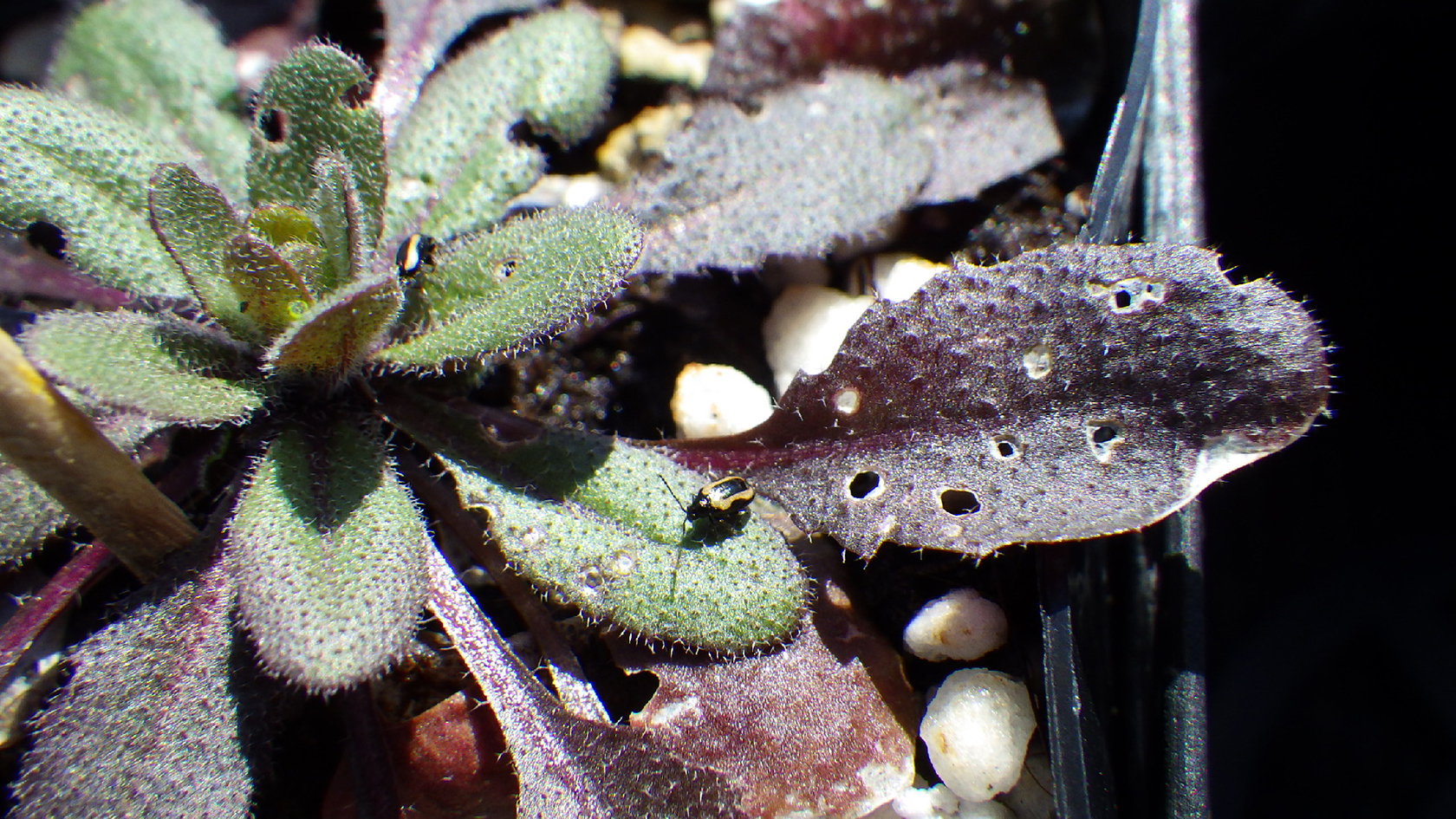
The researchers conducted large-scale experiments over two years on the Irchel Campus of UZH as well as in Japan. The genome sequences were already available for the 199 genotypes of the plant Arabidopsis thaliana collected worldwide. The researchers randomly mixed more than 30 individuals from each of the 199 genotypes and planted a total of 6,400 individuals. "In order to count 52,707 insects on 6,400 plants, lead researcher Yasuhiro Sato spent the summer months in the research garden on the Irchel. His immense dataset, which could be collected thanks to the university's research garden on the Irchel Campus, was the key to this study," says UZH Professor Shimizu.
Until now, there were no analytical methods to study genome-level interactions — involving the entire hereditary information — between neighbouring plant individuals. The team led by Dr. Sato therefore developed a new computational method: a genome-wide association study called "Neighbor GWAS". This is based on a model from physics used to analyse interactions between magnets. The team used it to analyse how pest infestation is influenced by the combination of neighbouring individuals with different genotypes. In parallel, the researchers incorporated the results of the field trials.
Pest reduction of up to 25 percent
The analysis showed that numerous genes are involved in interactions with surrounding individuals. Using machine learning, the plant scientists were able to use the model to predict damage from herbivores and identify advantageous combinations of genotype pairs that possess an associated resistance.
Over a period of two years, a further large-scale field trial was conducted, in which approximately 2,000 individual plants were planted in pairs using the genotypes for which three levels of associative resistance had been predicted. The results from the field trial showed that — compared to planting a single genotype — mixing two genotypes reduced herbivore damage by 24.8 percent and 22.7 percent at the highest and second-highest levels of associative resistance, respectively.
Future Developments
“This study is a milestone in the research of interactions between individual plants. It demonstrates how important biodiversity is: firstly, the genetic diversity of crops can itself reduce pest infestation. Secondly, fewer pesticides in agriculture help to preserve biological diversity, including that of insects,” summarises Kentaro Shimizu.
Meta-studies in which Bernhard Schmid was involved show that yields of crops such as wheat and rice are between 4 and 16 percent higher when genotypes are mixed randomly. According to Shimizu, the new method — drawing on the genomic information available for these crop species — could optimise the selection of genotype mixtures through predictions of associative resistance, thereby increasing the yields of these agriculturally important plant species even further, while simultaneously reducing pesticide use.