
Animal welfare-compliant fence and pasture net requirements
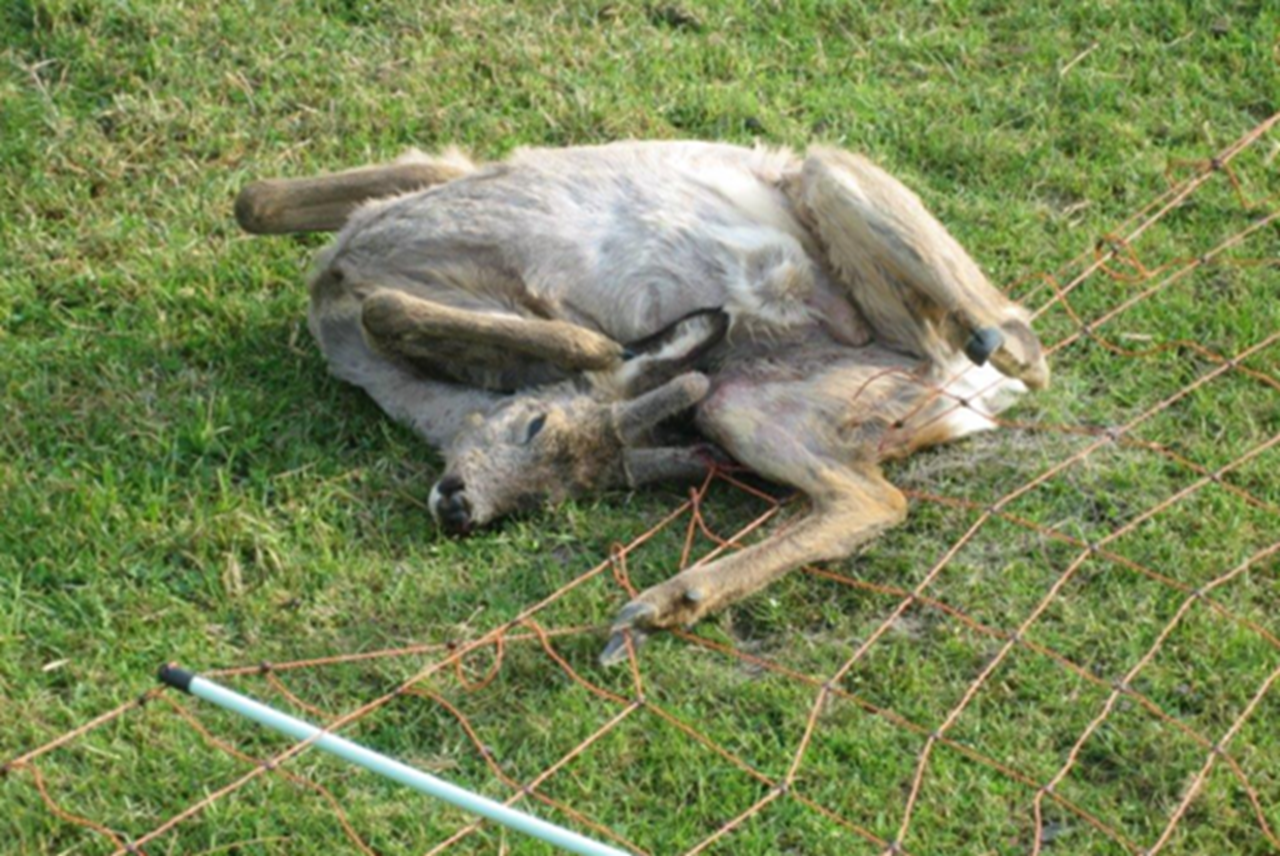
Inappropriate fences and pasture nets are often a deadly trap for wild animals, particularly deer, stags, foxes, hedgehogs, amphibians and many other species. Canton (………) should issue clear requirements so that pasture fences and nets are designed to be wildlife-friendly, operated correctly and consistently removed when not in use.
1. Motion
The Government Council is instructed to present to the Grand Council a draft for amending cantonal agricultural, animal welfare, hunting and, where applicable, forest law (Agriculture Act ……, Animal Welfare Ordinance ……., Hunting Act ……, Forest Act ……) as well as the associated ordinances. The aim is to introduce mandatory animal welfare-compliant standards for pasture fences and pasture nets in canton (………).
The revision of laws and ordinances must ensure in particular:
- that binding technical minimum requirements are established for pasture nets and electric fences in open land, particularly:
- maximum fence height in specific areas (for example along wildlife corridors and forest edges)
- minimum distance of the lowest wire or net mesh from the ground to prevent hedgehogs, amphibians and small mammals from getting trapped
- restrictions on mesh sizes, net forms and wire thicknesses that facilitate entanglement and snagging of wild animals.
- that pasture nets and electric fences may only be used where and for as long as livestock actually graze there. In particular, it must be stipulated:
- obligation to immediately remove pasture nets no longer in use
- prohibition against permanently leaving electric nets standing in the field without livestock
- obligation for seasonal removal of nets in known wildlife corridors and migration routes.
- that special restrictions apply in areas of forest edges, hedgerows, streams, wetlands, wildlife corridors and known crossing points, namely:
- prohibition of certain net types with high entanglement risk
- Minimum distances of fences from cover structures that force wildlife to jump over or slip through
- Requirements for passages, crossing opportunities or fence-free corridors for wildlife.
- that electrically operated grazing nets and fences:
- must be technically designed so that no avoidable severe burns, falls or injuries occur to wildlife and livestock
- may only be operated at night in certain sensitive locations (including amphibian migration areas) with reduced voltage or temporarily switched off.
- that the canton establishes an information and advisory service for farmers, livestock keepers and municipalities that:
- provides information about wildlife-friendly fence and net systems
- gives concrete recommendations for the placement, design and inspection of installations
- shows which systems have proven effective in terms of herd protection and animal welfare.
- that inspections of grazing fences and nets are integrated into the regular supervisory activities of agricultural, animal welfare and hunting authorities. Installations identified as particularly dangerous to wildlife must be:
- designated and given a deadline for remedying deficiencies
- sanctioned with administrative measures and fines if deficiencies are not remedied.
- that deaths or serious injuries to wildlife in connection with fences and grazing nets must be reported to the responsible authority. The canton maintains statistics on this in order to:
- identify particularly problematic fence types and locations
- derive targeted improvement measures.
- that financial support and funding instruments (including direct payments, contributions to herd protection) are linked to the requirement that fence and net systems used comply with animal welfare requirements.
- that mandatory units on wildlife-appropriate fence and net systems are included in hunting education and courses for farmers.
- that the government council explains in its message:
- what problems with grazing nets and fences are known in the canton so far
- which fence and net systems are considered particularly problematic
- what organizational and financial impacts can be expected for the canton, municipalities and affected parties.
The government council ensures that cantonal regulations do not fall below federal law requirements in the areas of animal welfare and agriculture, but rather specify and strengthen them in the sense of effective wildlife protection.
2. Brief justification
Grazing nets and fences are indispensable in agricultural practice. At the same time, they cause great, mostly invisible suffering to wildlife year after year:
- Roe deer, red deer, chamois and other ungulates get caught with legs or antlers in nets, panic, suffer severe injuries or die slowly.
- Hedgehogs, amphibians, young foxes, young badgers, hares and numerous small mammals get tangled in meshes, wires and strands, are electrocuted, injured or die from exhaustion.
- Birds can be seriously injured in poorly visible wires, particularly dense nets or barbed wire.
A fence should protect animals, not kill them agonizingly. Those who cover the landscape with nets and wires must ensure that wildlife does not perish on them.
These deaths and cases of suffering are not a law of nature, but the consequence of human design. Many of the grazing nets and fence forms used today are oriented solely toward short-term benefit and completely ignore the needs and movement patterns of free-living animals. Particularly problematic is the trend toward cheap, quickly erected plastic nets that:
- often stand for months without animals on the pasture
- are placed at forest edges, in wildlife corridors or along hedges
- carry a high risk of entanglement, getting caught and strangulation due to their structure.
In Switzerland, great emphasis is placed on biodiversity, animal welfare and wildlife-friendly infrastructure on the one hand. On the other hand, grazing fence and net systems remain largely a private decision, often without control, without clear requirements and without consequences, even when they demonstrably lead to animal suffering. This imbalance is no longer tenable from the perspective of animal welfare and credible wildlife policy.
Animal welfare-compliant fence and net requirements are:
- a simple, pragmatic lever to prevent much animal suffering
- technically easily implementable, as numerous more wildlife-friendly systems are available on the market
- also in the interest of farmers, because accidents with livestock and wildlife are reduced and conflicts with the population and animal welfare organizations are defused.
The motion does not demand the abolition of grazing nets, but their regulation:
- Dangerous constructions and locations should be prohibited or significantly restricted
- Nets and fences should only stand where they are actually needed
- Fence and net systems should be oriented toward the movement patterns of wildlife, not the other way around
- Violations should not remain without consequences when animals repeatedly die as a result.
In a landscape that is intensively used and shaped by humans, the canton bears responsibility for the consequences of this design. It is unacceptable that wildlife dies in an invisible web of plastic nets, wires and strands simply because animal welfare-compliant requirements are missing or not enforced.