Illegal Hunting Stands: Hobby Hunters Clutter Forests
Beneath many Swiss trees today stands a small symbol of hunting subculture: the elevated hunting stand.

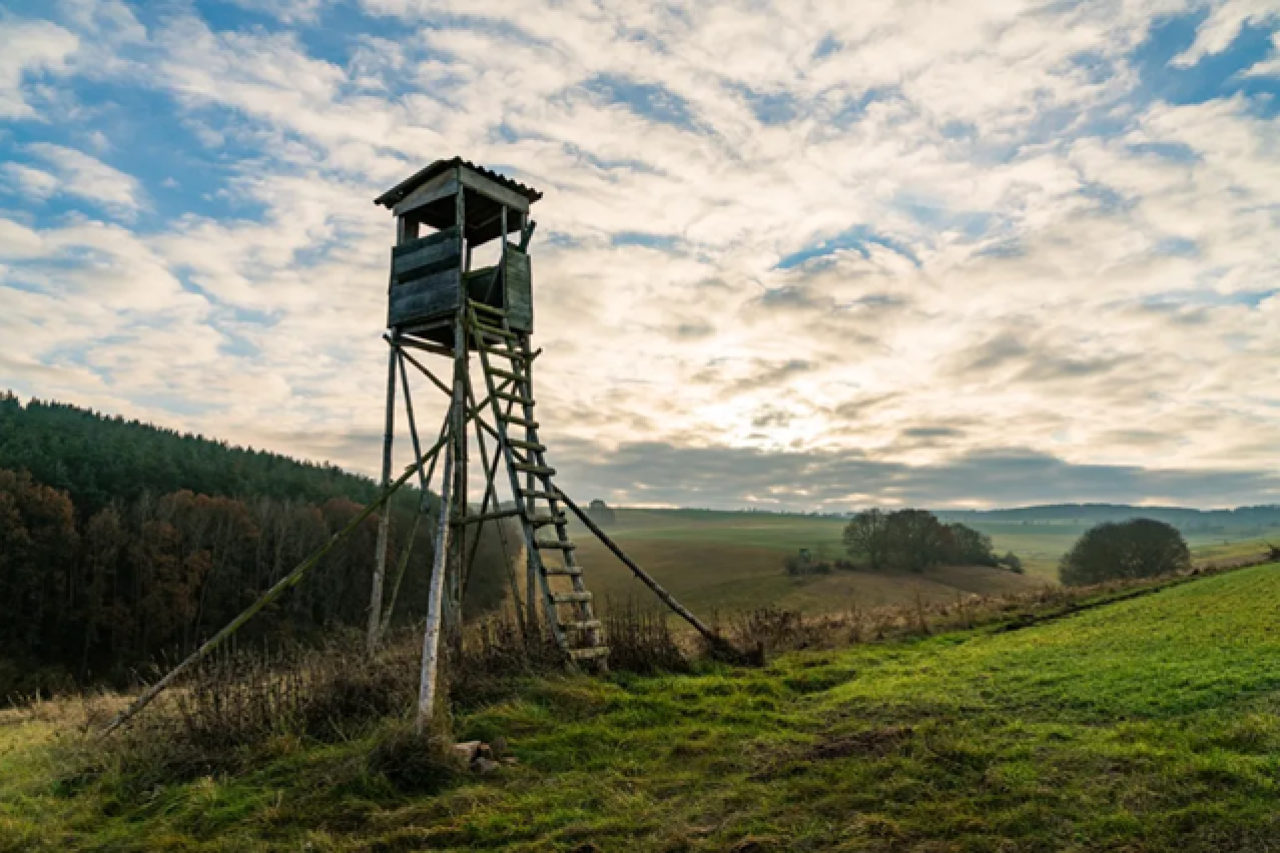
Often romanticised as a «traditional structure», it is from a legal perspective simply a building outside the designated building zone. And that is precisely where things get interesting in 2025, as the legal situation has tightened — and simultaneously been watered down again. For animals, forests and the landscape, the message remains clear: elevated hunting stands have no place in a modern, ethical wildlife policy.
1. Hunting Stands Are Not Romantic — They Are Unauthorised Structures in Non-Development Areas
Anyone who erects a pulpit with a roof, windows, plexiglass and a reclining surface in a forest is not building a harmless «little hunting aid». From the perspective of spatial planning law, this constitutes a structure or installation in a non-development area.
The Federal Office for Spatial Development has been emphasising for years that construction outside designated building zones is strictly regulated and permissible only in narrowly defined exceptional cases. The legal basis is the Spatial Planning Act (RPG) and the Spatial Planning Ordinance (RPV).
One point that many hobby hunters deliberately overlook is important:
- The consent of the landowner is not sufficient.
- A municipal building permit without cantonal approval is likewise insufficient.
- Without proper exceptional or zone-conformity authorisation, such structures are simply unlawful.
Anyone who believes a «private hunting tower» is a private matter is doubly mistaken: it violates building law, forestry law, and often nature and animal protection law as well.
2. Federal Supreme Court: Illegal Structures Outside Building Zones Are in Principle Subject to Demolition
In 2021, the Federal Supreme Court clarified in a landmark ruling what is particularly explosive for elevated hunting stands. In judgment BGE 147 II 309 concerning a depot in an agricultural zone, the court ruled:
- For illegal structures outside building zones, the obligation to restore the lawful condition does not lapse after 30 years.
- Authorities may order the demolition of such structures at any time, regardless of when they were built.
The ruling justifies this, among other things, as follows:
- Particularly strict requirements apply in non-building zones because the constitutional principle of separating building and non-building zones must be protected.
- A statute of limitations would reward unlawful behavior and disadvantage other, law-abiding owners.
Applied to hunting stands, this means: even the «ancient» hunting tower in the forest is no natural monument, but can be legally recognized as illegal at any time and be subject to a removal order, provided no retroactive permit is possible.
3. RPG 2: 30-year grace period for unauthorized structures, but stricter enforcement rules
The hunting lobby has not accepted this clear line. As part of the second stage of the revision of the Spatial Planning Act (RPG 2), parliament has newly regulated construction outside building zones. The official aim is to stabilize the number of buildings and the sealed surface area in non-building zones.
With the new Spatial Planning Ordinance, which enters into force in stages from 1 January and 1 July 2026, a sensitive new provision is being added:
- The right to restoration of the lawful condition for unlawful structures is to lapse after 30 years, provided no worthy public interests are affected.
At the same time, RPG 2 tightens enforcement:
- Unauthorized uses must be identified promptly and prohibited immediately.
- Removal orders must be issued without delay.
- Illegal structures may not serve to expand the permissible total number of buildings outside the building zone.
This means: anyone who today erects a new hunting stand in the forest without a permit is building in deliberate violation of the law. And that hunting stand can still be classified as unlawful and removed decades later, as long as the 30 years have not elapsed or significant nature and landscape interests are affected that justify removal even thereafter.
4. Cantonal practice: between notification requirements and tolerated monster platforms
The picture remains a patchwork, yet almost everywhere the rule applies: anyone who follows the rules would have to build tiny and very modestly. The reality in the forest looks different.
Appenzell Innerrhoden: notification requirement and 2 square meters
The canton of Appenzell Innerrhoden stipulates in an information sheet:
- Raised hides must be registered.
- Maximum base area of 2 square metres.
- Space for a maximum of 2 persons.
- No fastening with nails or screws to trees, no growing-in of chains or wires.
- Construction without foundations, using inconspicuous, non-reflective materials.
Anyone who knows the reality of the forest is aware: many high seats easily exceed these requirements. Multiple seating positions, fully enclosed cabins, ladders with platforms, solid foundations, metal anchors. In legal terms, these are no longer «simple raised hides» but rather small structures requiring a permit.
Bern: Raised hides require an exceptional permit
A circular from the canton of Bern makes a clear distinction:
- Umbrellas and simple, freestanding ladder seats, as well as mobile seats removed after hunting, are considered exempt from forestry permits.
- The construction of high seats in the forest, whether freestanding or attached to trees, is classified as a non-forestry small structure and requires an exceptional permit pursuant to Art. 24 of the Spatial Planning Act (RPG).
According to the circular, such permits may only be granted if a public interest exists — for example, a terrain pocket that is difficult to hunt and where significant wildlife damage has occurred.
The common practice in many hunting districts of simply placing «a permanent seat for every hobby hunter» in the forest directly contradicts this logic.
Other cantons: Rules exist, enforcement is scarce
Similar tendencies can be found in other cantons:
- Lucerne describes «hunting seat installations» as «appropriate facilities» in an information sheet and specifies when raised hides require a permit and which criteria apply.
- Uri emphasises clearly in its documentation that projects outside building zones are strictly assessed under federal law, and that the competent cantonal authority must determine whether zoning conformity or an exceptional permit is even a possibility.
- Municipalities such as Flims have introduced their own regulations for raised hides and pass shelters. Applications are subject to permit requirements, with clear specifications regarding who may build where and for how long such installations may remain in place.
And yet: anyone walking through Swiss forests will encounter countless high seats that comply neither with area, material, nor permit requirements. They stand there as though public forest were the private property of the hunting clique.
5. Safety and animal welfare perspective: raised hides also pose a risk
Hunting associations and insurance companies publish their own brochures on «safe elevated blind construction». These explicitly warn against the risk of falling, inadequate railings, rotting ladders, and missing bullet stops.
This is doubly revealing:
- Hobby hunting creates additional, entirely unnecessary risks in the forest that would not exist without hobby hunting.
- The supposed «safety for the public» through elevated shooting is rendered absurd when, at the same time, the location is poorly chosen, bullet stops are missing, and walking paths lie in the line of fire.
From an animal welfare perspective, elevated blinds are the perfect tool for a hunting practice that turns animals into purely interchangeable targets:
- Nocturnal stalking with residual light amplifiers.
- Bait feeding within shooting range.
- Shots fired at slowly approaching animals that have no chance whatsoever of assessing the situation.
This is not about «fair nature», but about maximum efficiency in killing. Elevated blinds are the platform of this uncivilized practice.
6. Geneva shows: it works without hobby hunters and without forests full of elevated blinds
The Canton of Geneva abolished hobby hunting by popular vote in 1974. Since then, there has been no private hunting of mammals and birds there.
The canton instead relies on professional wildlife management by state-employed game wardens. Culling is only permitted as a last resort, once all preventive measures have been exhausted.
The record after decades:
- High biodiversity, abundant populations of ungulates, hares, and waterfowl.
- No army of hobby hunters furnishing the forest with private elevated blinds.
- Regulation of wild boar and roe deer according to clear criteria and under state responsibility.
Geneva proves that modern wildlife protection works without hobby hunting — and therefore also without a thicket of illegal elevated blinds.
7. What needs to happen now: inventory, dismantling, the Geneva model
From the perspective of IG Wild beim Wild, concrete steps are urgently needed:
- Complete inventory of elevated blinds per canton
Every elevated blind in the forest must be recorded, measured, and reviewed for legal compliance: location, footprint, material, year of construction, permits, owner. - Consistent removal of unlawful structures
Elevated blinds that are too large, have foundations, damage trees, or do not possess a valid permit must be consistently removed. BGE 147 II 309 provides the clear legal basis for this; RPG 2 explicitly compels the authorities to enforce compliance more rigorously. - Moratorium on new hunting structures in forests
As long as the stabilization targets for construction outside building zones and the new enforcement regulations are not being complied with, new elevated hunting stands should in principle no longer be approved. - Transition to professional wildlife management following the Geneva model
Instead of hobby hunters entrenching themselves in private elevated stands in the forest, what is needed are well-trained wildlife wardens serving the public good — not a leisure lobby. Geneva demonstrates that this works and benefits biodiversity. - Minimum ethical standard: No animal cruelty on stilts
Hunting from an elevated stand represents the radical asymmetry between a human with a weapon and an animal with no chance of escape. Anyone who speaks of animal welfare cannot simultaneously accept this.
Elevated hunting stands are not a harmless part of «livid tradition». They are visible signs of a parallel hunting world in which forest law, spatial planning, and animal protection are perceived as nuisances.
The current legal situation removes all excuses from the authorities: illegal elevated stands can be inventoried, legally assessed, and dismantled.
What is lacking is not the law, but the political will to free forests from this hunting infrastructure and clear the way for a wildlife management approach oriented toward Geneva rather than the hobby hunter on a wooden platform.