Deforestation: Brazilian Meat at Coop
An investigation by Greenpeace Switzerland shows that Coop and Migros still offer products made from Brazilian beef – despite their commitments against deforestation in their supply chains.

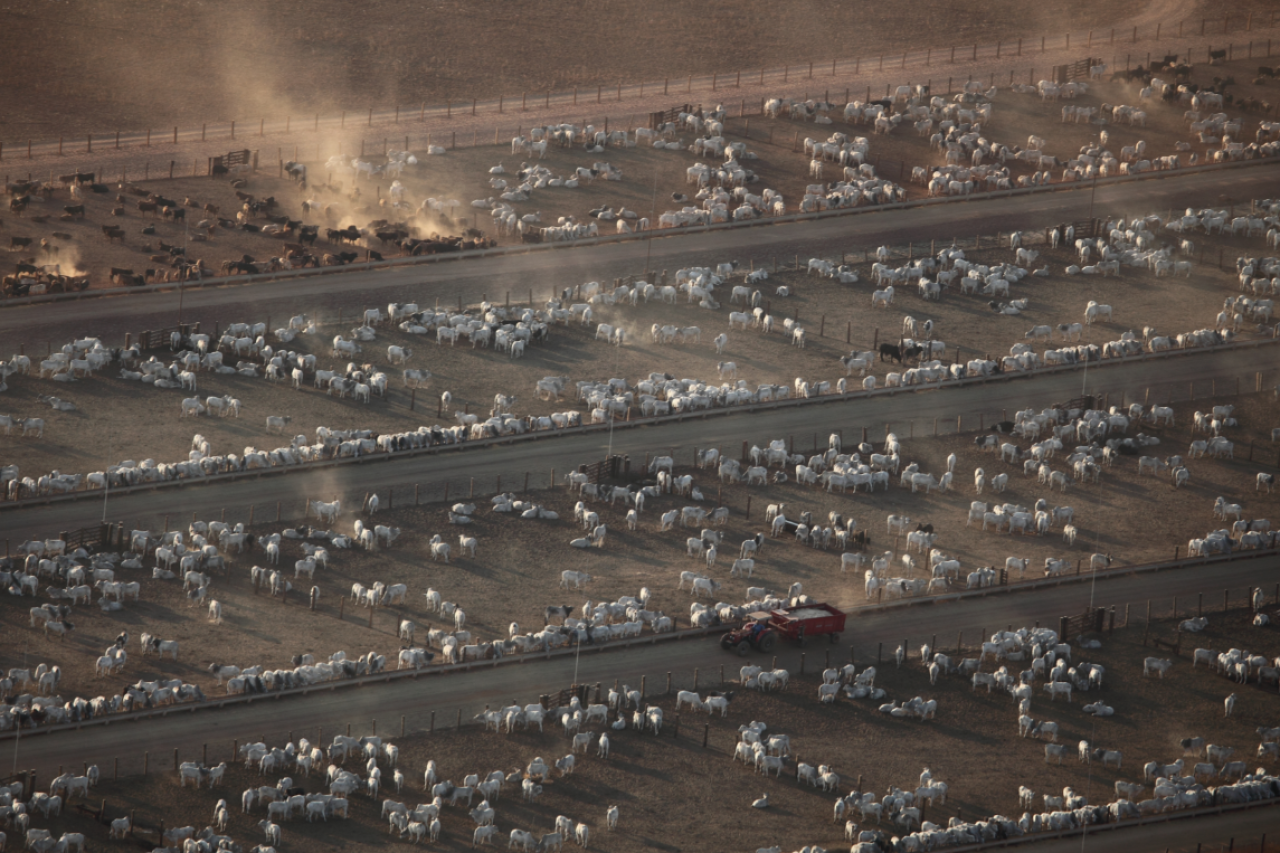
Greenpeace Switzerland was able to link a product sold by Coop to the deforestation of the Amazon rainforest.
Greenpeace is calling on retailers to stop selling beef from countries threatened by deforestation. The Swiss government must enact legislation modelled on the new EU regulation against deforestation.
The expansion of livestock farming is the largest driver of deforestation.
In Brazil, this leads to the clearing of nearly one million hectares of Amazon rainforest every year. Powerful corporations control this opaque supply chain. After Greenpeace Switzerland found Brazilian beef in several products such as corned beef, pâtés and dried meat in Swiss supermarkets, it commissioned a specialised firm to trace the supply chain. Despite the scandals and the unreliability of this industry, hundreds of tonnes of Brazilian beef continue to enter Switzerland every year.
False promises at Migros and a lack of transparency at Coop
Both Swiss retail giants have set deforestation targets: Coop aims for a deforestation-free supply chain by 2026; Migros has committed to ensuring a deforestation-free supply chain for its supermarkets and Migros Industry by the end of 2025. Surprisingly, Migros states that it has not imported any beef from Brazil since 2020 (cf. p. 7). An on-site inspection proves the contrary: despite this claim, there are still products in the Migros range (e.g. dried meat and bresaola under the M-Budget brand) that are produced from Brazilian beef.
Another example is the Bonfine brand corned beef sold at Coop. The meat for this product is processed by meat conglomerate JBS and originates, among other sources, from the Brazilian agricultural operation Fazendo Rio Preto. The latter has been convicted more than a dozen times, including for illegal deforestation in the state of Mato Grosso. Satellite images show that over 800 hectares of rainforest have been cleared on this agricultural operation over the past 15 years. That corresponds to an area of 1,120 football pitches. Either Coop is aware of this and is doing nothing to resolve the problem, or Coop does not know what is happening at the beginning of its supply chain — which would be equally alarming and irresponsible.
Legislation is necessary
“The findings of our investigation once again confront retailers with the fact that their sustainability pledges lack credibility. Coop and Migros generally sell far too many animal products. When the meat additionally originates from South American countries with deforestation risks, that is an environmental scandal that retailers must stop immediately. Beef from Uruguay is not an acceptable alternative. Its already poor climate footprint is made even worse by air freight. When one considers that this Uruguayan meat is regularly offered on promotion, doubts arise about the genuine commitment of Coop and Migros to sustainability,” says Sera Pantillon, consumer expert at Greenpeace Switzerland.
“This investigation demonstrates once again that the voluntary measures taken by retailers are insufficient to counter deforestation and preserve biodiversity. Unfortunately, our country is lagging behind in regulating deforestation. Switzerland must rapidly align its legal framework with the EU regulation against deforestation, which will enter into force next year. In general, we must accelerate the transformation of our food system towards a more sustainable, more plant-based diet.”
| You can help all animals and our planet with compassion. Choose mercy on your plate and in your glass. Go vegan. |