White as Snow and Yet a Red Fox
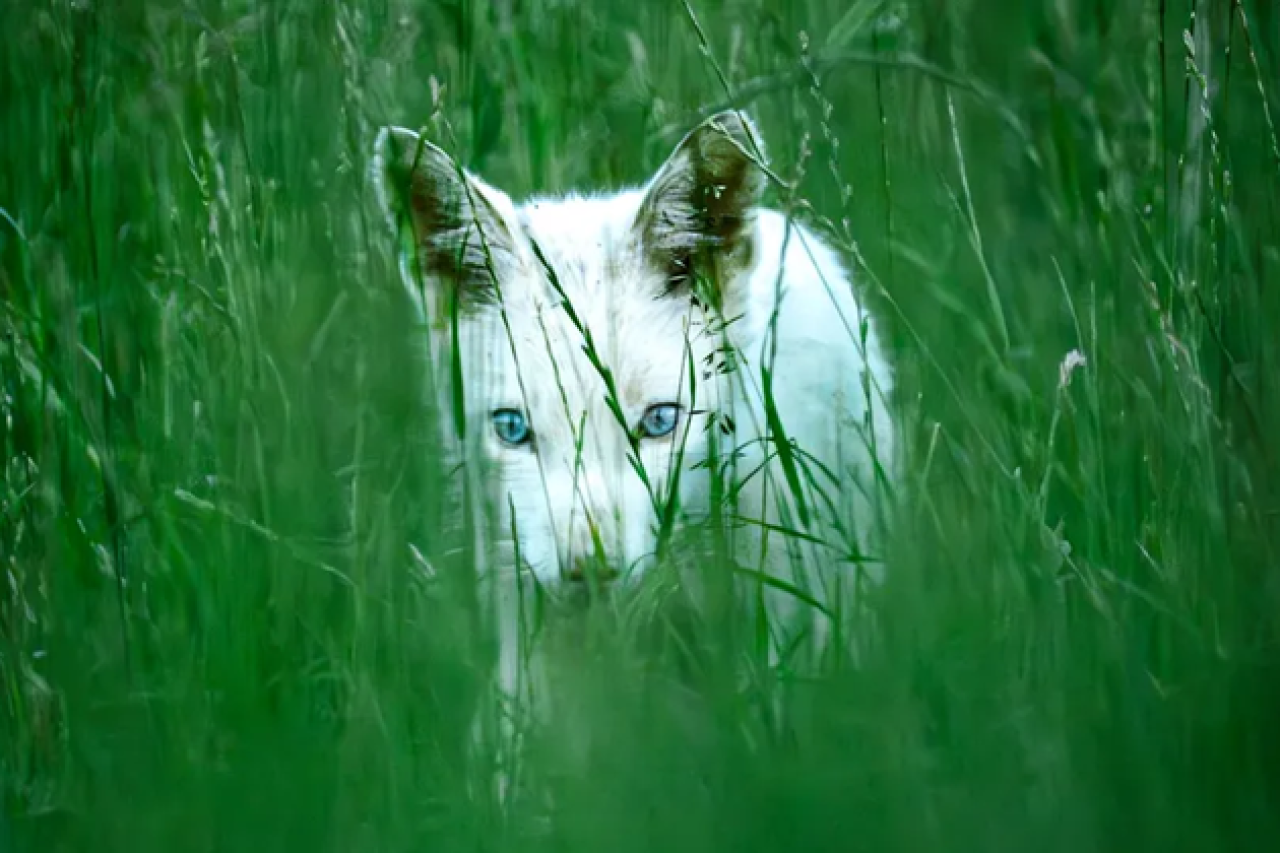
A rare find in the Munich district: nature photographer Dominik Reigl has discovered an extraordinary red fox – completely white in colour and with blue eyes.

Reigl regularly ventures out with his camera in the Munich district, especially in summer when fox cubs begin to show themselves.
“Actually, I had intended to drive home empty-handed that day, but then decided to head out one more time. At dusk, it suddenly stood there – a small, completely white fox with blue eyes, at the edge of a maize field,” recalls the photographer.
For several days he observed the animal and submitted his photographs to the LBV.
According to LBV executive director Heinz Sedlmeier, the animal is neither an escaped Arctic fox nor an albino. The cause of the unusual coat is leucism – a rare pigmentation disorder that reduces natural colouration.
Leucism is a genetically caused pigmentation disorder in which the skin, fur or feathers of an animal appear partially or completely colourless.
This occurs because during embryonic development, pigment cells (melanocytes) are not deposited, or only partially deposited, into the skin and hair follicles. Unlike albinism, the ability to produce pigment is not absent – rather, the pigment cells themselves are simply not present in certain areas.
Key differences from albinism:
- Leucism: fur, feathers or skin may be wholly or partially white; eye colour remains normal (e.g. brown or blue).
- Albinism: complete absence of the pigment melanin; eyes appear red or pink because blood vessels show through.
Leucism occurs in many animal species – from birds (blackbirds, crows) and reptiles to mammals such as deer or indeed foxes.
Completely white red foxes are rare. The exact location where the animal lives is being kept secret in order to protect it from disturbance.
IG Wild beim Wild appeals to the hobby hunters’ association Hobby-Jägerverein München-Land e. V. in Sauerlach in the Munich district and in surrounding regions to let the white fox live.
From a wildlife biology and public health perspective, there is no reason to hunt foxes — that is hunters’ folklore. Many case studies illustrate this, for example national parks, Luxembourg, or the canton of Geneva in Switzerland.