Thun: Fur and trophies 2026, a step backwards
Thun remains a symbol of a hunting culture that exhibits, awards prizes to, and markets dead wild animals. On Friday and Saturday, January 30th and 31st, 2026, the Bernese cantonal trophy exhibition with fur and hide market will once again take place at the Thun-Expo grounds.


Update 2026: This article was originally published on 12.02.2017 and has been completely rewritten for 2026.
The occasion and dates have been updated to reflect the current fur and hide market and the trophy exhibition in Thun (January 30 and 31, 2026). What is sold as "tradition" is, in effect, a prestige and commercial format in which animal body parts become objects and hobby hunting is staged as a socially accepted norm.
The original post referred to February 11, 2017: That was the 83rd annual "Bernese Trophy Exhibition Fur and Skin Market" in Thun. Even back then, it was clear what the event was really about: a gathering of amateur hunters that showcases "success" through trophies and reduces the victims of this hobby hunting to mere scenery.
In 2026 it is important to clearly distinguish this: The event is not merely a historical episode, but continues to take place and has been modernized organizationally, not ethically.
What's happening today: trophies, awards, market logic
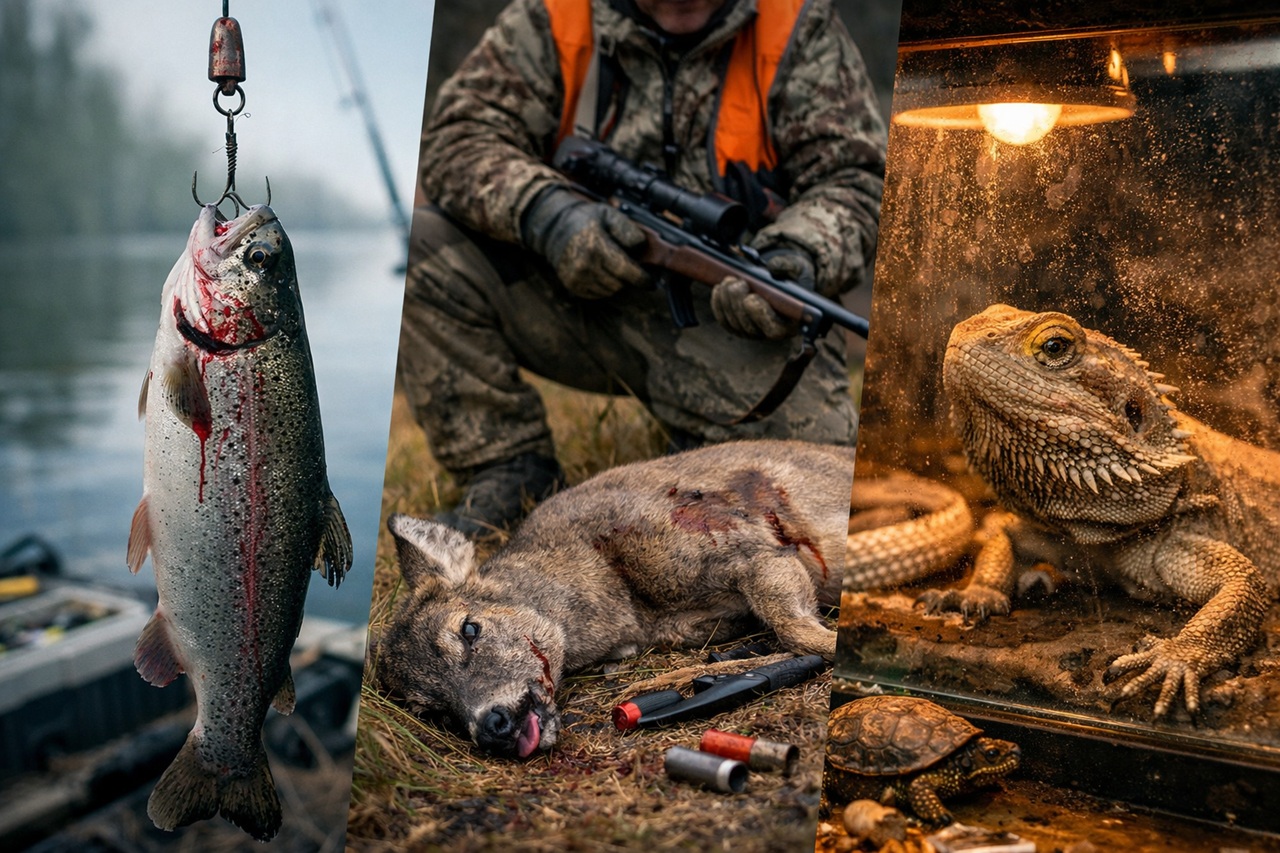
The program includes a trophy exhibition, exhibitors, awards, and the fur and pelt trade. This mix of exhibition, competition, and market is the crucial point: wild animals are not presented as sentient individuals, but as objects of measurement, decoration, and raw material.
Friday, January 30, 2026: Trophy exhibition (7:00 PM to 9:30 PM, Hall 7), exhibitors (5:00 PM to 10:00 PM, Hall 0), official part with awards (7:30 PM, Riding Hall).
The IG Wild beim Wild criticizes that this normalizes a practice that clearly contradicts the expectations of animal ethics: Thousands of killed wild animals in the canton of Bern, according to hunting statistics, are the focus; body parts are measured, graded, and awarded prizes.
Why the argument "care" doesn't hold water here
Organizers often frame such formats as "wildlife management" or "status analysis." But serious monitoring doesn't require a trophy wall, but rather scientific tools and transparent data, not self-promotion through antlers and horns. Furthermore, what systematically remains invisible is part of the reality of hunting: missed shots, injured animals , tracking wounded game, and suffering.
Fox as a target: Stigma instead of ecology
Even today , the fox is often viewed negatively in hunting terminology. Yet, as a predator, it plays a stabilizing role in the ecosystem. The original text already emphasized that recreational hunting is not a beneficial "regulator" for foxes, but rather a disruptive factor that is compensated for by reproduction.
Children, audience, habituation effect
What is particularly problematic is that such events can be perceived by society as "harmless customs." From an animal welfare perspective, it is concerning when children and young people are introduced to a setting that romanticizes violence and presents dead wild animals as status symbols.
What we demand
Thun must ask itself what kind of public framework the city wants to provide for such formats. The IG Wild beim Wild (Interest Group for Wild Animals) calls for a move away from trophy competitions and the fur trade as an "event," towards a contemporary, respectful approach to wild animals.
According to the IG Wild beim Wild (Interest Group for Wildlife), recreational hunters need annual medical-psychological fitness assessments, modeled on the Dutch system, as well as a binding upper age limit. The largest age group among recreational hunters today is 65+. In this group, age-related limitations such as declining eyesight, slowed reaction times, difficulty concentrating, and cognitive deficits increase significantly, statistically speaking. At the same time, accident analyses show that the number of serious hunting accidents resulting in injuries and fatalities rises significantly from middle age onward.
The regular reports of hunting accidents, fatal errors, and the misuse of hunting weapons highlight a structural problem. The private ownership and use of lethal firearms for recreational purposes largely escapes continuous monitoring. From the perspective of the IG Wild beim Wild (Interest Group for Wildlife with Wildlife), this is no longer acceptable. A practice based on voluntary killing that simultaneously creates significant risks for both humans and animals loses its social legitimacy.
Furthermore, recreational hunting is based on speciesism. Speciesism describes the systematic devaluation of non-human animals solely on the basis of their species. It is comparable to racism or sexism and cannot be justified either culturally or ethically. Tradition does not replace moral judgment.
Especially in the field of recreational hunting, critical examination is essential. Hardly any other area is so rife with embellished narratives, half-truths, and deliberate disinformation. Where violence is normalized, narratives often serve as justification. Transparency, verifiable facts, and an open public debate are therefore indispensable.