Criticism of St. Hubertus mass in Therwil

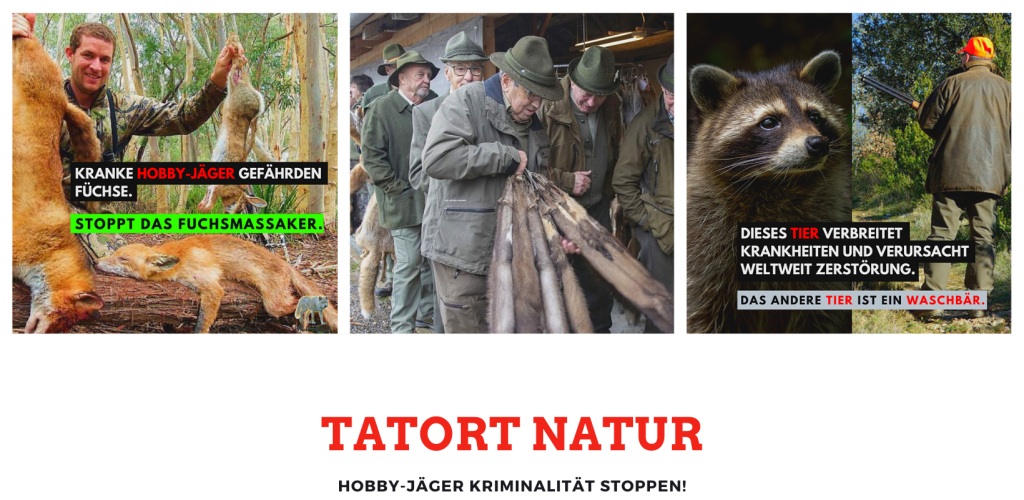
Killing with ecclesiastical blessing: On November 10, a St. Hubertus mass with the hunting horn players Reichenstein will take place at 10:00 AM at the Catholic church Therwil IG Wild beim Wild sharply criticizes the event and those responsible.
On St. Hubertus Day, the feast day of Saint Hubertus of Liège on November 3, IG Wild beim Wild criticizes such orientations of worship services.
St. Hubertus masses, which are primarily co-organized and attended by hobby hunters, are incompatible with the Christian ethic of respect for life.
They often form the prelude to particularly cruel driven hunts and special hunts where even senile hobby hunters move through forests in ways that constitute animal cruelty, chasing, injuring and killing countless wild animals. IG Wild beim Wild therefore appeals to church representatives to distance themselves in future from these violence-glorifying and sectarian masses.
If more and more wild animals of a species are shot because there are more and more of them, do even more need to be shot so that there will be fewer?
There is no comprehensible reason for recreational hunting, as it is not suitable for permanently regulating populations. Hunting does not mean fewer wild animals, but more births.
Historically speaking, hunting for population control is also not hunting, but terroristic zoocide.

According to the Veterinary Association for Animal Protection, up to two-thirds of wild animals shot during driven hunts do not die immediately. With shattered bones and protruding entrails, the animals flee, often suffering from their injuries for days and dying in agony if they are not found during the so-called tracking.
Numerous scientific studies prove that hunting is not suitable for permanently regulating wild animal populations. Scientists have demonstrated that in hunted wild boar populations, sexual maturity occurs earlier in female animals, which increases the birth rate. Consequently, high hunting pressure causes the population of the respective wild animals in the area to increase.
Celebrating a church service that gives hunters symbolic blessing for the systematic killing of defenseless fellow creatures sends a completely wrong signal. Churches must advocate for the preservation of creation, not for its destruction. The Hubertus Mass also fails to recognize that Saint Hubertus transformed from a hunter into a convinced opponent of hunting. Julia Bielecki, theologian.
The legend of Hubertus and the cross-bearing stag is known from literature and the visual arts.
According to the traditional legend, Hubertus was born around 655 as the son of a nobleman and died in the year 728. Initially, he led a pleasure-seeking life and was a passionate hunter. When he had one day tracked down a stag during a hunt and was pursuing it to kill it, the animal suddenly faced him. A cross blazed between its antlers and in the form of the stag, Christ spoke to him: "Hubertus, why do you hunt me?" Hubertus dismounted his horse and knelt before the stag. From that moment on, Hubertus ended his hunting and henceforth led a simple life.

So goes the legend. After his experience with the stag, Hubertus thus stopped hunting and became a devout Christian. For true Christianity and hunting simply do not go together. In his encounter with the stag, he was presented with a choice: either he kills the animal – and thus also kills Christ – or he does not do this and confesses to Christ. Or spoken in the words of Matthew 25:40: »What you have done to one of the least of my brothers, you have done to me«.
It is written nowhere that Jesus Christ, whom both denominations worship as the Son of God, ever hunted animals. That would also be very absurd, for God's 5th commandment states "Thou shalt not kill«. But every hunt is connected with killing.
Despite all this, the so-called Hubertus hunts as well as Hubertus Masses take place in churches every year. Instead of making Saint Hubertus the patron saint of animals, the Church appointed him as the patron of wildlife killers.
The meaning of the Hubertus legend is surely this: that man should live in harmony and peace with nature and animals. He should not be the hunter, but the protector and friend of animals. As it says so beautifully in Mark 16:15: "Go into all the world and proclaim the gospel to all creatures.« This certainly does not mean hunting.
True Christianity is a religion of ethics that advocates for mercy, respect for life, and love of neighbor. Practicing Christians concern themselves with the question of how these fundamental values can be implemented globally and formulate – biblically grounded and theologically founded – viable ethical guidelines for a peaceful coexistence of humans, nature, and animals. The animals are "our brothers and sisters", our neighbors. Any use of them – whether for food production, for clothing, for entertainment, or in animal experiments – and any degradation to commodities contradicts a peaceful, preserving, and life-respecting attitude.
Hobby hunters live on meat. That's why they are often angry, violent and aggressive. This is not strange, but completely natural. When one lives from killing, one has no respect for life. One is hostile towards life. And whoever is hostile to life cannot go into prayer, because prayer means reverence for life. And whoever is hostile towards God's creatures cannot be very friendly towards God either.