
Wildlife rescue
In spring, starting in April, the season begins in which thousands of roe deer fawns, young hares, wild rabbits, ground-nesting birds and other animals are maimed by farmers during mowing.
How many Wild animals there are exactly, nobody knows for sure, but based on the federal hunting statistics, it can be assumed that in Switzerland there are at least 1,500 young animals per year among roe deer fawns alone. Despite the use of new search methods, a downward trend in the number of cases has not been observed so far. Since by no means all animals caught by a mower's blades die instantly, but are sometimes only more or less severely injured, mowing accidents are, among other things, a serious animal welfare problem. Ever-faster agricultural machinery and modern harvesting methods leave our wild animals hardly any chance of survival.
Nowadays, no meadow or grain field where wild animals are suspected to be present may be mown without prior warning measures, as this would constitute a violation of the animal welfare act. Responsible farmers walk the area before mowing and mow during daylight hours from the inside out, in order to give wild animals a chance to flee.
Background on wildlife rescue
Roe deer mothers mostly place their fawns in meadows close to the forest. During the first few weeks, the mother only visits her fawn briefly to nurse it, often at night, so as not to draw predators' attention to the young through her presence. Many young animals survive because they behave inconspicuously and, when threatened, press themselves flat to the ground and remain motionless. Thanks to their spotted coats, the young animals are perfectly camouflaged. It is a survival tactic that leads to disaster. In our cultivated landscape, most roe deer fawns inevitably end up lying in agriculturally used meadows. When a mowing machine approaches, they have no chance. They get caught in the cutting mechanism, are cut to pieces, or are left behind severely injured. Such accidents are terrible for everyone involved.
It is also undisputed that more young hares are mown down today than in the past. However, this is not so much due to the wide working width and high speed of mowing machines, but is primarily a consequence of the fact that meadows and pastures today are sometimes mown every six to seven weeks. In the past, there were only two cuts: a hay cut and an aftermath cut. The hay cut took place at the end of May/beginning of June, and the aftermath cut in August. This meant that, at the time, young hares born in April and left in a meadow, as well as those born at the end of June/beginning of July, were safe from the mower's blades. Today, however, almost only silage is made. This means that a meadow is mown four to five times during the summer half-year. As a result, nowadays almost every young hare left in a meadow is caught by mowing death. Naturally, the doe chooses the right spot for giving birth to her fawns and for their first weeks of life. In dense grass, the newborn fawns are almost invisible. Even the fox catches little prey here, because it is reluctant to hunt in dense grass growth. It prefers less dense vegetation. Without coordination with farmers during meadow mowing, effective young wildlife rescue cannot be carried out.
Hands off young wild animals
It is well-intentioned, but usually harmful: time and again, people pick up apparently helpless young birds, rabbits, or other wild animals. In reality, these wild animals are rarely in distress.
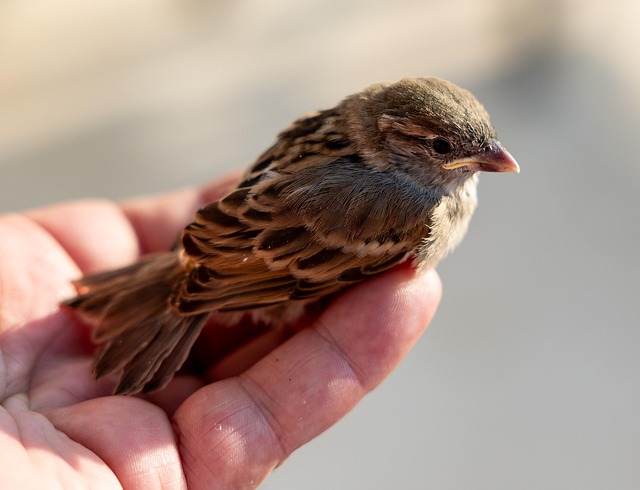
Young blackbirds, for example, leave the nest before they can fly properly, spreading out around the garden to reduce the risk of a cat or other predator catching the entire brood at once. The fledglings remain in constant vocal contact with their parents – to our ears, a helpless-sounding, piercing chirping. This way, the parent birds always know exactly where their offspring are and feed them regularly. So please leave these little bundles of feathers alone. Only if there is immediate danger, or if the fledgling lands on a busy pavement or road, should it be carefully placed in a sheltered, ideally elevated spot nearby. This also applies to young tawny owls and long-eared owls.
Fledglings can be picked up with bare hands, because unlike roe deer or brown hares, the parent birds are not bothered by human scent. In case children, out of misguided love for animals, bring a fledgling home, it can still be returned to the spot where it was found even hours later.
The chicks of gallinaceous birds, ducks, geese, and swans are precocial, meaning they are led around by one or both parents. If such a chick wanders around alone for an extended period, it is indeed abandoned and needs help. It is of no use to try to place an orphaned duckling with another mother duck leading her brood – she will chase it away or even try to kill it. Feathered foundlings are best brought, after prior telephone contact, immediately to an appropriate care station or other knowledgeable persons.
A roe deer fawn in the garden or a small bird in the living room, picked up by well-meaning people, poses major problems for inexperienced – and sometimes even experienced – caretakers. Similar to birds, incorrect feeding in young mammals often leads to permanent damage. Under such circumstances, rescued wild animals have only slim chances of survival!