
Argumentarium for wildlife wardens

Like us humans, wild animals are living beings — not resources for Stone Age hunting behaviour.
Wildlife deserves a science-based approach, not hobby hunting. Today, hunting is largely a public festival where businesspeople and animal abusers invite partners — to massacre animals and contaminate public coffers with blood money.
The Canton of Geneva has demonstrated for decades what serious wildlife management can look like.
Nature and Animal Protection
It is known today that hobby hunting is primarily about organizing attractive hunts — much like a travel agency — planned by cantonal hunting and fisheries offices in Switzerland. These offices reduce humans to predators and wild animals to livestock and breeding stock. The risk of being fatally struck by a hobby hunter is far greater than the risk of being attacked by a wolf.
From a wildlife biology perspective, this form of hunting is entirely unnecessary and no longer reflects the civilized spirit of the times. The Canton of Geneva demonstrates this with its hunting ban in place since 1974, and continues to serve as a cross-border model. A hunting ban would relieve wildlife of a great deal of stress caused by fear of humans hunting them. If wild animals are no longer hunted, they lose much of their wariness, and their forced, unnatural, nocturnal activity would increasingly shift into the daytime. Wildlife could thus lead a species-appropriate, healthier, and more fulfilling life, and bring joy to the majority of the population through their visibility. Wild animals would become a familiar, friendly sight.
As in the Canton of Geneva, therapeutic intervention is possible in cases of sanitary problems. In exceptional cases, a hunting-based correction — in consultation and cooperation with nature, animal protection, and environmental organizations — may be carried out by professionally trained wildlife wardens, for example as a protective measure in the event of an immediate and direct threat to human safety.
Wild animals, as sentient beings, deserve to be treated fairly by humans – as equals. Nature and animal protection often costs money, but also creates jobs. If billions are spent on failing banks, tunnel construction, military expenditure and so on, it is equally possible to invest money in the cultural and ethical enrichment of the common good. The population and wildlife would benefit immeasurably from this. The habitats available to all living beings are shrinking ever further, having until now been made available to hobby hunters as battlegrounds.
Experts in the field of forestry also welcome predators such as wolves, lynx, foxes and others, because they make an important contribution to reducing overpopulated or diseased wildlife stocks. Hobby hunters, however, are continuously decimating these predators that are so vital to the ecosystem. A lynx catches around 60 wild animals per year, primarily roe deer and chamois. The healthy red fox, a member of the canine family, is eliminated in the tens of thousands purely for sport, without any legally mandated culling plan or scientific justification. Hunting animals for entertainment is nothing other than murder, according to the true hunters of indigenous peoples.
Ethics
For wildlife, the initiative «Wildlife wardens instead of hobby hunters» is necessary because it creates protected zones that wildlife urgently needs given today's extreme pressure of density. The biomass of wild animals is completely out of balance with that of livestock. Far too much of the natural habitat of wild animals is occupied by livestock.
Hunting-free zones can help reduce the feared damage caused by wildlife. Energy expenditure is lowered. Wild animals need to consume less food in areas where hunters have until now confined them – in the forest. What wild animals graze upon, they draw more heavily from the pacified refuge zones. This means that the adjacent woodland areas are relieved of pressure rather than burdened further. In hunting-free zones, wildlife browsing damage is not necessarily higher, but biodiversity is greater.
«Hunting must have a sound justification« according to Pro Natura Switzerland. Because, stated in simple terms, ethics, science, legal foundations, etc. are indispensable prerequisites for contemporary wildlife management. The slogan is also true in reverse: without sufficient justification, the shooting of a wild animal cannot be ethically justified. This sufficient, compelling justification is lacking today in the hunting of animals that are simply “eliminated” (examples: fox, birds, trophy hunting, etc.). A so-called regulation of predators in favor of high ungulate densities must be categorically and consistently rejected on professional and ethical grounds. Modern humans respect predators as an important part of the ecosystem.
Safety
In 2011, according to the federal hunting statistics, not a single red deer, roe deer, red fox, badger, marten, brown hare, etc. was shot in Geneva.
When a wolf kills a farm animal, hobby hunters and others immediately demand its culling, up to and including renewed extermination. Where is the public debate when hunters annually kill people with their firearms and threaten and injure hundreds with them?
In Switzerland, where only statistics on accidents among hobby hunters exist (meaning private individuals affected by hobby hunters are not recorded!), between 2010 and 2013 there were fourteen fatal hunting accidents and around 200 non-fatal accidents involving hunting weapons out of a total of 1,157 accidents, according to the Bureau forAccident Prevention.
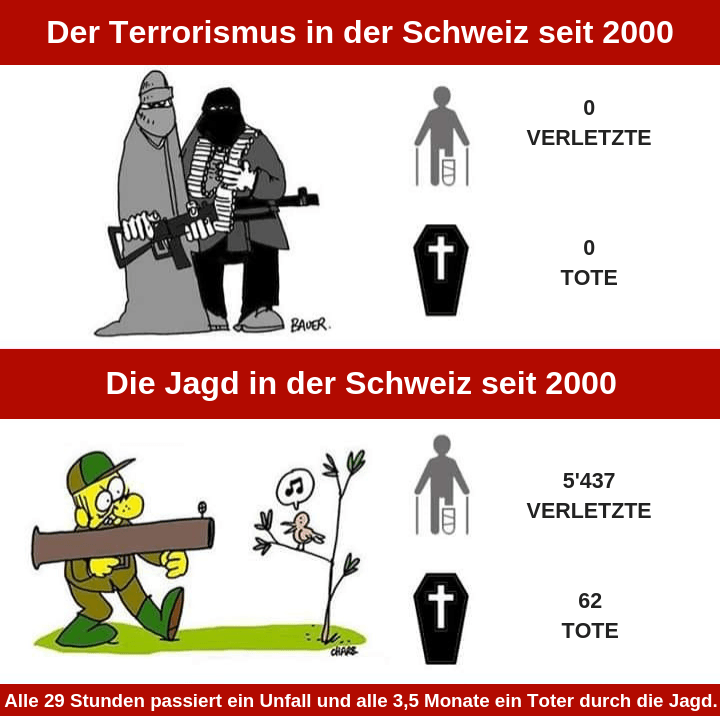
Dogs that appear as though they might bite are classified by law as dangerous, must undergo a temperament test, wear a muzzle, and be kept on a leash. By comparison, legislators treat hobby hunters with remarkable leniency: hobby hunters who harass and endanger people seeking recreation in nature, effectively holding them hostage.
Numerous seemingly insignificant aspects of hobby hunting have negativeconsequences. For example, Eurasian jays and other birds are shot for their colorful feathers, even though they are indispensable as seed dispersers for the reforestation and regeneration of woodlands. The jay is a thorn in the side of hobby hunters because it calls out when danger approaches, thereby alerting and driving away the very game that hobby hunters want to shoot! Endangered species such as the brown hare, black grouse, ptarmigan, ducks, woodcock, etc. still appear on the shooting lists in many cantons. Hobby hunters also bear partial responsibility for the many wildlife-related road accidents. Hobby hunting paralyzes normal economic sectors. The primary cause of forest damage is hunting pressure. There are no viable wildlife populations because there is no species-appropriate management. Hunting fosters criminal tendencies such as backroom dealings, cronyism, corruption, alcohol problems, arms smuggling, poaching, etc.
Environment and Sustainability
The contamination caused by the countless tonnes of lead and other highly toxic heavy metals that hobby hunters leave behind in nature through their use of firearms is nothing short of ecological terrorism. Lead ammunition is not only harmful to humans — it is also a particularly cruel form of hunting. Wounded animals that are not recovered frequently suffer not only from their injuries but also from slow lead poisoning. Carrion contaminated in this way harms predators such as foxes, lynx, badgers, wolves, etc. Finland, Denmark, the Netherlands, and others have long since banned lead ammunition.
Nor would nature continue to be disfigured by the many — often illegal — hunting blinds that make the landscape resemble a war zone. With the initiative «Wildlife wardens instead of hobby hunters» there will once again be more peace and quiet in nature. Unprofessional hobby hunters would be replaced by responsibly trained wildlife wardens.
Hobby hunters have no entitlement to prey. Dubious hobby hunters justify their shabby hobby in mantra-like fashion by claiming that they take pleasure in making a kill — meaning that the act of killing living creatures is their goal.
For me, hunting is like picking an apple. – Editor and hunter Karl Lüönd
Editor and hunter Karl Lüönd
What can one expect from people who are incapable of recognizing in their hearts the difference between an apple and a fox or a songbird? In today's society, anyone who feels nothing while killing is considered severely disturbed.
Hunting is no longer an existential drive for survival. The drives of hunger and thirst can be satisfied in an ethically sound manner in this post-Ice Age era. Moreover, there is meat in abundance. The hunting drive as entertainment is an archaic remnant of a bygone era, like cannibalism, slavery, making fire with stones, etc. – hardly a modern culture! Humans are not inherently hunters and therefore not meat-eaters either. Otherwise, a benevolent God would have equipped them with weapons such as claws or tearing teeth, four legs supporting a body capable of digesting meat raw. Furthermore, numerous studies indicate that meat poses a risk to human health.
In 2014, the Swiss National Park celebrated its 100th anniversary. The park is a piece of wilderness left to its own devices, where no one goes hunting. This presents no problem, says National Park Director and wildlife biologist Heinrich Haller:
Even without hunting, there are not suddenly too many foxes, hares, or birds. Experience shows that nature can be left to its own devices.
Wildlife biologist Heinrich Haller
Epidemics
In the circles of hobby hunters and authorities, much is based on assumption rather than knowledge and conscience.
Scientific studies have shown that even when three quarters of a population is culled, the same number of animals returns the following year. This holds true for the fox as well, for example. The more intensively foxes are hunted, the greater the offspring produced.
The Swiss Rabies Control Centre therefore concludes that reducing fox populations through hunting is evidently not feasible and that hunting as a means of rabies control is in fact counterproductive. As we know today, only animal-friendly vaccine baits were able to eradicate rabies — it is now considered eliminated in Switzerland and across much of Europe.
There are far more zoonoses in pets and livestock. As a rule, only hobby hunters contract a zoonosis such as fox tapeworm. Approximately 5–10 people in Switzerland are infected per year with this liver disease (Echinococcus multilocularis). This is no more than in the past, when fewer foxes were found in cities. The immune system of most people is strong enough to fend off an infection. As a rule, the larvae of the fox tapeworm develop in the liver of mice and some rats. If a fox eats the infected mouse, a tapeworm develops again in its intestine. Cats and dogs that eat mice can also spread the parasite in this way, though they do not become ill themselves.
The risk of infection for ordinary forest visitors is minimal. Contrary to the many rumours, no fox tapeworm patient is known to have been infected through wild forest berries. Berries hanging high on bushes can be ruled out as a route of infection. It is difficult to imagine how fox droppings could reach berries growing high up.
In the past, too, mange and distemper repeatedly flared up locally and then died out again on their own. Particularly in areas where mange has spread most severely, foxes appear to be developing increasing resistance to reinfection. However, since hunting negates the natural survival advantage of mange-resistant foxes (a hunter cannot tell from looking at a fox whether it is resistant to mange), killing foxes is likely to be counterproductive in this respect as well. Incidentally, with regard to distemper, it has been found that wild animals have already developed antibodies, making the risk marginal.
Mange mites cannot develop further in human skin and die off. Infection with mange (for example through contact with infected domestic animals) is therefore not possible. However, Sarcoptes scabiei can affect humans and trigger a brief illness involving itching and small papules. This so-called pseudo-scabies heals on its own within a few days, even without treatment.
Hunting associations, faced with the occurrence of fox mange, repeatedly propagate more intensive fox hunting as a cure-all for combating infections. However, as with rabies and fox tapeworm, there is no scientific evidence for why even more relentless fox hunting should curb the spread of zoonoses — after all, the past has shown that reducing fox population density through hunting is not possible. Furthermore, hunting promotes migratory movements within fox populations, which is likely to increase rather than decrease the rate of spread of the disease — similar to what has been demonstrated for rabies and is suspected for fox tapeworm. But perhaps that is precisely what hunters want, so that they can continue to pursue their dim-witted hobbies.
A field study conducted around Nancy over three years demonstrates that hunting foxes neither reduces the fox population nor decreases the prevalence of fox tapeworm infection in foxes. The spread is rather facilitated. In the case of rabies, too, hunting was not a solution.
The fox, as a predator of mice, also prevents the spread of diseases such as Hanta or Lyme disease. For example, around 1’000 foxes live within the city of Zurich. There are no hygiene problems there, because simple measures such as washing hands are sufficient.
Forest
Wildlife browsing damage is caused primarily by recreational hunters and by tourist development of forests for leisure activities. Hunting does not mean less wildlife, but more births. The regulation of wildlife populations is not achieved through hunting. Hunting is most often the cause of alleged problems.
On the other hand, foresters have been reporting for decades that deer — parked there mainly by hunters — are damaging protective forests, also because their traditional winter habitats are frequently used by sports enthusiasts. The animals retreat into the forest. The high wildlife populations in the mountains mean that forest regeneration can no longer be ensured to the required extent. Protective forests are at risk of losing their effectiveness. Almost half of our forests protect people, settlements and transport routes from natural hazards. To remain stable, they must be carefully maintained. For the preservation of protective forests and for avalanche control structures, the federal government millions in subsidies annually. From 2008 to 2012, for example, the federal government subsidized protective forest management in the canton of Valais with 40 million francs. The canton paid 44 million and the municipalities a further 16 million. In total, 100 million francs were invested in forests in Valais alone over four years — precisely where hunters park wildlife!
Bark stripping and fraying by wildlife is not a problem across Switzerland as a whole, but rather a regional one. Where lynx, fox, wolf and other predators are regularly present, less damage to forest regeneration is recorded, saving millions in taxpayer money and freeing up resources for game wardens .
According to current findings, it is not wildlife browsing that poses the main problem for forests, but rather the Asian longhorn beetle, the chestnut gall wasp, and climate change. Switzerland's timber reserves are among the highest in Europe.
If hobby hunters were not constantly allowed to indulge their primitive urge to kill, there would be no problems at all with population sizes of red deer and roe deer — because there would then be sufficient predators and thus also less wildlife browsing. The damage caused by browsing is marginal compared to the benefits that wildlife provides. Humans still cause the most damage and deprive wildlife of their habitat.
For genuine wildlife stewardship, a handful of game wardens is sufficient, as the example of Geneva demonstrates. Wildlife would no longer be fairground targets for a meaningless tradition. In this context, hunting cannot be described as a craft.
Law
Hobby hunters do not create habitat for wildlife — they create killing opportunities for themselves. Hobby hunters are disturbing and harassing wildlife every month of the year. Wildlife does not like hunters.
Under federal law, no canton in Switzerland is required to provide for hunting. It is the right of the cantons to decide whether hunting is permitted or not. If a canton decides against hunting — or even only partially against it — it is free to do so under the Federal Constitution. The canton of Geneva made this exemplary choice long ago. Many cantons already prohibit hunting locally through game sanctuaries, wildlife refuges, etc.
Even JagdSchweiz knows that wildlife populations would fundamentally regulate themselves — even in our cultivated landscape.
Jagd Schweiz
The careless shooting apart of the wild-biologically important social structures of huntable species also causes lasting damage to the genetics of animal populations. The word “sustainability” is misused by hobby hunters to legitimize wrongdoing. If there were a meaningful wildlife regulation through hunting, one would not have to decimate the wildlife population anew each year with brute force.
For most hunting measures there is no reasonable justification. This is demonstrated by numerous scientific studies. Because hobby hunters nevertheless want to pursue their desire to kill and their trophy cult, they have been serving us all manner of “hunters’ tales” for decades, with consequential costs in themillionsfor society and to the detriment of wildlife and nature conservation. This is what the initiative “Wildlife Wardens Instead of Hunters” aims to change.
Finances / Costs
In Geneva, serious wildlife management costs the taxpayer not even a cup of coffee per year. In addition, the state wildlife wardens generate revenue through the sale of game meat. The meat is no longer passed on privately but made available to the general public. The Geneva wildlife wardens also enforce animal welfare legislation, since no one may unjustifiably cause an animal pain, suffering or harm, or place it in a state of fear. If dubious amateurs were once again active in wildlife management in Geneva, costs would not be lower either, as they would have to be intensively supervised and monitored, just as in the other cantons. Wildlife wardens also take over some of the work of the police, thereby relieving them of part of their burden.
What hundreds of hobby hunters once did poorly in Genevais today handled more exemplarily by around 11 wildlife wardens, alongside many other duties. With more wildlife wardens who intervene only therapeutically alongside foxes, lynx, wolves, birds of prey, etc., the cantons would once again have order, biodiversity and greater protection against natural hazards. The taxpayer would likely be saved hundreds of millions of francs that the federal government, cantons and municipalities pump into forest conservation in areas where problem hunters breed wildlife.
If there were fewer problem hunters harboring ideas of exploiting nature, more peace-loving people could once again dedicate themselves to the cause of nature conservation – people who care for species – flora and fauna – with respect, decency and fairness, and who do not slaughter wildlife for fun.
Hunters like to argue with the many unpaid working hours they contribute. This cannot be verified precisely, and much of it is mere hunters' tales. Estimates suggest that 85% is driven by pure self-interest, such as public relations work, restaurant visits, hunting horn playing, proselytizing in schools, weapon maintenance, harassing wildlife, creating shooting opportunities, trophy shows, building shooting ramps, and other trivialities. Were this not the case, there would have to be somewhere within Switzerland a second paradisiacal Switzerland, with countless biotopes, hedgerows, species diversity, biodiversity, periods of no hunting, and so on. It is likewise not known that hunters make any active contribution to the renaturalization of riverbeds or the protection of raised bogs.
Animal rights:
The prevailing hunting laws have little to do with ethics and morality — indeed, they are diametrically opposed to the Swiss Animal Protection Act, e.g. Art. 4: No one may unjustifiably cause an animal pain, suffering or harm, place it in a state of fear, or otherwise disregard its dignity. The mistreatment, neglect or unnecessary overexertion of animals is prohibited.
Some advantages in brief:
- The monopoly on the use of force belongs in the hands of the state, not hunter gangs
- Better education, research, wildlife biology and science instead of hunters' tales
- Justice and responsibility towards nature and wildlife
- Hunters notoriously violate Swiss animal protection laws through their hunting methods and passions — wildlife wardens do not
- Wildlife wardens have an entirely different motivation than hunters. The word itself says as much.
- Recreation and tourism, touristic enhancement of the Swissness brand
- Zurich animal protection as a model for other cantons and countries (such as the canton of Geneva) in matters of hunting
- No blood money in the state coffers from hunters (unique worldwide)
- Curbing hunters' sectarianism (hunters' tales) — the cult of senseless killing and violence
- Dismantling the criminalized hunters' system (fewer legal violations such as breaches of hunting law, poaching, arms smuggling, environmental offences, animal protection violations, traffic offences, corruption, etc. by hunters) — the canton of Graubünden, for example, records over 1’000 complaints and fines against hunters per year (2015: 1,298 complaints and fines). Zurich keeps no statistics.
- Relief for investigative authorities, the state apparatus, prosecutors, courts, and the legal system (thousands of legal violations, reports, administrative fines, etc. against hunters every year in Switzerland)
- Relief in terms of time and costs for authorities, politicians, etc. (hunting revisions, surveillance, monitoring, motions, legislation, carcass disposal, etc.)
- Relief for the healthcare and insurance system and its contributions
- Relief for taxpayers (forestry, agriculture, etc.)
- Fewer personal injury accidents involving hunters' weapons. (From 2010 to 2013: fourteen fatal hunting accidents and around 200 non-fatal accidents involving hunters' weapons out of a total of 1,157 accidents) not including private individuals, according to the BFU
- The initiative promotes quality jobs for wildlife wardens and saves xxx million elsewhere
- More environmental protection instead of environmental pollution (toxic ammunition, illegal hunting stands, vehicle noise and traffic in nature, waste of resources, lead-contaminated shooting ranges, etc. by hunters)
- Demonstrably fewer wildlife-related road accidents (around 60 people injured per year and personal injury and property damage of 40 – 50 million francs). What you can see, you don't drive into
- Violence prevention, protection of animals rather than perpetrators, less violence, weapons and terror in society. Violence against animals often transitions seamlessly into violence against people
- Protection of children and young people from hunters and hunting tall tales
- More wildlife sightings, species diversity and biodiversity for the population, as seen for example in the Canton of Geneva, national parks or other hunting-free areas
- Enhancement of ethics, morality, fairness and safety in the cultural landscape
- Less abuse and manipulation of hunting dogs
- No more animal-cruelty-enabling hunting infrastructure (badger-baiting facilities, wild boar enclosures, etc.)
- Less animal cruelty such as trophy hunting, earth hunting, driven and push hunts, special hunts, etc.
- No more shooting of domestic animals
- Less browsing damage in forests and agriculture
- Fewer pesticides and poisons in agriculture due to mouse plagues caused by the absence of foxes, etc.
- Less alcohol and substance abuse while hunting. Wildlife wardens are prohibited from consuming alcohol while on duty. The hip flask and “steady-aim tipple” are constant companions of hunters. Hunters resist any alcohol ban during hunting.
- Public safety for the population, recreational activists, walkers, etc.
- No hunting on private land (need not be tolerated, according to the European Court of Human Rights
- A hunting ban is also good for the mental well-being of hunters. Today's «hunting» is also a pathological behavioral pattern (those who kill senselessly neither protect nor benefit society)
- Wildlife wardens, police officers, and soldiers are retired at 65. Hobby hunters are still pursuing their passion for shooting culture with firearms at 75
- Less groundwater contamination and ammunition residues from hunters in nature
- Less shooting noise for the population
- E.g. field hare density in the canton of Zurich with hunters at 1.0 per 100 ha or extinct. In the canton of Geneva with wildlife wardens 17.7 field hares per 100 ha, etc.
- The canton of Zurich is behind in terms of cruel hunting methods, e.g. earth hunting, driven hunts, ammunition, etc.Canton of Thurgau has banned earth hunting, Geneva has had a hunting ban for 40 years, etc.
- Healthcare: Processed game meat is neither organic nor a high-quality food (especially that from driven and push hunts) but makes people sick and is classified by the WHO in the same toxic category as cigarettes, arsenic, or asbestos. In Canada it is prohibited to sell hunters’ game meat in restaurants or stores because it is not classified as fit for human consumption
- Weapons are not toys and wild animals are not fairground targets
- Wildlife wardens have more comprehensive and meaningful training and a completely different motivation than hunters.
- Wildlife populations can once again regulate themselves naturally
- Wild animals will increasingly become active during the day, visible and observable, which not only pleases the general public
- In the canton of Zurich, after decades with hunters, there is not a single wildlife sanctuary recognized by the FOEN
- Hunting is not scientific wildlife management
- What more than 400 hobby hunters in the canton of Geneva once did unsatisfactorily — at the expense of wildlife, animal protection, ethics, safety, and the public — is today handled by 11 wildlife wardens who share three full-time positions, only one of which is required for hunting-related activities.
- The canton of Vaud is twice the size of the canton of Zurich and has 50% fewer hobby hunters
- etc.