
A child who is taken up to the hunting blind sees: There is a living animal, curious, attentive, nothing inherently "evil".
The next moment a shot rings out, the animal collapses, the adults nod in satisfaction, congratulate each other, perhaps even take a photo. For the child, the message is clear: It is okay to kill defenseless animals as long as an authority figure says it is right.
Anyone who voluntarily and willingly participates in an activity that involves killing defenseless animals demonstrates at least a high degree of willingness to morally relativize animal suffering. Recreational hunting is a practice that teaches people to normalize violence against animals and often even to view it positively. Without a certain desensitization to suffering, most people could not engage in recreational hunting for extended periods.
Hobby hunters often emphasize how much they love nature. But what one loves, one doesn't kill. In psychology, this is called cognitive dissonance, where behavior and self-image don't align. Anyone who sees themselves as a nature lover and simultaneously shoots animals voluntarily faces precisely this conflict and must somehow resolve it internally. The psychologist Leon Festinger has described how people can barely tolerate contradictions between values and actions and therefore adapt their thinking to their behavior. In the context of hunting, this means that instead of questioning the killing, it is reinterpreted as "conservation," "necessity," or "nature conservation." The violence remains real; it is merely softened by language.
Hunting is not just a hobby, but a worldview. It divides the world into top and bottom, into hunters and those shot at. Those who naturally place themselves at the top of this hierarchy find it easier to downplay the suffering of those below them.
Speciesism, the devaluation of other animal species compared to humans, is psychologically closely linked to other prejudices. Those who condone inequality between human groups often also approve of a harsh, exploitative attitude towards animals.
Studies on hunting tourism and trophy hunting describe how hunting scenes are staged in such a way that moral concerns are suppressed and relabeled as "ethical hunting." Anyone who claims to kill "out of love for the game" is walking a psychological tightrope. The violence is packaged in a sentimental narrative until, in the end, the victim is almost made to appear grateful for having been shot.
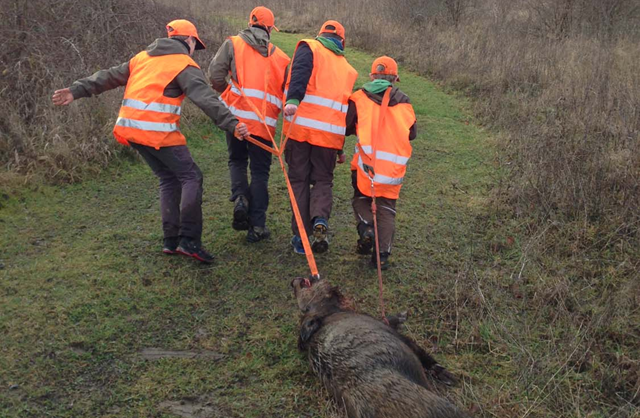
Hobby hunting thus becomes a school of desensitization. Blood, dead bodies, protruding tongues, slashed bellies are presented as "perfectly normal." People speak of "dressing" instead of tearing apart, of "laying out a kill" instead of carcasses. The language protects the adults, but it also shapes the children's perceptions. Violence no longer appears as something shocking, but as routine, as custom, as a cause for pride.
Hobby hunting is objectively violent, and there are already non-lethal alternatives.
The problem isn't just the individual hunting experience, but the message behind it: empathy is negotiable. Compassion for the animal is diminished as soon as tradition, hobby, or a supposed "responsibility for wildlife management" comes into play. Anyone who feels disgust or sadness at the sight of a dead deer is quickly labeled as sensitive. Children learn to suppress these feelings instead of taking them seriously.
It is particularly problematic when children are encouraged to shoot themselves. The first fox, the first deer, marked as a "success," links power over a living being with recognition and belonging to the group. Yet children need precisely the opposite: adults who show them that strength has nothing to do with killing, but with responsibility, consideration, and the ability to prevent suffering. Those who take children on recreational hunts are not teaching them "love of nature," but rather conditioned them to believe that the suffering of other living beings is secondary as long as it is called tradition or is legally permissible. In hunting training, people learn how to shoot accurately. What is often missing is the question of whether one is even allowed to shoot when alternatives exist.
Environmental education worthy of the name introduces children to wild animals without making them targets. It explains conflicts and seeks solutions where no one has to die. Those who take children seriously don't expose them to bloody rituals at an early age, but rather protect their natural empathy.
Children are not born as hobby hunters. They are born as sentient beings who intuitively sense that the death of an animal is a sad event. A society that wants to preserve this intuition should carefully consider what role hobby hunting should still be allowed to play in upbringing.